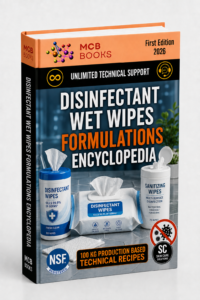
Wet wipe solutions are specially formulated liquids used to impregnate nonwoven fabrics for cleaning, personal care, disinfection, automotive maintenance, industrial degreasing, and household applications. Although the final product may appear simple, preparing a stable and effective wet wipe solution requires careful raw material selection, an appropriate manufacturing sequence, compatible nonwoven material, accurate liquid loading, and reliable packaging.
The formulation of a wet wipe solution depends primarily on its intended use. Baby wipes require mild cleansing agents and skin-conditioning ingredients, while disinfectant wipes require authorized antimicrobial systems and verified contact times. Heavy-duty industrial wipes may contain stronger surfactants, solvents, builders, and corrosion inhibitors for removing oil, grease, ink, adhesives, and workshop dirt.
The HEAVY-DUTY CLEANING WIPES FORMULATIONS ENCYCLOPEDIA provides structured technical information for manufacturers, formulation specialists, chemical suppliers, entrepreneurs, and private-label producers developing professional cleaning wipes. It explains how water-based, solvent-based, and hybrid wet wipe solutions can be prepared for demanding commercial and industrial applications.
Purified or deionized water is normally the main carrier in water-based wet wipe formulations. Controlled water quality helps improve solution clarity, microbiological stability, raw material compatibility, and finished-product consistency. Minerals and impurities in untreated water may reduce surfactant efficiency, cause sedimentation, or negatively affect preservatives and active ingredients.
Surfactants improve wetting and help loosen oily, particulate, or water-soluble contamination. Nonionic surfactants are widely used because they provide effective cleaning and generally produce less foam than many conventional detergent systems. Anionic, amphoteric, or specialized low-foam surfactants may also be selected according to the required cleaning performance and formula compatibility.
Cleaning solvents may be included to improve the removal of grease, lubricants, adhesives, inks, waxes, and industrial residues. Alcohols, glycol ethers, esters, hydrocarbons, or other suitable solvents may be used depending on the product concept. Solvent concentration should be carefully controlled because it influences odor, drying speed, flammability, surface compatibility, packaging stability, and worker exposure.
Additional ingredients may include chelating agents, alkaline builders, pH regulators, corrosion inhibitors, hydrotropes, solubilizers, preservatives, stabilizers, fragrances, and colorants. Each raw material should have a clearly defined technical function. Unnecessary ingredients may increase costs, create residues, reduce stability, or cause compatibility problems.
The HEAVY-DUTY CLEANING WIPES FORMULATIONS ENCYCLOPEDIA explains how these components can be balanced within professionally structured production formulas. Before commercial manufacturing, the complete formulation should be tested on the intended surfaces and evaluated together with the selected nonwoven substrate and packaging material.
Preparation normally begins by transferring purified water into a clean and chemically compatible mixing tank. Water-soluble ingredients such as chelating agents, preservatives, builders, and pH regulators are added gradually under controlled agitation. Surfactants are incorporated carefully to reduce excessive foam formation. Cleaning solvents, corrosion inhibitors, solubilizers, fragrances, and other functional additives are then introduced in the appropriate sequence.
Volatile or flammable raw materials should be handled under controlled temperature and ventilation conditions. Mixing equipment, pumps, pipelines, and storage tanks must be compatible with the complete formulation. The solution should be mixed until it becomes homogeneous and free from unacceptable separation, sedimentation, cloudiness, discoloration, or odor changes.
After preparation, quality-control tests may include appearance, odor, pH, density, viscosity, cleaning performance, microbiological quality, stability, residue level, and surface compatibility. Preservative performance is particularly important in water-based wet wipe solutions because these products may support bacterial, yeast, and mold growth if inadequately protected.
The prepared solution is applied to a suitable nonwoven fabric through a controlled impregnation process. The substrate should provide sufficient absorbency, wet strength, abrasion resistance, softness, and liquid-release performance. Accurate dosing prevents dry wipes, leakage, excessive product costs, and package deformation.
The HEAVY-DUTY CLEANING WIPES FORMULATIONS ENCYCLOPEDIA offers a practical technical foundation for preparing wet wipe solutions for degreasing, machinery cleaning, automotive maintenance, workshop use, and multi-surface applications. By combining compatible raw materials, an organized preparation method, suitable fabric, protective packaging, and consistent quality testing, manufacturers can produce stable, effective, and commercially competitive wet wipes.