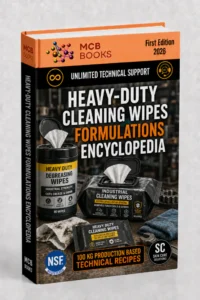
Heavy-duty cleaning wipes are professional products designed to remove grease, oil, ink, adhesive residues, carbon deposits, lubricants, dirt, and other difficult contaminants from commercial and industrial surfaces. They are commonly used in factories, workshops, automotive service centers, warehouses, printing facilities, construction sites, maintenance departments, and engineering plants. Their manufacturing requires a powerful but controlled cleaning solution, durable nonwoven material, accurate impregnation, reliable packaging, and consistent quality testing.
The HEAVY-DUTY CLEANING WIPES FORMULATIONS ENCYCLOPEDIA provides technical information for manufacturers, formulation specialists, private-label producers, chemical suppliers, entrepreneurs, and investors seeking practical industrial cleaning wipes formulas. It covers raw material functions, water-based and solvent-based systems, production methods, nonwoven fabric selection, packaging alternatives, and commercial manufacturing requirements.
The first stage of production is determining the intended use of the wipe. A product developed for removing grease from machinery may require a different cleaning system from a wipe intended for automotive interiors, printing inks, adhesives, tools, or general workshop surfaces. Surface compatibility, cleaning strength, drying rate, residue level, worker safety, and packaging type must therefore be considered during formulation development.
Heavy-duty cleaning wipes may use water-based, solvent-based, or hybrid formulas. Water-based solutions generally contain purified water, surfactants, solvents, chelating agents, alkaline builders, pH regulators, corrosion inhibitors, preservatives, and optional fragrance ingredients. These products can provide strong cleaning performance while offering controlled solvent content.
Solvent-based wipes are developed for difficult oily and adhesive contamination. They may contain suitable hydrocarbon, glycol ether, ester, alcohol, or other industrial cleaning solvents. Solvent selection must be based on cleaning power, evaporation rate, odor, flammability, surface compatibility, worker exposure, and local regulatory requirements.
Surfactants help lift grease, oils, and particulate dirt from surfaces. Nonionic surfactants are frequently selected because they provide effective degreasing and can remain compatible with different solvents and builders. Anionic or amphoteric surfactants may also be used in certain formulations, although foam level and material compatibility must be carefully controlled.
Chelating agents help bind minerals and metal ions that may reduce cleaning efficiency, particularly in hard-water systems. Alkaline builders can improve the removal of heavy grease, but excessive alkalinity may damage sensitive surfaces. Corrosion inhibitors may therefore be incorporated to reduce the risk of attacking metals such as steel, aluminum, or copper.
The HEAVY-DUTY CLEANING WIPES FORMULATIONS ENCYCLOPEDIA explains how these raw materials can be combined in professionally structured formulations. During production, purified water is transferred into a compatible mixing tank. Water-soluble ingredients are added under controlled agitation, followed by surfactants, solvents, builders, corrosion inhibitors, preservatives, and other additives in the correct sequence.
Volatile or flammable solvents should be handled with appropriate ventilation, grounding, storage, and fire-safety procedures. Excessive agitation should be avoided when it creates unnecessary foam or accelerates solvent evaporation. The prepared cleaning solution should remain homogeneous and should not develop unacceptable separation, sedimentation, discoloration, or odor changes.
Before impregnation, the solution should be tested for appearance, odor, pH, density, viscosity, cleaning performance, stability, and compatibility with the intended surfaces. The nonwoven fabric should provide high wet strength, absorbency, abrasion resistance, and controlled solution release. Industrial wipes must withstand firm scrubbing without tearing or leaving excessive fibers behind.
The fabric is unwound, folded, cut, and impregnated with a measured quantity of cleaning solution. Insufficient liquid may reduce cleaning performance, while excessive loading can cause leakage, increased costs, and package deformation.
Finished wipes may be packaged in canisters, soft packs, refill bags, industrial buckets, or individual sachets. The packaging must prevent contamination, leakage, drying, and solvent loss throughout the intended shelf life.
The HEAVY-DUTY CLEANING WIPES FORMULATIONS ENCYCLOPEDIA offers a practical foundation for producing degreasing wipes, workshop wipes, machinery-cleaning wipes, adhesive-removal wipes, ink-removal wipes, and multi-surface industrial cleaning products. Successful manufacturing depends on combining effective formulas, compatible raw materials, durable fabrics, controlled production methods, protective packaging, and reliable quality control.