
 Fulvic acid powder is a concentrated organic material widely used in agriculture, fertilizer production, soil conditioning, plant nutrition, and specialty formulations. Industrial fulvic acid powder manufacturing generally involves the extraction of fulvic substances from suitable humic raw materials, followed by separation, purification, concentration, drying, and final quality control.
The process begins with the selection and preparation of raw materials. Leonardite, lignite, humic-rich organic matter, or other suitable natural sources may be used depending on the required product characteristics. The raw material is normally crushed, screened, and prepared to improve extraction efficiency and process consistency.
During the extraction stage, the prepared material is contacted with an appropriate extraction medium under controlled mixing, temperature, pH, and residence-time conditions. The objective is to transfer soluble fulvic components into the liquid phase while leaving insoluble mineral and organic fractions behind.
After extraction, the slurry passes through solid-liquid separation. Filtration, settling, centrifugation, or combinations of these methods can be used to remove suspended solids. Additional clarification and purification may be required to obtain a cleaner fulvic acid solution with controlled ash, color, and insoluble matter.
The purified liquid is then sent to the concentration stage, where part of the water is removed. Evaporation or other concentration technologies may be used depending on plant capacity and product specifications. Careful control is important because excessive thermal exposure can negatively influence product quality.
The concentrated fulvic acid solution is subsequently converted into powder. Spray drying is commonly used for industrial-scale production because it enables rapid drying and consistent particle formation. Other drying technologies may also be selected depending on production capacity, energy consumption, and the desired powder characteristics.
Following drying, the material may undergo milling, sieving, blending, and packaging. The finished fulvic acid powder is typically evaluated for parameters such as fulvic acid content, moisture, solubility, pH, ash content, particle size, and appearance.
Successful commercial production requires more than a simple extraction method. Raw material variability, extraction efficiency, filtration performance, concentration conditions, drying parameters, equipment selection, and laboratory control all influence the final product.
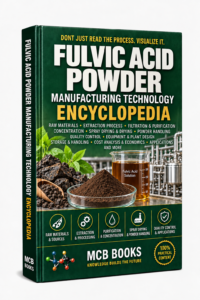
The FULVIC ACID POWDER MANUFACTURING TECHNOLOGY ENCYCLOPEDIA provides detailed technical information on raw materials, production stages, industrial equipment, process control, quality testing, troubleshooting, and manufacturing considerations for companies planning to understand or develop fulvic acid powder production.