Humic Acid Manufacturing Process and Production Methods
The humic acid manufacturing process begins with the extraction of humic substances from Leonardite, a naturally oxidized form of lignite rich in organic matter. Commercial producers use a combination of extraction, filtration, concentration and stabilization steps to obtain high-quality humic acid products for agricultural applications. Depending on the target product, manufacturers may produce liquid humic acid, potassium humate solutions or humic and fulvic acid fertilizer blends. Understanding the humic acid manufacturing process is essential for developing stable products with consistent quality and performance.
Professional Humic Acid Production Knowledge for Manufacturers
Developing a successful humic acid fertilizer is not simply a matter of mixing raw materials. Product stability, humic acid concentration, extraction efficiency, filtration quality and formulation design all play a critical role in commercial production.
Many manufacturers spend months testing different raw materials and production methods before achieving a stable and marketable product. Access to proven formulation and manufacturing knowledge can significantly reduce development time and production costs.
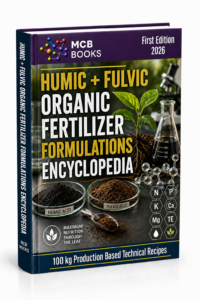
The HUMIC + FULVIC ORGANIC FERTILIZER FORMULATIONS ENCYCLOPEDIA provides practical information for manufacturers, entrepreneurs and fertilizer companies looking to develop commercial humic and fulvic acid products.
Inside the encyclopedia you will find:
✔ Commercial Humic Acid Fertilizer Formulations
✔ Fulvic Acid Fertilizer Formulations
✔ Potassium Humate Production Concepts
✔ Manufacturing Procedures and Processing Methods
✔ Raw Material Selection Guidelines
✔ Product Development Know-How
✔ Commercial Production Techniques
Access the HUMIC + FULVIC ORGANIC FERTILIZER FORMULATIONS ENCYCLOPEDIA and accelerate your fertilizer product development with professional formulations and proven manufacturing knowledge.
How Is Humic Acid Produced?
The humic acid manufacturing process starts with Leonardite, a naturally oxidized material rich in humic substances. Because of its high organic content and relatively consistent composition, Leonardite is one of the most widely used raw materials for producing commercial humic acid fertilizers.
During production, humic substances are extracted from Leonardite using alkaline solutions. The extracted material is then filtered and processed to remove unwanted solids before being standardized to the desired concentration. Depending on the final product, manufacturers may produce liquid humic acid, potassium humate solutions or combined humic and fulvic acid fertilizers.
Although the basic concept is straightforward, achieving a stable and commercially successful product requires much more than simply mixing ingredients. Factors such as raw material quality, extraction efficiency, filtration performance and formulation design all influence the final product quality.
Why Do Manufacturers Combine Humic and Fulvic Acid?
Many fertilizer manufacturers choose to combine humic acid and fulvic acid within the same formulation. While humic acid is often associated with improving soil structure and nutrient retention, fulvic acid is valued for its ability to improve nutrient mobility and availability.
The combination allows manufacturers to develop more versatile fertilizer products suitable for a wide range of crops and growing conditions. As a result, humic and fulvic acid blends have become one of the fastest-growing categories in the organic fertilizer market.
SUMMARY
As demand for organic fertilizers and sustainable agriculture continues to grow, the market for humic acid and fulvic acid fertilizers is expanding worldwide. Understanding the humic acid manufacturing process is an important step for companies looking to develop competitive fertilizer products.
Whether you are launching a new fertilizer line or expanding an existing portfolio, access to reliable formulation knowledge, production expertise and commercial manufacturing methods can significantly reduce development time and improve product quality.
For professionals seeking practical solutions,
the
HUMIC + FULVIC ORGANIC FERTILIZER FORMULATIONS ENCYCLOPEDIA
provides valuable technical knowledge for developing market-ready fertilizer products.