 Liquid algae and kelp biostimulant fertilizer formulations are increasingly used in modern agriculture because they can be applied efficiently through foliar spray and fertigation systems. These products are commonly developed from seaweed extracts, kelp concentrates, microalgae derivatives, amino acids, micronutrients, humic substances, and other functional ingredients. Their flexible application methods make them suitable for a wide range of crops, including vegetables, fruits, cereals, ornamentals, greenhouse plants, and high-value commercial crops.
Seaweed and kelp extracts are among the main active components used in liquid algae biostimulant fertilizers. Depending on their source and processing method, these extracts may contain naturally occurring minerals, polysaccharides, organic compounds, and other components that support plant development. Commercial formulations are often designed to promote root growth, vegetative development, flowering, fruit formation, nutrient uptake, and improved crop performance under different environmental conditions.
Foliar algae biostimulant fertilizers are formulated for direct application to plant leaves. In these products, good solubility, low sediment formation, appropriate pH, and effective spreading are important technical properties. Wetting agents or compatible surfactants may be included to improve leaf coverage and help the formulation distribute more evenly across the plant surface. Micronutrients such as iron, zinc, manganese, boron, and molybdenum can also be combined with algae extracts to create multifunctional foliar fertilizers.
Fertigation formulations are designed to be delivered through irrigation systems. These products must remain highly soluble and stable to reduce the risk of precipitation, sediment formation, or blockage in irrigation equipment. Liquid algae and kelp fertilizers used for fertigation may also contain amino acids, fulvic acids, potassium sources, or selected micronutrients to support root-zone nutrition and improve nutrient availability.
The production process generally begins with the addition of water to a suitable mixing tank. Algae or kelp extracts are then incorporated under controlled agitation, followed by other water-soluble nutrients and functional additives. Mixing speed, temperature, pH, viscosity, density, and raw material addition order should be carefully controlled. After homogenization, the finished fertilizer may be filtered before quality control and packaging.
Product stability is especially important in commercial liquid biostimulant manufacturing. Manufacturers should evaluate pH, density, viscosity, solubility, appearance, sediment formation, nutrient content, and storage stability. Packaging materials should also be compatible with the final formulation to maintain product quality during transportation and storage.
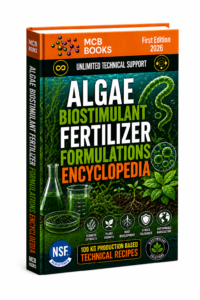
The ALGAE BIOSTIMULANT FERTILIZER FORMULATIONS ENCYCLOPEDIA provides practical information about liquid algae and kelp fertilizer formulations, foliar spray products, fertigation fertilizers, raw materials, manufacturing processes, and quality-control requirements. It is a useful technical reference for fertilizer manufacturers, formulators, agricultural chemical companies, and entrepreneurs seeking to develop professional seaweed and algae-based biostimulant products for modern agricultural production.