 Micronutrient-enriched organomineral granular fertilizers are developed to provide plants with essential trace elements while combining the nutritional benefits of mineral fertilizers with organic matter. Iron, zinc, manganese, and boron are required by plants in relatively small quantities, but deficiencies of these nutrients can significantly affect plant development, crop productivity, and product quality. For this reason, micronutrient-enriched granular fertilizer formulations have become an important part of modern agricultural nutrition programs.
Iron is essential for chlorophyll formation, photosynthesis, respiration, and many enzymatic processes within the plant. Iron deficiency commonly appears as yellowing between the veins of young leaves and can reduce photosynthetic activity. In organomineral granular fertilizer formulations, suitable iron sources can be incorporated together with organic matter, NPK nutrients, and other micronutrients to provide more complete plant nutrition.
Zinc is another important micronutrient involved in enzyme activity, protein synthesis, hormone regulation, and plant growth. Zinc deficiency can result in reduced internode development, smaller leaves, and lower crop performance. Including an appropriate zinc source in granular organomineral fertilizers can help manufacturers develop products intended to support balanced vegetative development, root activity, and crop productivity.
Manganese contributes to photosynthesis, enzyme activation, nitrogen metabolism, and several important biochemical processes. Adequate manganese nutrition is particularly important for maintaining healthy plant metabolism and efficient nutrient utilization. Depending on the intended crop and soil conditions, manganese sources can be incorporated into organomineral fertilizer formulations at carefully controlled concentrations.
Boron plays an important role in cell wall development, pollen formation, flowering, sugar transport, and reproductive growth. Although plants require boron in very small quantities, both deficiency and excessive application can cause problems. Accurate formulation and homogeneous distribution are therefore particularly important when producing boron-containing granular fertilizers.
Micronutrient-enriched organomineral fertilizers may combine iron, zinc, manganese, and boron with nitrogen, phosphorus, potassium, humic substances, organic matter, calcium, magnesium, sulfur, and other nutrients. This flexibility enables manufacturers to develop specialized granular fertilizers for different crops, soil conditions, and growth stages.
Raw material compatibility is an important consideration when developing micronutrient fertilizer formulations. The selected micronutrient sources should be evaluated according to nutrient concentration, solubility, chemical stability, particle size, interaction with other ingredients, and behavior during granulation. Homogeneous mixing is especially important because micronutrients are generally used in relatively low quantities and must be distributed uniformly throughout the fertilizer.
Commercial production typically includes accurate weighing, blending, granulation, drying, cooling, screening, and, when required, coating. Process conditions must be carefully controlled to maintain uniform nutrient distribution and produce granules with suitable strength, particle size, moisture content, and storage stability.
Quality control may include analysis of iron, zinc, manganese, and boron concentrations as well as NPK values, organic matter content, moisture, particle size distribution, bulk density, granule strength, and storage stability. Consistent quality control helps ensure that every production batch meets the desired formulation and technical specifications.
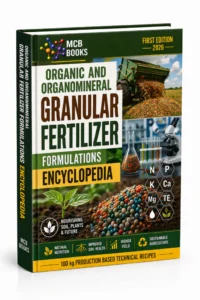
The ORGANIC AND ORGANOMINERAL GRANULAR FERTILIZER FORMULATIONS ENCYCLOPEDIA provides practical formulation and manufacturing information for professionals interested in developing micronutrient-enriched organomineral fertilizers. The book covers production-based formulations, raw material functions, manufacturing processes, and technical principles related to commercial granular fertilizer production.
For fertilizer manufacturers, agricultural companies, entrepreneurs, and formulation specialists, the ORGANIC AND ORGANOMINERAL GRANULAR FERTILIZER FORMULATIONS ENCYCLOPEDIA can serve as a useful technical reference for developing iron, zinc, manganese, and boron enriched granular fertilizer products designed to support balanced plant nutrition, healthy crop development, and improved agricultural productivity.