A good bearing grease formula is not only about choosing the right grease. The amount applied to the bearing and the interval between applications are just as important for reliable lubrication.
Bearing size, operating temperature, speed, vibration, moisture and contamination can all influence grease consumption. For this reason, both grease quantity and regreasing frequency should be considered when planning a lubrication program.
For manufacturers, the same principle applies to grease production. Base oils, additives and processing conditions need to be selected according to a clear formulation and manufacturing method if the finished grease is expected to perform consistently.

Bearing Grease Quantity Calculation
A practical way to estimate grease quantity is to use the bearing’s outside diameter and width.
When the measurements are in inches:
Grease quantity (oz) = Outside Diameter × Bearing Width × 0.114
When metric measurements are used:
Grease quantity (g) = Outside Diameter × Bearing Width × 0.005
This type of calculation provides a useful starting point for determining the amount of grease required for a bearing. In actual maintenance programs, bearing design, manufacturer recommendations and operating conditions should also be considered.
Why Regreasing Frequency Matters
Calculating the initial grease quantity is only part of the job. The next question is how often the bearing should receive fresh grease.
This interval is known as the regreasing frequency, and it can change considerably depending on the way the machine operates.
A bearing running in a clean, moderate environment may require less frequent lubrication than one exposed to high temperatures, dust, moisture or heavy vibration.
Factors That Affect Grease Reapplication
Several operating conditions can shorten the useful life of grease inside a bearing.
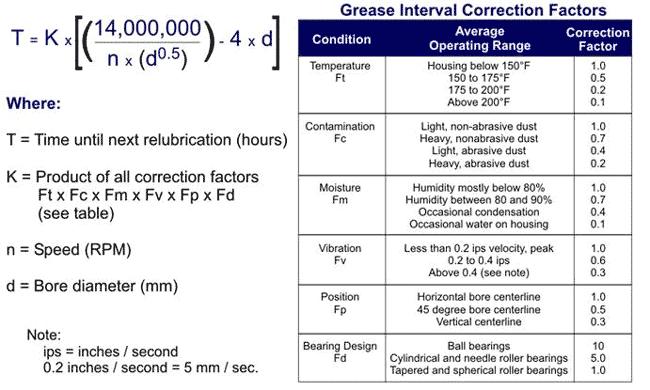
Temperature is one of the most important factors. As operating temperature increases, grease can deteriorate more quickly and may need to be replenished sooner.
Dust and contamination can also reduce lubricant life. Bearings operating in dirty environments generally need closer lubrication control.
Moisture and humidity are another concern, particularly where bearings are regularly exposed to water or wet operating conditions.
The physical position of the bearing matters as well. A bearing mounted on a vertical shaft may lose grease more easily than one operating in a horizontal position.
Vibration can contribute to oil separation from the thickener and may cause the lubricant to leave the required contact area faster.
Bearing Type and Grease Performance
The shape of the rolling element also influences how grease behaves inside the bearing.
Ball bearings, roller bearings and spherical roller bearings do not work the grease in exactly the same way. Their internal movement and mechanical stresses can therefore affect lubricant life and the preferred regreasing interval.
For this reason, bearing type should be considered together with speed, load and operating environment.
Regreasing Correction Factors
Temperature, contamination, moisture, vibration, bearing position and rolling-element design all work together when determining a practical relubrication interval.
Complex Grease Manufacturing
The manufacturing process of complex grease is generally based on a controlled combination of base oils, thickener systems and performance additives.
Depending on the type of grease being produced, the formulation may also include antifoam agents, pour point depressants and other lubricant additives.
The production process itself may be relatively straightforward once the formulation has been established, but the order of addition, raw material quantities and processing conditions are important.
Why the Grease Formulation Matters
A reliable manufacturing process starts with a clear formula.
The formulation should define which base oils and additives are used, how much of each raw material is required and the order in which they are introduced into the process.
Without a suitable formulation, it becomes much more difficult to achieve consistent viscosity, lubrication performance and product stability from one batch to another.