ADVANCED PEPPER BIO PESTICIDE FORMULATIONS & ; MANUFACTURING ENCYCLOPEDIA
Book details
- Author
- MCB BOOKS Technical Team
- Editor
- MCB BOOKS
- ISBN
- 978-605-88350-0-9
- Number of Pages
- 320 Pages
- Publication Date
- 2026
- Copyright
- MCB BOOKS
- Format
- Hard Book & E book (PDF)
- Language
- English
About the Encyclopedia
The Advanced Pepper Bio Pesticide Formulations & Manufacturing Encyclopedia is a specialized technical reference developed for manufacturers, formulators, agricultural chemical producers, researchers, and professionals working with plant-based and bio-derived pesticide products. It focuses on advanced pepper-based bio pesticide formulations designed for use in agricultural crop protection and natural pest management applications.
This encyclopedia provides detailed information on formulation structure, suitable raw materials, functional ingredients, preparation principles, production stages, processing conditions, quality considerations, and industrial manufacturing approaches. Particular attention is given to pepper-derived active materials and supporting ingredients used to improve product stability, dispersion, effectiveness, compatibility, and practical application performance.
The book is designed to help readers understand how professional pepper bio pesticide formulations can be developed and manufactured at commercial scale. It serves as a practical formulation and production guide for companies seeking to develop new bio pesticide products, improve existing formulations, expand their agricultural product portfolio, or establish reliable manufacturing procedures for plant-based crop protection products.
Table of contents
01Page 1 Contents 175 formulations · 1–280
- 1Bio Pesticide for Aphid Control in Pepper Cultivation Formulation and Industrial Production process – 1
- 3Bio Pesticide for Aphid Control in Pepper Cultivation Formulation and Industrial Production process – 2
- 5Bio Pesticide for Aphid Control in Pepper Cultivation Formulation and Industrial Production process – 3
- 7Application Guidelines and Field Usage Program
- 8Technical Properties, Mode of Action and Effects
- 9Bio Pesticide for Whitefly Management in Pepper Growth Formulation and Industrial Production process – 1
- 11Bio Pesticide for Whitefly Management in Pepper Growth Formulation and Industrial Production process – 2
- 13Bio Pesticide for Whitefly Management in Pepper Growth Formulation and Industrial Production process – 3
- 15Application Guidelines and Field Usage Program
- 16Technical Properties, Mode of Action and Effects
- 17Bio Pesticide for Thrips Suppression in Pepper Crops Formulation and Industrial Production process – 1
- 19Bio Pesticide for Thrips Suppression in Pepper Crops Formulation and Industrial Production process – 2
- 21Bio Pesticide for Thrips Suppression in Pepper Crops Formulation and Industrial Production process – 3
- 23Application Guidelines and Field Usage Program
- 24Technical Properties, Mode of Action and Effects
- 25Bio Pesticide for Spider Mite Control in Pepper Plants Formulation and Industrial Production process – 1
- 27Bio Pesticide for Spider Mite Control in Pepper Plants Formulation and Industrial Production process – 2
- 29Bio Pesticide for Spider Mite Control in Pepper Plants Formulation and Industrial Production process – 3
- 31Application Guidelines and Field Usage Program
- 32Technical Properties, Mode of Action and Effects
- 33Bio Pesticide for Pepper Leafminer Management Formulation and Industrial Production process – 1
- 35Bio Pesticide for Pepper Leafminer Management Formulation and Industrial Production process – 2
- 37Bio Pesticide for Pepper Leafminer Management Formulation and Industrial Production process – 3
- 39Application Guidelines and Field Usage Program
- 40Technical Properties, Mode of Action and Effects
- 41Bio Pesticide for Caterpillar Control in Pepper Fields Formulation and Industrial Production process – 1
- 43Bio Pesticide for Caterpillar Control in Pepper Fields Formulation and Industrial Production process – 2
- 45Bio Pesticide for Caterpillar Control in Pepper Fields Formulation and Industrial Production process – 3
- 47Application Guidelines and Field Usage Program
- 48Technical Properties, Mode of Action and Effects
- 49Bio Pesticide for Pepper Fruit Borer Prevention Formulation and Industrial Production process – 1
- 51Bio Pesticide for Pepper Fruit Borer Prevention Formulation and Industrial Production process – 2
- 53Bio Pesticide for Pepper Fruit Borer Prevention Formulation and Industrial Production process – 3
- 55Application Guidelines and Field Usage Program
- 56Technical Properties, Mode of Action and Effects
- 57Bio Pesticide for Pepper Root Rot Disease Management Formulation and Industrial Production process – 1
- 59Bio Pesticide for Pepper Root Rot Disease Management Formulation and Industrial Production process – 2
- 61Bio Pesticide for Pepper Root Rot Disease Management Formulation and Industrial Production process – 3
- 63Application Guidelines and Field Usage Program
- 64Technical Properties, Mode of Action and Effects
- 65Bio Pesticide for Pepper Damping-Off Prevention Formulation and Industrial Production process – 1
- 67Bio Pesticide for Pepper Damping-Off Prevention Formulation and Industrial Production process – 2
- 69Bio Pesticide for Pepper Damping-Off Prevention Formulation and Industrial Production process – 3
- 71Application Guidelines and Field Usage Program
- 72Technical Properties, Mode of Action and Effects
- 73Bio Pesticide for Pepper Powdery Mildew Suppression Formulation and Industrial Production process – 1
- 75Bio Pesticide for Pepper Powdery Mildew Suppression Formulation and Industrial Production process – 2
- 77Bio Pesticide for Pepper Powdery Mildew Suppression Formulation and Industrial Production process – 3
- 79Application Guidelines and Field Usage Program
- 80Technical Properties, Mode of Action and Effects
- 81Bio Pesticide for Pepper Downy Mildew Control Formulation and Industrial Production process – 1
- 83Bio Pesticide for Pepper Downy Mildew Control Formulation and Industrial Production process – 2
- 85Bio Pesticide for Pepper Downy Mildew Control Formulation and Industrial Production process – 3
- 87Application Guidelines and Field Usage Program
- 88Technical Properties, Mode of Action and Effects
- 89Bio Pesticide for Pepper Anthracnose Disease Prevention Formulation and Industrial Production process – 1
- 91Bio Pesticide for Pepper Anthracnose Disease Prevention Formulation and Industrial Production process – 2
- 93Bio Pesticide for Pepper Anthracnose Disease Prevention Formulation and Industrial Production process – 3
- 95Application Guidelines and Field Usage Program
- 96Technical Properties, Mode of Action and Effects
- 97Bio Pesticide for Pepper Fusarium Wilt Management Formulation and Industrial Production process – 1
- 99Bio Pesticide for Pepper Fusarium Wilt Management Formulation and Industrial Production process – 2
- 101Bio Pesticide for Pepper Fusarium Wilt Management Formulation and Industrial Production process – 3
- 103Application Guidelines and Field Usage Program
- 104Technical Properties, Mode of Action and Effects
- 105Bio Pesticide for Pepper Bacterial Spot Suppression Formulation and Industrial Production process – 1
- 107Bio Pesticide for Pepper Bacterial Spot Suppression Formulation and Industrial Production process – 2
- 109Bio Pesticide for Pepper Bacterial Spot Suppression Formulation and Industrial Production process – 3
- 111Application Guidelines and Field Usage Program
- 112Technical Properties, Mode of Action and Effects
- 113Bio Pesticide for Pepper Phytophthora Blight Prevention Formulation and Industrial Production process – 1
- 115Bio Pesticide for Pepper Phytophthora Blight Prevention Formulation and Industrial Production process – 2
- 117Bio Pesticide for Pepper Phytophthora Blight Prevention Formulation and Industrial Production process – 3
- 119Application Guidelines and Field Usage Program
- 120Technical Properties, Mode of Action and Effects
- 121Bio Pesticide for Pepper Seedling Protection Programs Formulation and Industrial Production process – 1
- 123Bio Pesticide for Pepper Seedling Protection Programs Formulation and Industrial Production process – 2
- 125Bio Pesticide for Pepper Seedling Protection Programs Formulation and Industrial Production process – 3
- 127Application Guidelines and Field Usage Program
- 128Technical Properties, Mode of Action and Effects
- 129Bio Pesticide for Pepper Nursery Disease Prevention Formulation and Industrial Production process – 1
- 131Bio Pesticide for Pepper Nursery Disease Prevention Formulation and Industrial Production process – 2
- 133Bio Pesticide for Pepper Nursery Disease Prevention Formulation and Industrial Production process – 3
- 135Application Guidelines and Field Usage Program
- 136Technical Properties, Mode of Action and Effects
- 137Bio Pesticide for Pepper Root Zone Protection Formulation and Industrial Production process – 1
- 139Bio Pesticide for Pepper Root Zone Protection Formulation and Industrial Production process – 2
- 141Bio Pesticide for Pepper Root Zone Protection Formulation and Industrial Production process – 3
- 143Application Guidelines and Field Usage Program
- 144Technical Properties, Mode of Action and Effects
- 145Bio Pesticide for Pepper Rhizosphere Colonization Enhancement Formulation and Industrial Production process – 1
- 147Bio Pesticide for Pepper Rhizosphere Colonization Enhancement Formulation and Industrial Production process – 2
- 149Bio Pesticide for Pepper Rhizosphere Colonization Enhancement Formulation and Industrial Production process – 3
- 151Application Guidelines and Field Usage Program
- 152Technical Properties, Mode of Action and Effects
- 153Bio Pesticide for Pepper Soil Health Improvement Formulation and Industrial Production process – 1
- 155Bio Pesticide for Pepper Soil Health Improvement Formulation and Industrial Production process – 2
- 157Bio Pesticide for Pepper Soil Health Improvement Formulation and Industrial Production process – 3
- 159Application Guidelines and Field Usage Program
- 160Technical Properties, Mode of Action and Effects
- 161Bio Pesticide for Pepper Root Development Support Formulation and Industrial Production process – 1
- 163Bio Pesticide for Pepper Root Development Support Formulation and Industrial Production process – 2
- 165Bio Pesticide for Pepper Root Development Support Formulation and Industrial Production process – 3
- 167Application Guidelines and Field Usage Program
- 168Technical Properties, Mode of Action and Effects
- 169Bio Pesticide for Pepper Nutrient Uptake Enhancement Formulation and Industrial Production process – 1
- 171Bio Pesticide for Pepper Nutrient Uptake Enhancement Formulation and Industrial Production process – 2
- 173Bio Pesticide for Pepper Nutrient Uptake Enhancement Formulation and Industrial Production process – 3
- 175Application Guidelines and Field Usage Program
- 176Technical Properties, Mode of Action and Effects
- 177Bio Pesticide for Pepper Plant Vigor Improvement Formulation and Industrial Production process – 1
- 179Bio Pesticide for Pepper Plant Vigor Improvement Formulation and Industrial Production process – 2
- 181Bio Pesticide for Pepper Plant Vigor Improvement Formulation and Industrial Production process – 3
- 183Application Guidelines and Field Usage Program
- 184Technical Properties, Mode of Action and Effects
- 185Bio Pesticide for Pepper Stress Resistance Enhancement Formulation and Industrial Production process – 1
- 187Bio Pesticide for Pepper Stress Resistance Enhancement Formulation and Industrial Production process – 2
- 189Bio Pesticide for Pepper Stress Resistance Enhancement Formulation and Industrial Production process – 3
- 191Application Guidelines and Field Usage Program
- 192Technical Properties, Mode of Action and Effects
- 193Bio Pesticide for Pepper Heat Stress Reduction Formulation and Industrial Production process – 1
- 195Bio Pesticide for Pepper Heat Stress Reduction Formulation and Industrial Production process – 2
- 197Bio Pesticide for Pepper Heat Stress Reduction Formulation and Industrial Production process – 3
- 199Application Guidelines and Field Usage Program
- 200Technical Properties, Mode of Action and Effects
- 201Bio Pesticide for Pepper Salinity Stress Management Formulation and Industrial Production process – 1
- 203Bio Pesticide for Pepper Salinity Stress Management Formulation and Industrial Production process – 2
- 205Bio Pesticide for Pepper Salinity Stress Management Formulation and Industrial Production process – 3
- 207Application Guidelines and Field Usage Program
- 208Technical Properties, Mode of Action and Effects
- 209Bio Pesticide for Pepper Transplant Shock Reduction Formulation and Industrial Production process – 1
- 211Bio Pesticide for Pepper Transplant Shock Reduction Formulation and Industrial Production process – 2
- 213Bio Pesticide for Pepper Transplant Shock Reduction Formulation and Industrial Production process – 3
- 215Application Guidelines and Field Usage Program
- 216Technical Properties, Mode of Action and Effects
- 217Bio Pesticide for Pepper Flowering Support Programs Formulation and Industrial Production process – 1
- 219Bio Pesticide for Pepper Flowering Support Programs Formulation and Industrial Production process – 2
- 221Bio Pesticide for Pepper Flowering Support Programs Formulation and Industrial Production process – 3
- 223Application Guidelines and Field Usage Program
- 224Technical Properties, Mode of Action and Effects
- 225Bio Pesticide for Pepper Fruit Set Enhancement Formulation and Industrial Production process – 1
- 227Bio Pesticide for Pepper Fruit Set Enhancement Formulation and Industrial Production process – 2
- 229Bio Pesticide for Pepper Fruit Set Enhancement Formulation and Industrial Production process – 3
- 231Application Guidelines and Field Usage Program
- 232Technical Properties, Mode of Action and Effects
- 233Bio Pesticide for Pepper Yield Stability Improvement Formulation and Industrial Production process – 1
- 235Bio Pesticide for Pepper Yield Stability Improvement Formulation and Industrial Production process – 2
- 237Bio Pesticide for Pepper Yield Stability Improvement Formulation and Industrial Production process – 3
- 239Application Guidelines and Field Usage Program
- 240Technical Properties, Mode of Action and Effects
- 241Bio Pesticide Formula for Pepper Continuous Harvest Production Formulation and Industrial Production process – 1
- 243Bio Pesticide Formula for Pepper Continuous Harvest Production Formulation and Industrial Production process – 2
- 245Bio Pesticide Formula for Pepper Continuous Harvest Production Formulation and Industrial Production process – 3
- 247Application Guidelines and Field Usage Program
- 248Technical Properties, Mode of Action and Effects
- 249Bio Pesticide for Pepper Fruit Quality Protection Formulation and Industrial Production process – 1
- 251Bio Pesticide for Pepper Fruit Quality Protection Formulation and Industrial Production process – 2
- 253Bio Pesticide for Pepper Fruit Quality Protection Formulation and Industrial Production process – 3
- 255Application Guidelines and Field Usage Program
- 256Technical Properties, Mode of Action and Effects
- 257Bio Pesticide for Pepper Post-Stress Recovery Programs Formulation and Industrial Production process – 1
- 259Bio Pesticide for Pepper Post-Stress Recovery Programs Formulation and Industrial Production process – 2
- 261Bio Pesticide for Pepper Post-Stress Recovery Programs Formulation and Industrial Production process – 3
- 263Application Guidelines and Field Usage Program
- 264Technical Properties, Mode of Action and Effects
- 265Bio Pesticide for Pepper Root Regeneration Support Formulation and Industrial Production process – 1
- 267Bio Pesticide for Pepper Root Regeneration Support Formulation and Industrial Production process – 2
- 269Bio Pesticide for Pepper Root Regeneration Support Formulation and Industrial Production process – 3
- 271Application Guidelines and Field Usage Program
- 272Technical Properties, Mode of Action and Effects
- 273Bio Pesticide for Pepper Disease Resistance Enhancement Formulation and Industrial Production process – 1
- 275Bio Pesticide for Pepper Disease Resistance Enhancement Formulation and Industrial Production process – 2
- 277Bio Pesticide for Pepper Disease Resistance Enhancement Formulation and Industrial Production process – 3
- 279Application Guidelines and Field Usage Program
- 280Technical Properties, Mode of Action and Effects
More about this book
What's Inside the Encyclopedia
The Advanced Pepper Bio Pesticide Formulations & Manufacturing Encyclopedia contains practical technical information for the development and production of pepper-based bio pesticide products. The encyclopedia covers formulation principles, raw material selection, pepper-derived active ingredients, emulsifiers, dispersing agents, stabilizers, solvents, carriers, preservatives, wetting agents, and other functional components used in professional bio pesticide systems.
Readers will find detailed guidance on formulation design, ingredient functions, manufacturing sequences, mixing procedures, processing conditions, product stabilization, quality control parameters, storage considerations, and industrial-scale production practices. The content also addresses different product formats and formulation approaches intended for agricultural pest-control applications.
Designed as a professional reference for manufacturers and formulators, the encyclopedia helps support product development, formulation optimization, pilot production, commercial manufacturing, and the creation of new pepper bio pesticide formulations for modern agricultural applications.
Why This Encyclopedia
The Advanced Pepper Bio Pesticide Formulations & Manufacturing Encyclopedia was developed for professionals who need practical, formulation-focused information for producing pepper-based bio pesticide products. Instead of providing only general theoretical information, this encyclopedia concentrates on the technical details required for real product development and industrial manufacturing.
It helps manufacturers understand how raw materials are selected, how functional ingredients work together, how formulations are structured, and how production parameters can influence stability, consistency, dispersion, storage performance, and final product quality. The encyclopedia also supports companies seeking to develop new agricultural products, improve existing formulations, reduce unnecessary trial-and-error work, and establish more standardized manufacturing procedures.
With its focus on pepper bio pesticide formulations, manufacturing processes, raw materials, and production practices, this encyclopedia is a valuable technical resource for formulators, agricultural chemical manufacturers, R&D teams, and businesses expanding into bio-based crop protection products.
About Formulations
Pepper Bio Pesticide Formulations, natural crop protection formulations, Capsaicin Based Pesticide Formulations, botanical pesticide products, Organic Pest Control Formulations, agricultural bio pesticide formulations, Pepper Extract Formulations, plant-based insect control products, Natural Insect Repellent Formulations, bio-based agricultural products, Eco-Friendly Pesticide Formulations, crop protection concentrates, Liquid Bio Pesticide Formulations, pepper-based pest control products, Agricultural Pest Management Formulations, botanical active ingredient systems, Commercial Bio Pesticide Formulations, professional agricultural formulations, Advanced Pepper Pesticide Formulations, industrial bio pesticide production
Manufacturing Methods
Each formulation is presented in a clear and practical structure showing the raw materials, CAS numbers, functions of each ingredient, and exact quantities required for production.
All formulations are calculated on a 100 kg production basis, making them easy to understand, compare, scale, and adapt for laboratory or industrial R&D work.
The book uses straightforward technical language so that readers can follow the formulations without needing advanced engineering knowledge.
The Production Process section explains the manufacturing sequence step by step, including charging order, mixing, dissolution, dispersion, temperature control, viscosity adjustment, filtration, and final filling.
Special attention is given to what happens at each production stage, helping the reader understand not only what to add, but when, how, and why it is added.
The formulations are presented as practical starting formulations for laboratory, in-house, R&D, product-development, and commercial production studies, with final validation and regulatory testing required before market use.
In this way, the encyclopedia guides the reader through the complete manufacturing workflow in a form that can be followed by formulators, technicians, production staff, entrepreneurs, and manufacturers alike.
Troubleshooting
The encyclopedia helps readers understand and identify common problems that may occur during production and application.
Issues such as incorrect viscosity, poor adhesion, slow or incomplete curing, premature thickening, air bubbles, poor dispersion, and moisture-related instability can be evaluated through the formulation and production guidance.
The production processes explain critical factors such as mixing order, temperature, moisture control, dispersion, degassing, viscosity adjustment, filtration, and packaging conditions that can directly influence the final product.
Readers can also understand how substrate preparation, mixing accuracy, bond-line thickness, curing conditions, and application environment affect adhesive performance.
By comparing the expected product properties with actual production results, users can more easily determine where a problem may have originated in the manufacturing process.
This practical approach helps reduce unnecessary trial and error and provides a clearer direction for corrective formulation adjustments and process optimization.
Troubleshooting therefore becomes part of the overall formulation-development process rather than a separate, complicated engineering task.
Unlimited Technical Support
With the Advanced Pepper Bio Pesticide Formulations & Manufacturing Encyclopedia, customers receive unlimited technical support related to the formulations and manufacturing information included in the book. Our technical team can assist with questions about raw materials, ingredient functions, formulation structure, production steps, processing conditions, product stability, and manufacturing applications.
This support is especially useful when adapting formulations to available raw materials, evaluating alternative ingredients, solving production-related issues, or improving an existing product. Customers can contact us after purchase whenever clarification is needed regarding the technical content of the encyclopedia.
Our goal is not only to provide formulations, but also to help manufacturers use the information more effectively during product development, laboratory trials, pilot production, and commercial manufacturing.
Featured Articles
Pepper Bio Pesticide Formulations for Agricultural Pest Control
Pepper-based bio pesticides are increasingly studied and used as part of modern agricultural pest management systems. These products are generally developed from pepper-derived active materials, including capsaicin-containing extracts, together with carefully selected carriers, emulsifiers, wetting agents, stabilizers, dispersing agents, and other functional ingredients. The objective is to create formulations that can be applied effectively to crops while maintaining acceptable product stability and application performance.
Developing professional pepper bio pesticide formulations requires more than simply adding pepper extract to water. The behavior of the active ingredient, solubility characteristics, dispersion quality, pH, compatibility with other ingredients, storage stability, and application method must all be considered. The formulation system should allow the active components to remain evenly distributed and suitable for practical agricultural use.
Different agricultural applications may require different formulation formats. Liquid concentrates, emulsifiable systems, suspension-based products, and ready-to-use preparations can each require different supporting ingredients and manufacturing approaches. Raw material selection therefore plays an important role in determining the final product characteristics.
Commercial production also requires consistent manufacturing procedures. Mixing order, agitation conditions, filtration, homogenization, filling, packaging, and quality-control checks can influence the reliability of the finished product. Manufacturers should also consider applicable pesticide regulations, labeling requirements, permitted claims, and local registration rules before commercializing any crop-protection product.
The Advanced Pepper Bio Pesticide Formulations & Manufacturing Encyclopedia provides manufacturers, formulators, and R&D professionals with a practical technical reference for understanding pepper-based bio pesticide development and manufacturing. It is designed to support companies developing professional botanical crop-protection products and expanding their agricultural formulation portfolio.
Tags: Pepper Bio Pesticide Formulations, Capsaicin Based Pesticides, Botanical Pesticides, Agricultural Pest Control, Natural Pesticide Formulations, Bio Pesticide Manufacturing, Pepper Extract Products, Crop Protection Formulations, Plant Based Pesticides, Agricultural Formulations
Capsaicin Based Bio Pesticides and Their Formulation Principles
Capsaicin is one of the best-known naturally occurring compounds associated with hot peppers and has attracted attention in botanical pest-control product development. In agricultural formulations, capsaicin-containing materials may be incorporated into products designed for repellent or crop-protection applications, depending on the intended use, local regulations, and approved product claims.
Creating stable capsaicin based bio pesticide formulations requires careful consideration of the physical and chemical characteristics of the active material. Capsaicin has limited direct solubility in water, which means formulators often need appropriate carriers, solubilizing systems, emulsifiers, or dispersing agents to achieve a uniform product. Stability is especially important because separation, sedimentation, crystallization, or inconsistent dispersion can affect product quality and application performance.
The selection of supporting ingredients depends on the formulation type. Some products may be designed as concentrated liquids that are diluted before agricultural use, while others may be prepared as ready-to-use products. Wetting agents can improve surface coverage, stabilizers can help maintain formulation consistency, and suitable preservatives may be required in water-containing systems.
Manufacturing conditions are equally important. Controlled mixing, gradual raw-material addition, appropriate agitation, filtration, and quality-control testing help improve consistency between production batches. Parameters such as appearance, pH, density, viscosity, dispersion, and storage behavior may be monitored depending on the product design.
For manufacturers entering the botanical pesticide sector, having access to organized formulation and production information can significantly simplify research and development. The Advanced Pepper Bio Pesticide Formulations & Manufacturing Encyclopedia brings together technical information related to raw materials, formulation structure, production practices, and manufacturing considerations for pepper-derived agricultural products.
Tags: Capsaicin Based Bio Pesticides, Pepper Extract Formulations, Botanical Pest Control, Natural Agricultural Pesticides, Bio Pesticide Formulation, Capsaicin Formulations, Plant Derived Pesticides, Agricultural Crop Protection, Pepper Based Repellent, Bio Based Agricultural Products
How Pepper Based Botanical Pesticides Are Manufactured
Manufacturing a commercial pepper-based botanical pesticide involves several carefully controlled stages. The process begins with selecting appropriate pepper-derived active materials and determining the type of finished product to be produced. Depending on the formulation design, manufacturers may use pepper extracts, capsaicin-containing concentrates, botanical carriers, surfactants, emulsifying systems, stabilizers, and other functional raw materials.
The first challenge in pepper bio pesticide manufacturing is creating a uniform and stable formulation. Botanical extracts can behave differently depending on their composition, concentration, solvent system, and processing history. This makes raw-material compatibility an important part of product development.
During manufacturing, ingredients are generally introduced in a controlled sequence to ensure proper incorporation. Mixing equipment must provide sufficient circulation without creating unnecessary aeration or instability. Some formulations may require homogenization or additional dispersion stages to achieve the desired appearance and consistency. Filtration may also be used to remove unwanted particles before the product is transferred to the filling stage.
Quality control is an important part of professional pesticide manufacturing. Typical checks may include product appearance, pH, density, viscosity, homogeneity, phase stability, and storage behavior. Companies should establish their own product specifications based on formulation design, intended use, and applicable regulatory requirements.
Packaging selection should also match the chemical characteristics of the finished product. Containers must protect the formulation during storage and transportation while remaining compatible with the ingredients used.
The Advanced Pepper Bio Pesticide Formulations & Manufacturing Encyclopedia is designed for manufacturers that need practical information about pepper-based botanical pesticide production. It provides a technical foundation for formulation development, manufacturing planning, raw-material selection, and product improvement.
Tags: Pepper Bio Pesticide Manufacturing, Botanical Pesticide Production, Pepper Pesticide Formulations, Agricultural Chemical Manufacturing, Bio Pesticide Production Process, Plant Based Pesticide Manufacturing, Pepper Extract Pesticide, Crop Protection Products, Natural Pest Control Products, Bio Pesticide Encyclopedia
Raw Materials Used in Pepper Bio Pesticide Formulations
Raw-material selection has a major influence on the performance, stability, and commercial quality of pepper bio pesticide formulations. A successful product usually contains more than one functional component. In addition to pepper-derived active materials, formulators may need carriers, solvents, emulsifiers, dispersing agents, wetting agents, stabilizers, preservatives, and other supporting ingredients.
The pepper-derived ingredient forms the central part of the formulation. Depending on the manufacturing concept, this may be a botanical extract, concentrated pepper material, or a capsaicin-containing ingredient. Its concentration and physical properties influence how the rest of the formulation should be designed.
Emulsifiers and solubilizing agents can be important when botanical active ingredients have limited compatibility with water. These materials help distribute hydrophobic components throughout the formulation and improve product uniformity. Wetting agents may support better spreading and coverage during application, while stabilizers can help reduce separation during storage.
Water quality is another factor that is sometimes overlooked. Hardness, mineral content, and pH can influence formulation behavior, particularly in concentrated agricultural products. For this reason, manufacturers often evaluate the suitability of process water during product development.
Preservation may also be necessary in formulations containing significant amounts of water or botanical materials that can support microbial growth. The preservation system must be selected according to the formulation composition and local regulatory requirements.
Understanding how each raw material contributes to the finished product allows formulators to create more reliable and reproducible systems. The Advanced Pepper Bio Pesticide Formulations & Manufacturing Encyclopedia provides practical information about formulation structures, ingredient functions, production procedures, and technical considerations for manufacturers developing professional botanical crop-protection products.
Tags: Pepper Bio Pesticide Raw Materials, Capsaicin Raw Materials, Botanical Pesticide Ingredients, Bio Pesticide Formulation Ingredients, Agricultural Surfactants, Pesticide Emulsifiers, Pepper Extract, Natural Crop Protection Ingredients, Plant Based Pest Control, Agricultural Product Formulation
Developing Commercial Pepper Bio Pesticide Products
Developing a commercial pepper bio pesticide product requires a structured approach that combines formulation science, manufacturing control, quality evaluation, and regulatory planning. Although botanical crop-protection products are often associated with natural ingredients, producing a stable and commercially reliable formulation still requires professional product-development methods.
The development process normally begins by defining the intended product type and application. Manufacturers must determine whether the product will be supplied as a concentrate, ready-to-use liquid, emulsified system, or another suitable format. Once the product concept is established, the formulation can be designed around the selected pepper-derived active material.
During laboratory development, formulators evaluate ingredient compatibility, dispersion, appearance, pH, stability, and application characteristics. Several trial batches may be necessary before the formulation reaches the required performance level. Pilot-scale production then helps determine whether the laboratory process can be transferred successfully to larger manufacturing equipment.
Commercial manufacturing also requires standardized operating procedures. Raw-material control, weighing accuracy, mixing sequence, production temperature, agitation, filtration, filling, and batch documentation all contribute to product consistency.
Quality control should continue throughout production and storage. Products may be evaluated for physical stability, packaging compatibility, appearance, viscosity, density, pH, and other relevant parameters. Manufacturers must also comply with the registration, labeling, safety, and pesticide regulations that apply in the markets where the product will be sold.
For businesses seeking to develop new botanical agricultural products, the Advanced Pepper Bio Pesticide Formulations & Manufacturing Encyclopedia offers a practical starting point. It provides formulation-focused technical information that can support R&D teams, agricultural chemical producers, contract manufacturers, and entrepreneurs developing commercial pepper-based crop-protection products.
Tags: Commercial Pepper Bio Pesticide, Pepper Pesticide Product Development, Botanical Crop Protection, Bio Pesticide Manufacturing, Agricultural Product Development, Natural Pest Control Formulations, Capsaicin Pesticides, Commercial Botanical Pesticides, Agricultural R&D, Pepper Bio Pesticide Encyclopedia
Some Raw Materials Used
Capsaicin Extract, pepper extract, Chili Pepper Oleoresin, botanical active ingredients, Capsicum Extract, natural plant extracts, Nonionic Surfactants, emulsifying agents, Wetting Agents, dispersing agents, Solubilizers, formulation stabilizers, Vegetable-Based Carriers, water, Natural Solvents, preservatives, Antioxidants, pH adjusters, Chelating Agents, defoamers, Humectants, suspension stabilizers, Botanical Oils, adhesion promoters, Plant-Derived Functional Ingredients, formulation auxiliaries
Why Choose This Encyclopedia
ADVANCED PEPPER BIO PESTICIDE FORMULATIONS & MANUFACTURING ENCYCLOPEDIA is prepared for manufacturers, formulators and R&D teams who want to produce commercially, not only to read about chemistry. Every product in the book follows the same structure: raw materials with their functions and quantities; the complete production process with charging order, mixing, temperature and control points; product specifications; and troubleshooting guidance that links common production problems to their causes.
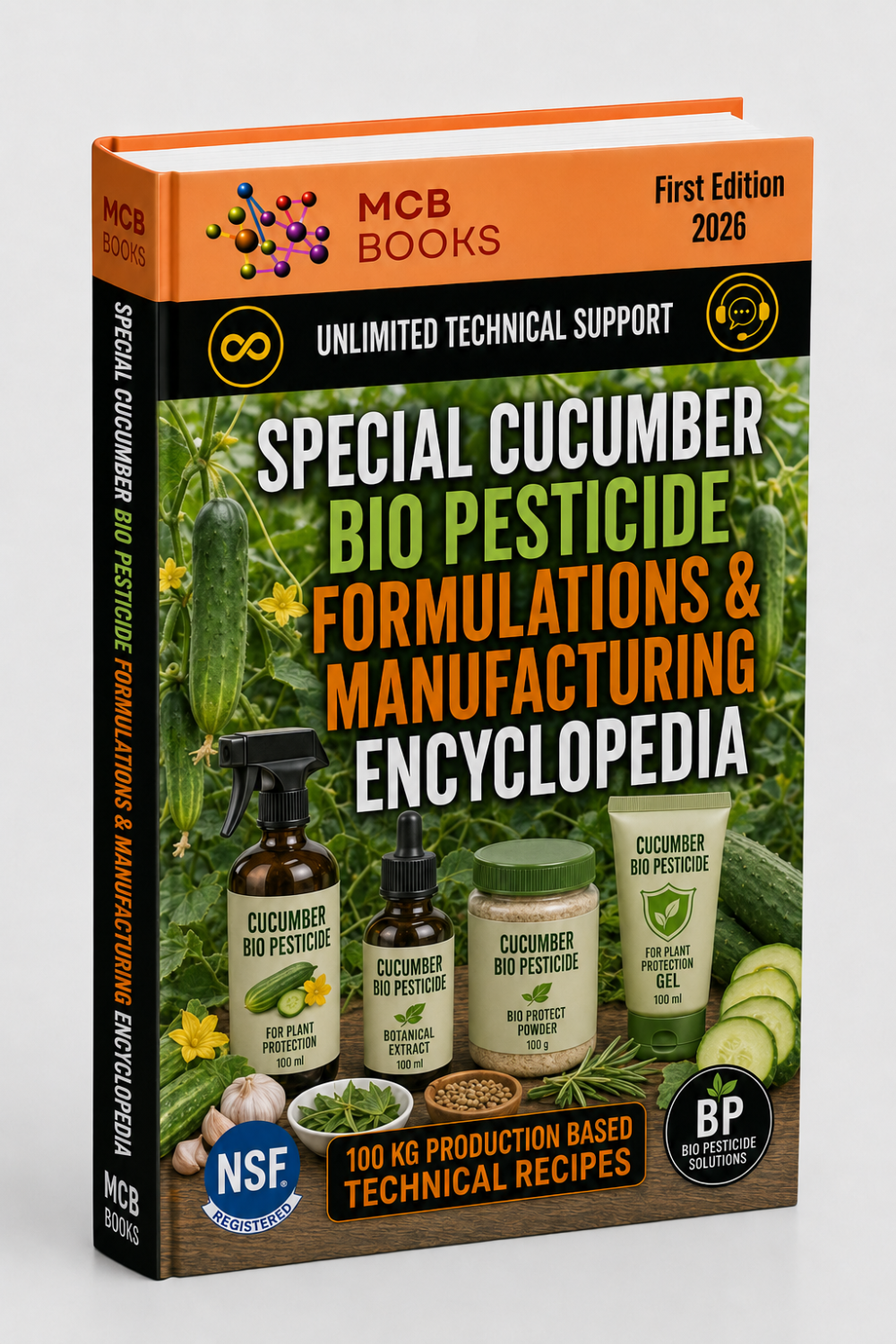
The recipes are written as tested starting points: reproduce them at laboratory scale, confirm the specification, then scale up to pilot and full production. Readers planning a new line often combine this book with SPECIAL CUCUMBER BIO PESTICIDE FORMULATIONS & MANUFACTURING ENCYCLOPEDIA, and our free articles offer further technical background.
Every MCB Books encyclopedia is available as a hard book and PDF — the PDF is delivered instantly, the printed edition ships worldwide — and all purchases include unlimited technical support. Questions before ordering? Contact the MCB Books team or write to us on WhatsApp; we reply the same day.
Related books