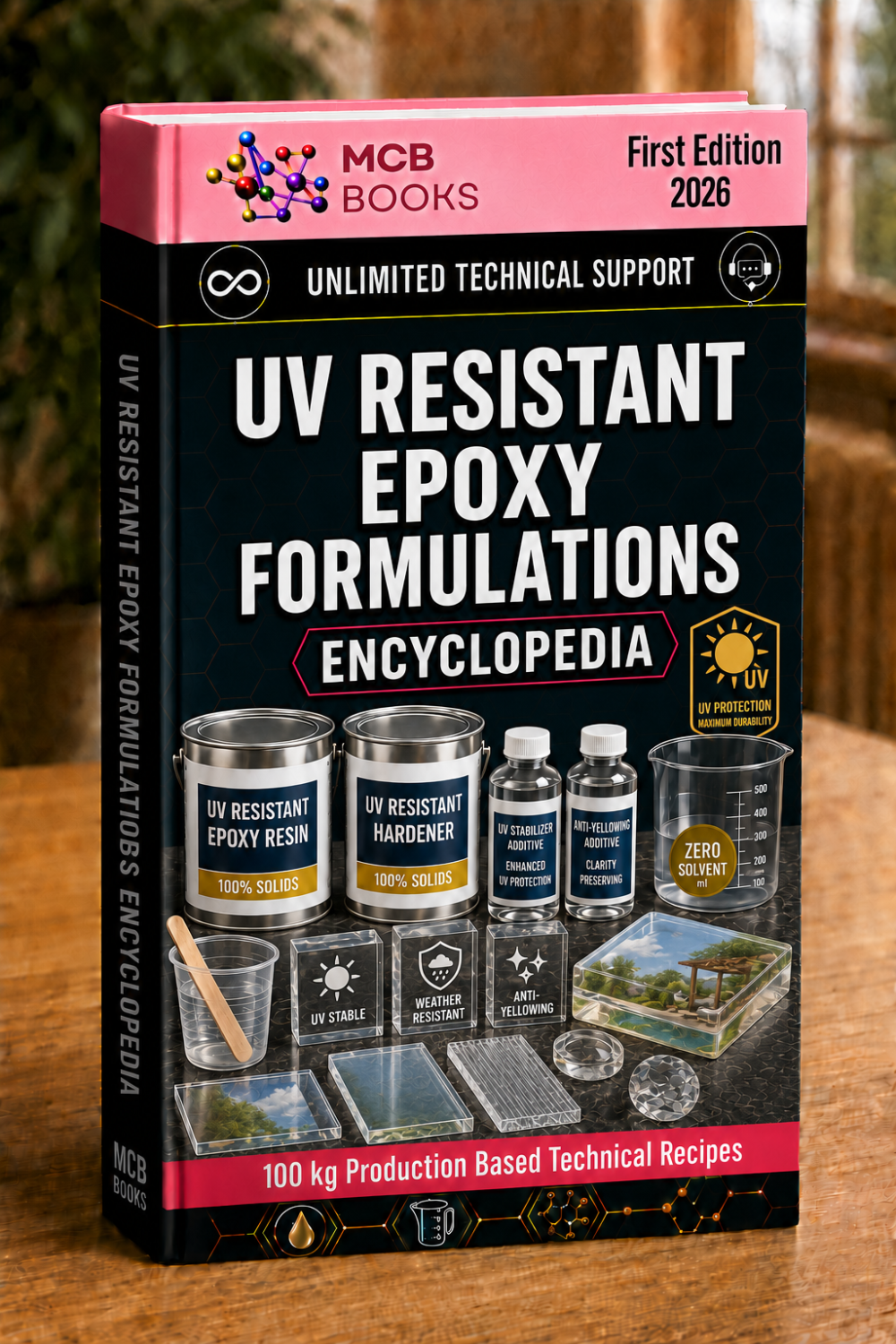
EPOXY SYSTEMS FORMULATIONS ENCYCLOPEDIA
Book details
- Editor
- MCB BOOKS
- ISBN
- 978-6259-6032-2-3
- Number of Pages
- 350 Pages
- Publication Date
- 2026
- Copyright
- MCB BOOKS
- Format
- Hard Book & E book (PDF)
- Language
- English
About the Encyclopedia
The Epoxy Systems Formulations Encyclopedia is a comprehensive technical reference for manufacturers, formulators and R&D teams developing professional epoxy systems for different processing and performance requirements.
It brings together epoxy systems formulations, manufacturing methods, raw material information and product-development guidance for two-component, solvent-free, water-based, fast-curing, slow-curing, flexible and rigid technologies.
Rather than concentrating on one finished epoxy product, the encyclopedia examines how resin, hardener, viscosity, cure profile and functional additives can be balanced to create different system characteristics.
It is designed for manufacturers who want a broader technical platform for developing multiple commercial epoxy system grades from related chemistry.
Table of contents
01Page 1 Contents 200 formulations · 1–320
- 1Two-Component Epoxy System Formulation and Industrial Production Process 1
- 3Two-Component Epoxy System Formulation and Industrial Production Process 2
- 5Two-Component Epoxy System Formulation and Industrial Production Process 3
- 7Two-Component Epoxy System Special Specification
- 8Two-Component Epoxy System Technical Properties and Usage
- 9Solvent-Free Epoxy System Formulation and Industrial Production Process 1
- 11Solvent-Free Epoxy System Formulation and Industrial Production Process 2
- 13Solvent-Free Epoxy System Formulation and Industrial Production Process 3
- 15Solvent-Free Epoxy System Special Specification
- 16Solvent-Free Epoxy System Technical Properties and Usage
- 17Water-Based Epoxy System Formulation and Industrial Production Process 1
- 19Water-Based Epoxy System Formulation and Industrial Production Process 2
- 21Water-Based Epoxy System Formulation and Industrial Production Process 3
- 23Water-Based Epoxy System Special Specification
- 24Water-Based Epoxy System Technical Properties and Usage
- 25Fast Curing Epoxy System Formulation and Industrial Production Process 1
- 27Fast Curing Epoxy System Formulation and Industrial Production Process 2
- 29Fast Curing Epoxy System Formulation and Industrial Production Process 3
- 31Fast Curing Epoxy System Special Specification
- 32Fast Curing Epoxy System Technical Properties and Usage
- 33Slow Curing Epoxy System Formulation and Industrial Production Process 1
- 35Slow Curing Epoxy System Formulation and Industrial Production Process 2
- 37Slow Curing Epoxy System Formulation and Industrial Production Process 3
- 39Slow Curing Epoxy System Special Specification
- 40Slow Curing Epoxy System Technical Properties and Usage
- 41Room Temperature Curing Epoxy System Formulation and Industrial Production Process 1
- 43Room Temperature Curing Epoxy System Formulation and Industrial Production Process 2
- 45Room Temperature Curing Epoxy System Formulation and Industrial Production Process 3
- 47Room Temperature Curing Epoxy System Special Specification
- 48Room Temperature Curing Epoxy System Technical Properties and Usage
- 49Heat Curing Epoxy System Formulation and Industrial Production Process 1
- 51Heat Curing Epoxy System Formulation and Industrial Production Process 2
- 53Heat Curing Epoxy System Formulation and Industrial Production Process 3
- 55Heat Curing Epoxy System Special Specification
- 56Heat Curing Epoxy System Technical Properties and Usage
- 57Low Viscosity Epoxy System Formulation and Industrial Production Process 1
- 59Low Viscosity Epoxy System Formulation and Industrial Production Process 2
- 61Low Viscosity Epoxy System Formulation and Industrial Production Process 3
- 63Low Viscosity Epoxy System Special Specification
- 64Low Viscosity Epoxy System Technical Properties and Usage
- 65High Viscosity Epoxy System Formulation and Industrial Production Process 1
- 67High Viscosity Epoxy System Formulation and Industrial Production Process 2
- 69High Viscosity Epoxy System Formulation and Industrial Production Process 3
- 71High Viscosity Epoxy System Special Specification
- 72High Viscosity Epoxy System Technical Properties and Usage
- 73Self-Leveling Epoxy System Formulation and Industrial Production Process 1
- 75Self-Leveling Epoxy System Formulation and Industrial Production Process 2
- 77Self-Leveling Epoxy System Formulation and Industrial Production Process 3
- 79Self-Leveling Epoxy System Special Specification
- 80Self-Leveling Epoxy System Technical Properties and Usage
- 81Clear Casting Epoxy System Formulation and Industrial Production Process 1
- 83Clear Casting Epoxy System Formulation and Industrial Production Process 2
- 85Clear Casting Epoxy System Formulation and Industrial Production Process 3
- 87Clear Casting Epoxy System Special Specification
- 88Clear Casting Epoxy System Technical Properties and Usage
- 89Deep Pour Epoxy System Formulation and Industrial Production Process 1
- 91Deep Pour Epoxy System Formulation and Industrial Production Process 2
- 93Deep Pour Epoxy System Formulation and Industrial Production Process 3
- 95Deep Pour Epoxy System Special Specification
- 96Deep Pour Epoxy System Technical Properties and Usage
- 97High Strength Structural Epoxy System Formulation and Industrial Production Process 1
- 99High Strength Structural Epoxy System Formulation and Industrial Production Process 2
- 101High Strength Structural Epoxy System Formulation and Industrial Production Process 3
- 103High Strength Structural Epoxy System Special Specification
- 104High Strength Structural Epoxy System Technical Properties and Usage
- 105Flexible Epoxy System Formulation and Industrial Production Process 1
- 107Flexible Epoxy System Formulation and Industrial Production Process 2
- 109Flexible Epoxy System Formulation and Industrial Production Process 3
- 111Flexible Epoxy System Special Specification
- 112Flexible Epoxy System Technical Properties and Usage
- 113Rigid Epoxy System Formulation and Industrial Production Process 1
- 115Rigid Epoxy System Formulation and Industrial Production Process 2
- 117Rigid Epoxy System Formulation and Industrial Production Process 3
- 119Rigid Epoxy System Special Specification
- 120Rigid Epoxy System Technical Properties and Usage
- 121Chemical Resistant Epoxy System Formulation and Industrial Production Process 1
- 123Chemical Resistant Epoxy System Formulation and Industrial Production Process 2
- 125Chemical Resistant Epoxy System Formulation and Industrial Production Process 3
- 127Chemical Resistant Epoxy System Special Specification
- 128Chemical Resistant Epoxy System Technical Properties and Usage
- 129Abrasion Resistant Epoxy System Formulation and Industrial Production Process 1
- 131Abrasion Resistant Epoxy System Formulation and Industrial Production Process 2
- 133Abrasion Resistant Epoxy System Formulation and Industrial Production Process 3
- 135Abrasion Resistant Epoxy System Special Specification
- 136Abrasion Resistant Epoxy System Technical Properties and Usage
- 137UV Resistant Epoxy System Formulation and Industrial Production Process 1
- 139UV Resistant Epoxy System Formulation and Industrial Production Process 2
- 141UV Resistant Epoxy System Formulation and Industrial Production Process 3
- 143UV Resistant Epoxy System Special Specification
- 144UV Resistant Epoxy System Technical Properties and Usage
- 145High Temperature Resistant Epoxy System Formulation and Industrial Production Process 1
- 147High Temperature Resistant Epoxy System Formulation and Industrial Production Process 2
- 149High Temperature Resistant Epoxy System Formulation and Industrial Production Process 3
- 151High Temperature Resistant Epoxy System Special Specification
- 152High Temperature Resistant Epoxy System Technical Properties and Usage
- 153Electrical Insulating Epoxy System Formulation and Industrial Production Process 1
- 155Electrical Insulating Epoxy System Formulation and Industrial Production Process 2
- 157Electrical Insulating Epoxy System Formulation and Industrial Production Process 3
- 159Electrical Insulating Epoxy System Special Specification
- 160Electrical Insulating Epoxy System Technical Properties and Usage
- 161Composite Lamination Epoxy System Formulation and Industrial Production Process 1
- 163Composite Lamination Epoxy System Formulation and Industrial Production Process 2
- 165Composite Lamination Epoxy System Formulation and Industrial Production Process 3
- 167Composite Lamination Epoxy System Special Specification
- 168Composite Lamination Epoxy System Technical Properties and Usage
- 169Carbon Fiber Epoxy System Formulation and Industrial Production Process 1
- 171Carbon Fiber Epoxy System Formulation and Industrial Production Process 2
- 173Carbon Fiber Epoxy System Formulation and Industrial Production Process 3
- 175Carbon Fiber Epoxy System Special Specification
- 176Carbon Fiber Epoxy System Technical Properties and Usage
- 177Glass Fiber Epoxy System Formulation and Industrial Production Process 1
- 179Glass Fiber Epoxy System Formulation and Industrial Production Process 2
- 181Glass Fiber Epoxy System Formulation and Industrial Production Process 3
- 183Glass Fiber Epoxy System Special Specification
- 184Glass Fiber Epoxy System Technical Properties and Usage
- 185Marine Grade Epoxy System Formulation and Industrial Production Process 1
- 187Marine Grade Epoxy System Formulation and Industrial Production Process 2
- 189Marine Grade Epoxy System Formulation and Industrial Production Process 3
- 191Marine Grade Epoxy System Special Specification
- 192Marine Grade Epoxy System Technical Properties and Usage
- 193Flooring Epoxy System Formulation and Industrial Production Process 1
- 195Flooring Epoxy System Formulation and Industrial Production Process 2
- 197Flooring Epoxy System Formulation and Industrial Production Process 3
- 199Flooring Epoxy System Special Specification
- 200Flooring Epoxy System Technical Properties and Usage
- 201Concrete Repair Epoxy System Formulation and Industrial Production Process 1
- 203Concrete Repair Epoxy System Formulation and Industrial Production Process 2
- 205Concrete Repair Epoxy System Formulation and Industrial Production Process 3
- 207Concrete Repair Epoxy System Special Specification
- 208Concrete Repair Epoxy System Technical Properties and Usage
- 209Crack Injection Epoxy System Formulation and Industrial Production Process 1
- 211Crack Injection Epoxy System Formulation and Industrial Production Process 2
- 213Crack Injection Epoxy System Formulation and Industrial Production Process 3
- 215Crack Injection Epoxy System Special Specification
- 216Crack Injection Epoxy System Technical Properties and Usage
- 217Metal Repair Epoxy System Formulation and Industrial Production Process 1
- 219Metal Repair Epoxy System Formulation and Industrial Production Process 2
- 221Metal Repair Epoxy System Formulation and Industrial Production Process 3
- 223Metal Repair Epoxy System Special Specification
- 224Metal Repair Epoxy System Technical Properties and Usage
- 225Anti-Corrosion Epoxy System Formulation and Industrial Production Process 1
- 227Anti-Corrosion Epoxy System Formulation and Industrial Production Process 2
- 229Anti-Corrosion Epoxy System Formulation and Industrial Production Process 3
- 231Anti-Corrosion Epoxy System Special Specification
- 232Anti-Corrosion Epoxy System Technical Properties and Usage
- 233Protective Coating Epoxy System Formulation and Industrial Production Process 1
- 235Protective Coating Epoxy System Formulation and Industrial Production Process 2
- 237Protective Coating Epoxy System Formulation and Industrial Production Process 3
- 239Protective Coating Epoxy System Special Specification
- 240Protective Coating Epoxy System Technical Properties and Usage
- 241Adhesive Epoxy System Formulation and Industrial Production Process 1
- 243Adhesive Epoxy System Formulation and Industrial Production Process 2
- 245Adhesive Epoxy System Formulation and Industrial Production Process 3
- 247Adhesive Epoxy System Special Specification
- 248Adhesive Epoxy System Technical Properties and Usage
- 249Potting Compound Epoxy System Formulation and Industrial Production Process 1
- 251Potting Compound Epoxy System Formulation and Industrial Production Process 2
- 253Potting Compound Epoxy System Formulation and Industrial Production Process 3
- 255Potting Compound Epoxy System Special Specification
- 256Potting Compound Epoxy System Technical Properties and Usage
- 257Encapsulation Epoxy System Formulation and Industrial Production Process 1
- 259Encapsulation Epoxy System Formulation and Industrial Production Process 2
- 261Encapsulation Epoxy System Formulation and Industrial Production Process 3
- 263Encapsulation Epoxy System Special Specification
- 264Encapsulation Epoxy System Technical Properties and Usage
- 265Low VOC Epoxy System Formulation and Industrial Production Process 1
- 267Low VOC Epoxy System Formulation and Industrial Production Process 2
- 269Low VOC Epoxy System Formulation and Industrial Production Process 3
- 271Low VOC Epoxy System Special Specification
- 272Low VOC Epoxy System Technical Properties and Usage
- 273Eco-Friendly Epoxy System Formulation and Industrial Production Process 1
- 275Eco-Friendly Epoxy System Formulation and Industrial Production Process 2
- 277Eco-Friendly Epoxy System Formulation and Industrial Production Process 3
- 279Eco-Friendly Epoxy System Special Specification
- 280Eco-Friendly Epoxy System Technical Properties and Usage
- 281Industrial Epoxy System Formulation and Industrial Production Process 1
- 283Industrial Epoxy System Formulation and Industrial Production Process 2
- 285Industrial Epoxy System Formulation and Industrial Production Process 3
- 287Industrial Epoxy System Special Specification
- 288Industrial Epoxy System Technical Properties and Usage
- 289Professional Epoxy System Formulation and Industrial Production Process 1
- 291Professional Epoxy System Formulation and Industrial Production Process 2
- 293Professional Epoxy System Formulation and Industrial Production Process 3
- 295Professional Epoxy System Special Specification
- 296Professional Epoxy System Technical Properties and Usage
- 297Premium Epoxy System Formulation and Industrial Production Process 1
- 299Premium Epoxy System Formulation and Industrial Production Process 2
- 301Premium Epoxy System Formulation and Industrial Production Process 3
- 303Premium Epoxy System Special Specification
- 304Premium Epoxy System Technical Properties and Usage
- 305Multi-Purpose Epoxy System Formulation and Industrial Production Process 1
- 307Multi-Purpose Epoxy System Formulation and Industrial Production Process 2
- 309Multi-Purpose Epoxy System Formulation and Industrial Production Process 3
- 311Multi-Purpose Epoxy System Special Specification
- 312Multi-Purpose Epoxy System Technical Properties and Usage
- 313Advanced Epoxy System Technology Formulation and Industrial Production Process 1
- 315Advanced Epoxy System Technology Formulation and Industrial Production Process 2
- 317Advanced Epoxy System Technology Formulation and Industrial Production Process 3
- 319Advanced Epoxy System Technology Special Specification
- 320Advanced Epoxy System Technology Technical Properties and Usage
More about this book
What's Inside the Encyclopedia
The encyclopedia covers epoxy technologies according to both processing behavior and finished performance.
Readers can study two-component, solvent-free and water-based epoxy systems together with fast-curing, slow-curing, room-temperature-curing and heat-curing technologies.
The content also includes low-viscosity and high-viscosity products together with flexible, rigid, abrasion-resistant, UV-resistant and high-temperature-resistant systems.
More specialized sections demonstrate how the same broad epoxy chemistry can be adapted to different commercial and industrial requirements.
This structure makes the book particularly useful for companies that want to understand how epoxy systems are designed, not simply how one finished epoxy product is manufactured.
Why This Encyclopedia
An epoxy system is more than resin and hardener sold in two containers.
The relationship between resin chemistry, curing agent, mixing ratio, viscosity, pot life and final crosslink structure determines how the product behaves during both processing and service.
A fast-curing system cannot be formulated in the same way as a long-working-time system.
A flexible epoxy needs a different balance from a rigid, high-strength formulation.
Solvent-free and water-based systems also create different manufacturing and application requirements.
The Epoxy Systems Formulations Encyclopedia helps manufacturers understand these relationships so they can create product families around different performance profiles rather than simply changing one raw material and calling it a new grade.
About Formulations
Epoxy Systems Formulations, Two Component Epoxy Systems, Solvent Free Epoxy Systems, Water Based Epoxy Systems, Fast Curing Epoxy Systems, Slow Curing Epoxy Systems, Room Temperature Curing Epoxy Systems, Heat Curing Epoxy Systems, Low Viscosity Epoxy Systems, High Viscosity Epoxy Systems, Flexible Epoxy Systems, Rigid Epoxy Systems, High Strength Epoxy Systems, Abrasion Resistant Epoxy Systems, UV Resistant Epoxy Systems, High Temperature Resistant Epoxy Systems, Low VOC Epoxy Systems, Industrial Epoxy Systems, Professional Epoxy Systems, Premium Epoxy Systems, Multi Purpose Epoxy Systems, Advanced Epoxy System Technologies
Manufacturing Methods
Each formulation is presented in a clear and practical structure showing the raw materials, CAS numbers, functions of each ingredient, and exact quantities required for production.
All formulations are calculated on a 100 kg production basis, making them easy to understand, compare, scale, and adapt for laboratory or industrial R&D work.
The book uses straightforward technical language so that readers can follow the formulations without needing advanced engineering knowledge.
The Production Process section explains the manufacturing sequence step by step, including charging order, mixing, dissolution, dispersion, temperature control, viscosity adjustment, filtration, and final filling.
Special attention is given to what happens at each production stage, helping the reader understand not only what to add, but when, how, and why it is added.
The formulations are presented as practical starting formulations for laboratory, in-house, R&D, product-development, and commercial production studies, with final validation and regulatory testing required before market use.
In this way, the encyclopedia guides the reader through the complete manufacturing workflow in a form that can be followed by formulators, technicians, production staff, entrepreneurs, and manufacturers alike.
Troubleshooting
The encyclopedia helps readers understand and identify common problems that may occur during production and application.
Issues such as incorrect viscosity, poor adhesion, slow or incomplete curing, premature thickening, air bubbles, poor dispersion, and moisture-related instability can be evaluated through the formulation and production guidance.
The production processes explain critical factors such as mixing order, temperature, moisture control, dispersion, degassing, viscosity adjustment, filtration, and packaging conditions that can directly influence the final product.
Readers can also understand how substrate preparation, mixing accuracy, bond-line thickness, curing conditions, and application environment affect adhesive performance.
By comparing the expected product properties with actual production results, users can more easily determine where a problem may have originated in the manufacturing process.
This practical approach helps reduce unnecessary trial and error and provides a clearer direction for corrective formulation adjustments and process optimization.
Troubleshooting therefore becomes part of the overall formulation-development process rather than a separate, complicated engineering task.
Unlimited Technical Support
Customers purchasing the Epoxy Systems Formulations Encyclopedia receive technical support from MCB BOOKS for questions related to the formulations and manufacturing information included in the book.
If you need help understanding an epoxy system formulation, resin-hardener balance, curing profile, viscosity adjustment, additive function or production step, you can contact our technical team.
Technical support helps manufacturers use the formulation information more confidently during laboratory development, pilot production and commercial scale-up.
Featured Articles
1 – Epoxy Systems Formulations for Commercial Product Development
Professional epoxy systems formulations can be developed around very different processing and performance requirements.
One customer may need a fast-curing system for rapid assembly, while another needs extended working time for a larger application.
Some products require low viscosity and easy flow. Others need higher body or thixotropy.
Flexible and rigid systems also serve different mechanical requirements after curing.
For manufacturers, this creates an important commercial opportunity.
Instead of selling one standard epoxy kit, companies can develop several system grades around cure speed, viscosity, flexibility and final performance.
The Epoxy Systems Formulations Encyclopedia provides a broad technical platform for building those differentiated product families.
TAGS: epoxy systems formulations, epoxy systems, epoxy system manufacturing, industrial epoxy systems, epoxy formulation technology
2 – Two Component Epoxy Systems: Resin, Hardener and Mixing Ratio
A two component epoxy system normally consists of a resin component and a curing component supplied separately until use.
The relationship between these two components is one of the most important parts of formulation development.
Incorrect mixing ratios can result in soft cure, incomplete reaction or reduced mechanical performance.
Manufacturers also need to consider how easily the two parts can be mixed in practical use.
Viscosity differences between Component A and Component B can make mixing more difficult, particularly in larger batches.
Pot life then determines how long the mixed product remains workable.
By adjusting resin chemistry, hardener selection and formulation balance, manufacturers can create different 2K systems for different processing and performance requirements.
TAGS: two component epoxy system, 2K epoxy system, epoxy resin hardener system, epoxy mixing ratio, epoxy systems formulations
3 – Fast Curing and Slow Curing Epoxy Systems
Cure speed is one of the most useful ways to differentiate commercial epoxy products.
A fast curing epoxy system can reduce waiting time and improve productivity where rapid handling strength is important.
The trade-off is usually shorter working time.
Slow-curing products offer longer pot life and may be more suitable for large applications, detailed assembly or processes where the material needs time to flow.
Temperature also changes reaction speed, so the same product can behave differently under different working conditions.
For manufacturers, offering both faster and slower grades makes it possible to serve customers with very different production processes using the same broad epoxy chemistry platform.
TAGS: fast curing epoxy system, slow curing epoxy system, epoxy cure time, long pot life epoxy, epoxy systems formulations
4 – Flexible and Rigid Epoxy System Formulations
Not every epoxy product should cure into the same mechanical structure.
A rigid epoxy system may be selected where dimensional stability, hardness and structural strength are important.
A flexible epoxy system can be more suitable where movement, vibration, thermal expansion or impact needs to be accommodated.
Flexibility can be modified through resin selection, reactive components and specialized modifiers.
However, increasing flexibility can also change hardness, heat resistance and strength.
The goal is therefore not simply to make an epoxy softer.
Professional system design balances flexibility with the mechanical properties needed for the final application.
This gives manufacturers another useful way to divide one epoxy product line into distinct commercial grades.
TAGS: flexible epoxy system, rigid epoxy system, epoxy system formulation, modified epoxy systems, industrial epoxy formulations
5 – Solvent-Free and Water-Based Epoxy Systems
Processing technology is another major way epoxy systems can be differentiated.
Solvent-free epoxy systems can provide high applied solids while avoiding dependence on significant levels of volatile solvent.
Their formulation challenge is often viscosity.
Water-based epoxy systems take a different approach by using technologies designed to operate within an aqueous environment.
These systems require careful attention to compatibility, dispersion stability and curing behavior.
Neither technology is simply a replacement for the other.
Each gives manufacturers a different platform for developing products around application method, VOC requirements, viscosity and customer preference.
The Epoxy Systems Formulations Encyclopedia includes both solvent-free and water-based technologies as part of its broader system-development approach.
TAGS: solvent free epoxy systems, water based epoxy systems, low VOC epoxy system, epoxy system manufacturing, epoxy systems formulations
Some Raw Materials Used
Bisphenol A Epoxy Resin, Bisphenol F Epoxy Resin, Epoxy Novolac Resins, Cycloaliphatic Epoxy Resins, Amine Curing Agents, Cycloaliphatic Amines, Polyamide Hardeners, Phenalkamine Hardeners, Anhydride Curing Agents, Polyetheramines, Reactive Diluents, Flexibilizers, Toughening Agents, Accelerators, Catalysts, Calcium Carbonate, Silica, Fumed Silica, Barium Sulfate, Mineral Fillers, Silane Coupling Agents, Defoamers, Air Release Additives, Rheology Modifiers, Thixotropic Agents, UV Stabilizers
Why Choose This Encyclopedia
The Epoxy Systems Formulations Encyclopedia is designed for manufacturers who want practical formulation and production information across different epoxy system architectures rather than one single end-product category.
It combines epoxy systems formulations, two-component technologies, solvent-free and water-based systems, different curing profiles, viscosity ranges, flexible and rigid systems and industrial performance grades in one comprehensive technical reference.
The book contains 350 pages and 200 formulations, ranging from fundamental 2K and curing technologies through industrial, professional and multi-purpose epoxy systems.
Its commercial value lies in helping manufacturers create multiple epoxy grades from different system concepts—for example faster and slower curing products, flexible and rigid grades, different viscosities and different performance levels.
That makes the book especially useful for companies that want to expand an existing epoxy portfolio without positioning every new product around an entirely different chemistry.
The formulations should first be evaluated at laboratory scale, followed by pilot production and final validation according to resin and curing-agent specifications, mixing ratio, processing conditions and required final performance.
Every MCB Books encyclopedia is available as a hard book and PDF — the PDF is delivered instantly, the printed edition ships worldwide — and all purchases include unlimited technical support. Questions before ordering? Contact the MCB Books team or write to us on WhatsApp; we reply the same day.
Related books