MOLD RELEASE AEROSOL FORMULATIONS ENCYCLOPEDIA
Book details
- Editor
- MCB BOOKS
- ISBN
- 978-9944-0292-1-8
- Number of Pages
- 350 Pages
- Publication Date
- 2026
- Copyright
- MCB BOOKS
- Format
- Hard Book & E book (PDF)
- Language
- English
About the Encyclopedia
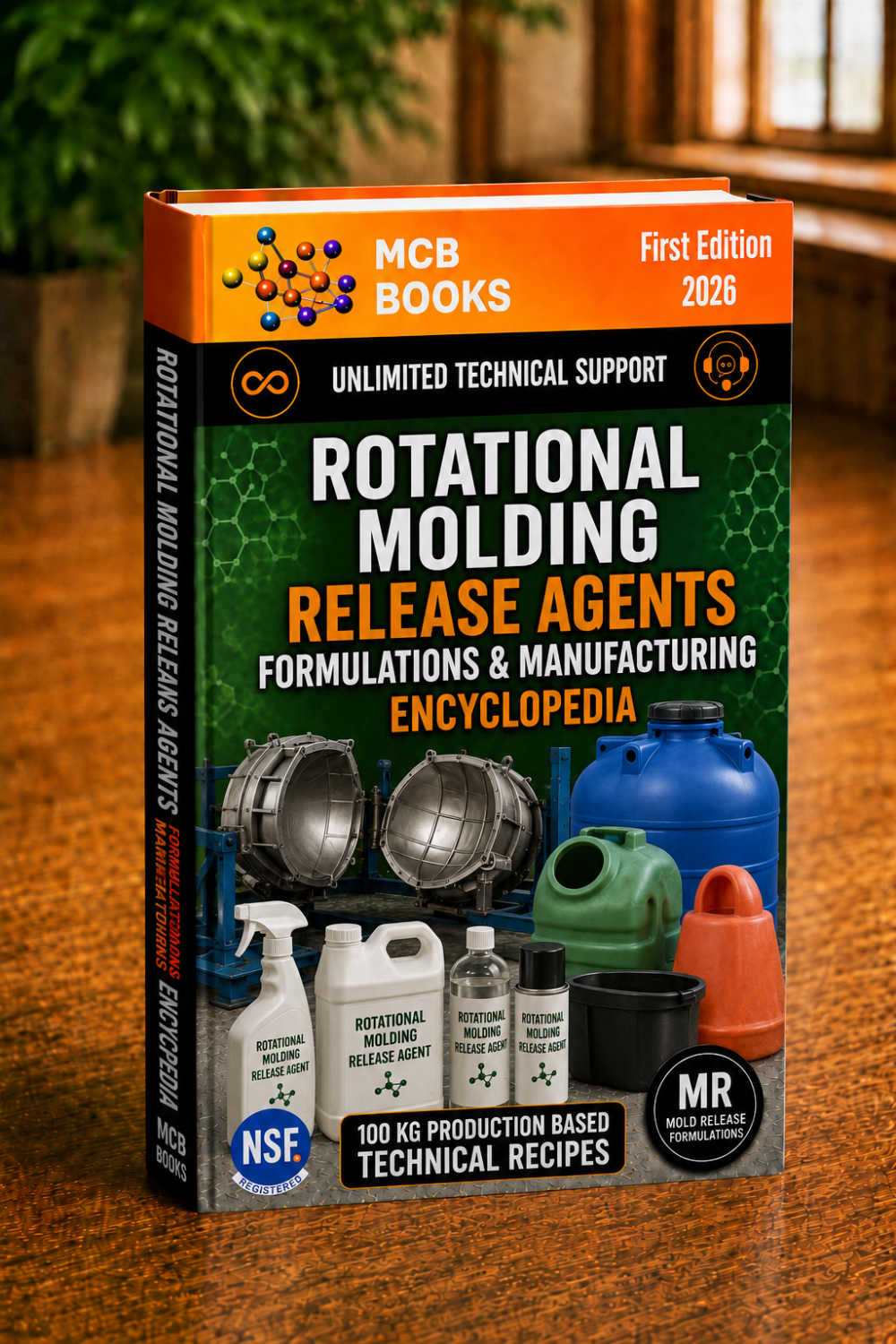
MOLD RELEASE AEROSOL FORMULATIONS ENCYCLOPEDIA is a professional technical reference developed for aerosol manufacturers, molding-industry chemical companies, formulators and entrepreneurs who want to manufacture different types of mold release sprays.
The encyclopedia covers a wide range of technologies including silicone mold release aerosols, silicone-free systems, semi-permanent release agents, dry-film sprays, water-based and solvent-based products, high-temperature release agents and fast-drying formulations.
Application-specific products include mold release aerosols for plastic injection molding, rubber molding, polyurethane foam, composites, fiberglass, epoxy resins, polyester resins, concrete, die casting, foundry processes, rotational molding and thermoforming.
Readers can study how release agents, lubricating materials, carriers, solvents and aerosol delivery systems influence release performance, film formation, residue, surface quality and processing efficiency.
Table of contents
01Page 1 Contents 205 formulations · 1–328
- 1General Purpose Mold Release Aerosol Formulation and Industrial Production Process 1
- 3General Purpose Mold Release Aerosol Formulation and Industrial Production Process 2
- 5General Purpose Mold Release Aerosol Formulation and Industrial Production Process 3
- 7General Purpose Mold Release Aerosol Special Specification
- 8General Purpose Mold Release Aerosol Technical Properties and Usage
- 9Silicone Mold Release Aerosol Formulation and Industrial Production Process 1
- 11Silicone Mold Release Aerosol Formulation and Industrial Production Process 2
- 13Silicone Mold Release Aerosol Formulation and Industrial Production Process 3
- 15Silicone Mold Release Aerosol Special Specification
- 16Silicone Mold Release Aerosol Technical Properties and Usage
- 17Silicone-Free Mold Release Aerosol Formulation and Industrial Production Process 1
- 19Silicone-Free Mold Release Aerosol Formulation and Industrial Production Process 2
- 21Silicone-Free Mold Release Aerosol Formulation and Industrial Production Process 3
- 23Silicone-Free Mold Release Aerosol Special Specification
- 24Silicone-Free Mold Release Aerosol Technical Properties and Usage
- 25Semi-Permanent Mold Release Aerosol Formulation and Industrial Production Process 1
- 27Semi-Permanent Mold Release Aerosol Formulation and Industrial Production Process 2
- 29Semi-Permanent Mold Release Aerosol Formulation and Industrial Production Process 3
- 31Semi-Permanent Mold Release Aerosol Special Specification
- 32Semi-Permanent Mold Release Aerosol Technical Properties and Usage
- 33Dry Film Mold Release Aerosol Formulation and Industrial Production Process 1
- 35Dry Film Mold Release Aerosol Formulation and Industrial Production Process 2
- 37Dry Film Mold Release Aerosol Formulation and Industrial Production Process 3
- 39Dry Film Mold Release Aerosol Special Specification
- 40Dry Film Mold Release Aerosol Technical Properties and Usage
- 41Water-Based Mold Release Aerosol Formulation and Industrial Production Process 1
- 43Water-Based Mold Release Aerosol Formulation and Industrial Production Process 2
- 45Water-Based Mold Release Aerosol Formulation and Industrial Production Process 3
- 47Water-Based Mold Release Aerosol Special Specification
- 48Water-Based Mold Release Aerosol Technical Properties and Usage
- 49Solvent-Based Mold Release Aerosol Formulation and Industrial Production Process 1
- 51Solvent-Based Mold Release Aerosol Formulation and Industrial Production Process 2
- 53Solvent-Based Mold Release Aerosol Formulation and Industrial Production Process 3
- 55Solvent-Based Mold Release Aerosol Special Specification
- 56Solvent-Based Mold Release Aerosol Technical Properties and Usage
- 57High Temperature Mold Release Aerosol Formulation and Industrial Production Process 1
- 59High Temperature Mold Release Aerosol Formulation and Industrial Production Process 2
- 61High Temperature Mold Release Aerosol Formulation and Industrial Production Process 3
- 63High Temperature Mold Release Aerosol Special Specification
- 64High Temperature Mold Release Aerosol Technical Properties and Usage
- 65Fast Dry Mold Release Aerosol Formulation and Industrial Production Process 1
- 67Fast Dry Mold Release Aerosol Formulation and Industrial Production Process 2
- 69Fast Dry Mold Release Aerosol Formulation and Industrial Production Process 3
- 71Fast Dry Mold Release Aerosol Special Specification
- 72Fast Dry Mold Release Aerosol Technical Properties and Usage
- 73Low Residue Mold Release Aerosol Formulation and Industrial Production Process 1
- 75Low Residue Mold Release Aerosol Formulation and Industrial Production Process 2
- 77Low Residue Mold Release Aerosol Formulation and Industrial Production Process 3
- 79Low Residue Mold Release Aerosol Special Specification
- 80Low Residue Mold Release Aerosol Technical Properties and Usage
- 81Anti-Stick Mold Release Aerosol Formulation and Industrial Production Process 1
- 83Anti-Stick Mold Release Aerosol Formulation and Industrial Production Process 2
- 85Anti-Stick Mold Release Aerosol Formulation and Industrial Production Process 3
- 87Anti-Stick Mold Release Aerosol Special Specification
- 88Anti-Stick Mold Release Aerosol Technical Properties and Usage
- 89Plastic Injection Mold Release Aerosol Formulation and Industrial Production Process 1
- 91Plastic Injection Mold Release Aerosol Formulation and Industrial Production Process 2
- 93Plastic Injection Mold Release Aerosol Formulation and Industrial Production Process 3
- 95Plastic Injection Mold Release Aerosol Special Specification
- 96Plastic Injection Mold Release Aerosol Technical Properties and Usage
- 97Rubber Mold Release Aerosol Formulation and Industrial Production Process 1
- 99Rubber Mold Release Aerosol Formulation and Industrial Production Process 2
- 101Rubber Mold Release Aerosol Formulation and Industrial Production Process 3
- 103Rubber Mold Release Aerosol Special Specification
- 104Rubber Mold Release Aerosol Technical Properties and Usage
- 105Polyurethane Foam Mold Release Aerosol Formulation and Industrial Production Process 1
- 107Polyurethane Foam Mold Release Aerosol Formulation and Industrial Production Process 2
- 109Polyurethane Foam Mold Release Aerosol Formulation and Industrial Production Process 3
- 111Polyurethane Foam Mold Release Aerosol Special Specification
- 112Polyurethane Foam Mold Release Aerosol Technical Properties and Usage
- 113Composite Mold Release Aerosol Formulation and Industrial Production Process 1
- 115Composite Mold Release Aerosol Formulation and Industrial Production Process 2
- 117Composite Mold Release Aerosol Formulation and Industrial Production Process 3
- 119Composite Mold Release Aerosol Special Specification
- 120Composite Mold Release Aerosol Technical Properties and Usage
- 121Fiberglass Mold Release Aerosol Formulation and Industrial Production Process 1
- 123Fiberglass Mold Release Aerosol Formulation and Industrial Production Process 2
- 125Fiberglass Mold Release Aerosol Formulation and Industrial Production Process 3
- 127Fiberglass Mold Release Aerosol Special Specification
- 128Fiberglass Mold Release Aerosol Technical Properties and Usage
- 129Epoxy Mold Release Aerosol Formulation and Industrial Production Process 1
- 131Epoxy Mold Release Aerosol Formulation and Industrial Production Process 2
- 133Epoxy Mold Release Aerosol Formulation and Industrial Production Process 3
- 135Epoxy Mold Release Aerosol Special Specification
- 136Epoxy Mold Release Aerosol Technical Properties and Usage
- 137Polyester Resin Mold Release Aerosol Formulation and Industrial Production Process 1
- 139Polyester Resin Mold Release Aerosol Formulation and Industrial Production Process 2
- 141Polyester Resin Mold Release Aerosol Formulation and Industrial Production Process 3
- 143Polyester Resin Mold Release Aerosol Special Specification
- 144Polyester Resin Mold Release Aerosol Technical Properties and Usage
- 145Concrete Mold Release Aerosol Formulation and Industrial Production Process 1
- 147Concrete Mold Release Aerosol Formulation and Industrial Production Process 2
- 149Concrete Mold Release Aerosol Formulation and Industrial Production Process 3
- 151Concrete Mold Release Aerosol Special Specification
- 152Concrete Mold Release Aerosol Technical Properties and Usage
- 153Die Casting Mold Release Aerosol Formulation and Industrial Production Process 1
- 155Die Casting Mold Release Aerosol Formulation and Industrial Production Process 2
- 157Die Casting Mold Release Aerosol Formulation and Industrial Production Process 3
- 159Die Casting Mold Release Aerosol Special Specification
- 160Die Casting Mold Release Aerosol Technical Properties and Usage
- 161Foundry Mold Release Aerosol Formulation and Industrial Production Process 1
- 163Foundry Mold Release Aerosol Formulation and Industrial Production Process 2
- 165Foundry Mold Release Aerosol Formulation and Industrial Production Process 3
- 167Foundry Mold Release Aerosol Special Specification
- 168Foundry Mold Release Aerosol Technical Properties and Usage
- 169Rotational Molding Release Aerosol Formulation and Industrial Production Process 1
- 171Rotational Molding Release Aerosol Formulation and Industrial Production Process 2
- 173Rotational Molding Release Aerosol Formulation and Industrial Production Process 3
- 175Rotational Molding Release Aerosol Special Specification
- 176Rotational Molding Release Aerosol Technical Properties and Usage
- 177Thermoforming Mold Release Aerosol Formulation and Industrial Production Process 1
- 179Thermoforming Mold Release Aerosol Formulation and Industrial Production Process 2
- 181Thermoforming Mold Release Aerosol Formulation and Industrial Production Process 3
- 183Thermoforming Mold Release Aerosol Special Specification
- 184Thermoforming Mold Release Aerosol Technical Properties and Usage
- 185Food-Grade Mold Release Aerosol Formulation and Industrial Production Process 1
- 187Food-Grade Mold Release Aerosol Formulation and Industrial Production Process 2
- 189Food-Grade Mold Release Aerosol Formulation and Industrial Production Process 3
- 191Food-Grade Mold Release Aerosol Special Specification
- 192Food-Grade Mold Release Aerosol Technical Properties and Usage
- 193NSF H1 Mold Release Aerosol Formulation and Industrial Production Process 1
- 195NSF H1 Mold Release Aerosol Formulation and Industrial Production Process 2
- 197NSF H1 Mold Release Aerosol Formulation and Industrial Production Process 3
- 199NSF H1 Mold Release Aerosol Special Specification
- 200NSF H1 Mold Release Aerosol Technical Properties and Usage
- 201Precision Mold Release Aerosol Formulation and Industrial Production Process 1
- 203Precision Mold Release Aerosol Formulation and Industrial Production Process 2
- 205Precision Mold Release Aerosol Formulation and Industrial Production Process 3
- 207Precision Mold Release Aerosol Special Specification
- 208Precision Mold Release Aerosol Technical Properties and Usage
- 209Industrial Mold Release Aerosol Formulation and Industrial Production Process 1
- 211Industrial Mold Release Aerosol Formulation and Industrial Production Process 2
- 213Industrial Mold Release Aerosol Formulation and Industrial Production Process 3
- 215Industrial Mold Release Aerosol Special Specification
- 216Industrial Mold Release Aerosol Technical Properties and Usage
- 217Heavy-Duty Mold Release Aerosol Formulation and Industrial Production Process 1
- 219Heavy-Duty Mold Release Aerosol Formulation and Industrial Production Process 2
- 221Heavy-Duty Mold Release Aerosol Formulation and Industrial Production Process 3
- 223Heavy-Duty Mold Release Aerosol Special Specification
- 224Heavy-Duty Mold Release Aerosol Technical Properties and Usage
- 225High Lubricity Mold Release Aerosol Formulation and Industrial Production Process 1
- 227High Lubricity Mold Release Aerosol Formulation and Industrial Production Process 2
- 229High Lubricity Mold Release Aerosol Formulation and Industrial Production Process 3
- 231High Lubricity Mold Release Aerosol Special Specification
- 232High Lubricity Mold Release Aerosol Technical Properties and Usage
- 233Water Repellent Mold Release Aerosol Formulation and Industrial Production Process 1
- 235Water Repellent Mold Release Aerosol Formulation and Industrial Production Process 2
- 237Water Repellent Mold Release Aerosol Formulation and Industrial Production Process 3
- 239Water Repellent Mold Release Aerosol Special Specification
- 240Water Repellent Mold Release Aerosol Technical Properties and Usage
- 241Eco-Friendly Mold Release Aerosol Formulation and Industrial Production Process 1
- 243Eco-Friendly Mold Release Aerosol Formulation and Industrial Production Process 2
- 245Eco-Friendly Mold Release Aerosol Formulation and Industrial Production Process 3
- 247Eco-Friendly Mold Release Aerosol Special Specification
- 248Eco-Friendly Mold Release Aerosol Technical Properties and Usage
- 249Biodegradable Mold Release Aerosol Formulation and Industrial Production Process 1
- 251Biodegradable Mold Release Aerosol Formulation and Industrial Production Process 2
- 253Biodegradable Mold Release Aerosol Formulation and Industrial Production Process 3
- 255Biodegradable Mold Release Aerosol Special Specification
- 256Biodegradable Mold Release Aerosol Technical Properties and Usage
- 257Low VOC Mold Release Aerosol Formulation and Industrial Production Process 1
- 259Low VOC Mold Release Aerosol Formulation and Industrial Production Process 2
- 261Low VOC Mold Release Aerosol Formulation and Industrial Production Process 3
- 263Low VOC Mold Release Aerosol Special Specification
- 264Low VOC Mold Release Aerosol Technical Properties and Usage
- 265Professional Mold Release Aerosol Formulation and Industrial Production Process 1
- 267Professional Mold Release Aerosol Formulation and Industrial Production Process 2
- 269Professional Mold Release Aerosol Formulation and Industrial Production Process 3
- 271Professional Mold Release Aerosol Special Specification
- 272Professional Mold Release Aerosol Technical Properties and Usage
- 273Premium Mold Release Aerosol Formulation and Industrial Production Process 1
- 275Premium Mold Release Aerosol Formulation and Industrial Production Process 2
- 277Premium Mold Release Aerosol Formulation and Industrial Production Process 3
- 279Premium Mold Release Aerosol Special Specification
- 280Premium Mold Release Aerosol Technical Properties and Usage
- 281OEM Mold Release Aerosol Formulation and Industrial Production Process 1
- 283OEM Mold Release Aerosol Formulation and Industrial Production Process 2
- 285OEM Mold Release Aerosol Formulation and Industrial Production Process 3
- 287OEM Mold Release Aerosol Special Specification
- 288OEM Mold Release Aerosol Technical Properties and Usage
- 289Multi-Purpose Mold Release Aerosol Formulation and Industrial Production Process 1
- 291Multi-Purpose Mold Release Aerosol Formulation and Industrial Production Process 2
- 293Multi-Purpose Mold Release Aerosol Formulation and Industrial Production Process 3
- 295Multi-Purpose Mold Release Aerosol Special Specification
- 296Multi-Purpose Mold Release Aerosol Technical Properties and Usage
- 297Industrial Maintenance Mold Release Aerosol Formulation and Industrial Production Process 1
- 299Industrial Maintenance Mold Release Aerosol Formulation and Industrial Production Process 2
- 301Industrial Maintenance Mold Release Aerosol Formulation and Industrial Production Process 3
- 303Industrial Maintenance Mold Release Aerosol Special Specification
- 304Industrial Maintenance Mold Release Aerosol Technical Properties and Usage
- 305Advanced Mold Release Aerosol Formulation and Industrial Production Process 1
- 307Advanced Mold Release Aerosol Formulation and Industrial Production Process 2
- 309Advanced Mold Release Aerosol Formulation and Industrial Production Process 3
- 311Advanced Mold Release Aerosol Special Specification
- 312Advanced Mold Release Aerosol Technical Properties and Usage
- 313Multi-Functional Mold Release Aerosol Formulation and Industrial Production Process 1
- 315Multi-Functional Mold Release Aerosol Formulation and Industrial Production Process 2
- 317Multi-Functional Mold Release Aerosol Formulation and Industrial Production Process 3
- 319Multi-Functional Mold Release Aerosol Special Specification
- 320Multi-Functional Mold Release Aerosol Technical Properties and Usage
- 321High Performance Mold Release Aerosol Formulation and Industrial Production Process 1
- 323High Performance Mold Release Aerosol Formulation and Industrial Production Process 2
- 325High Performance Mold Release Aerosol Formulation and Industrial Production Process 3
- 327High Performance Mold Release Aerosol Special Specification
- 328High Performance Mold Release Aerosol Technical Properties and Usage
More about this book
What's Inside the Encyclopedia
The encyclopedia contains practical technical information about mold release aerosol formulations, raw-material selection, industrial production processes, special specifications and technical product properties.
Formulation categories include general-purpose mold release aerosols, silicone release sprays, silicone-free release agents, semi-permanent systems, dry-film release agents, water-based products and solvent-based products.
Performance-oriented systems include high-temperature, fast-dry, low-residue, anti-stick, high-lubricity and water-repellent mold release aerosols.
The book also includes application-specific formulations for plastic injection molds, rubber molds, polyurethane foam, composite manufacturing, fiberglass, epoxy, polyester resin, concrete molds, die casting, foundry operations, rotational molding and thermoforming.
Additional product concepts include food-grade, NSF H1, precision, industrial, heavy-duty, eco-friendly, biodegradable, low-VOC, professional, premium, OEM, multi-purpose and high-performance mold release aerosols.
Why This Encyclopedia
Mold release products play an important role in manufacturing because they help separate finished parts from molds while supporting surface quality and production efficiency.
A professional mold release formulation must provide sufficient release performance without creating excessive buildup, unwanted transfer or surface defects.
Different molding processes require different release technologies.
Plastic injection molding may require a fast, controlled release film, while polyurethane foam or composite manufacturing may need a different balance of film durability and surface coverage.
Silicone-based products can provide strong lubricity and release performance, while silicone-free systems may be preferred where subsequent painting, bonding or finishing operations are important.
High-temperature molding, die casting and foundry applications place additional demands on thermal stability.
The aerosol delivery system also plays an important role by allowing thin and even application over the mold surface.
This encyclopedia helps manufacturers understand these differences and develop specialized products for individual molding technologies.
It is suitable for aerosol manufacturers, plastic and rubber chemical suppliers, composite-industry companies, die-casting chemical producers, private-label manufacturers and industrial formulation laboratories.
About Formulations
Mold Release Aerosol Formulations, Release Agent Spray Formulations, Silicone Mold Release Aerosols, Silicone-Free Mold Release Sprays, Semi-Permanent Mold Release Agents, Dry Film Mold Release Aerosols, Water-Based Mold Release Sprays, Solvent-Based Mold Release Agents, High Temperature Mold Release, Fast Dry Mold Release Sprays, Low Residue Mold Release Agents, Anti-Stick Mold Release Aerosols, Plastic Injection Mold Release, Rubber Mold Release Sprays, Polyurethane Foam Release Agents, Composite Mold Release Aerosols, Fiberglass Mold Release Sprays, Epoxy Mold Release Agents, Polyester Resin Mold Release, Concrete Mold Release Aerosols, Die Casting Mold Release, Foundry Mold Release Sprays, Rotational Molding Release Agents, Thermoforming Mold Release Aerosols, Industrial Mold Release Agents
Manufacturing Methods
Each formulation is presented in a clear and practical structure showing the raw materials, CAS numbers, functions of each ingredient, and exact quantities required for production.
All formulations are calculated on a 100 kg production basis, making them easy to understand, compare, scale, and adapt for laboratory or industrial R&D work.
The book uses straightforward technical language so that readers can follow the formulations without needing advanced engineering knowledge.
The Production Process section explains the manufacturing sequence step by step, including charging order, mixing, dissolution, dispersion, temperature control, viscosity adjustment, filtration, and final filling.
Special attention is given to what happens at each production stage, helping the reader understand not only what to add, but when, how, and why it is added.
The formulations are presented as practical starting formulations for laboratory, in-house, R&D, product-development, and commercial production studies, with final validation and regulatory testing required before market use.
In this way, the encyclopedia guides the reader through the complete manufacturing workflow in a form that can be followed by formulators, technicians, production staff, entrepreneurs, and manufacturers alike.
Troubleshooting
The encyclopedia helps readers understand and identify common problems that may occur during production and application.
Issues such as incorrect viscosity, poor adhesion, slow or incomplete curing, premature thickening, air bubbles, poor dispersion, and moisture-related instability can be evaluated through the formulation and production guidance.
The production processes explain critical factors such as mixing order, temperature, moisture control, dispersion, degassing, viscosity adjustment, filtration, and packaging conditions that can directly influence the final product.
Readers can also understand how substrate preparation, mixing accuracy, bond-line thickness, curing conditions, and application environment affect adhesive performance.
By comparing the expected product properties with actual production results, users can more easily determine where a problem may have originated in the manufacturing process.
This practical approach helps reduce unnecessary trial and error and provides a clearer direction for corrective formulation adjustments and process optimization.
Troubleshooting therefore becomes part of the overall formulation-development process rather than a separate, complicated engineering task.
Unlimited Technical Support
When you purchase the MOLD RELEASE AEROSOL FORMULATIONS ENCYCLOPEDIA, you are not limited to the technical information contained in the book.
MCB BOOKS provides unlimited technical support related to the formulations and manufacturing subjects covered in the encyclopedia.
If you need clarification about raw-material functions, formulation principles, industrial production methods or technical details included in the book, you can contact our technical team.
Our aim is to help readers understand professional mold release aerosol manufacturing and use the encyclopedia as a practical technical reference during product development and commercial production.
Featured Articles
1 – Mold Release Aerosol Formulation and Manufacturing Process
Mold release aerosols are industrial products designed to create a controlled release layer between a mold surface and the material being processed.
Developing a professional mold release aerosol formulation requires balancing release efficiency, film thickness, lubrication, evaporation and surface compatibility.
The active release system may contain silicone-based materials, waxes, specialized lubricants or other functional components depending on the intended molding process.
Carrier materials help distribute these ingredients evenly across the mold surface.
Aerosol application provides an important advantage because it allows manufacturers to apply a thin, controlled layer over complex mold geometries.
Uniform application can help reduce excessive product consumption and minimize localized buildup.
The formulation must also be selected according to the material being molded.
Plastic, rubber, polyurethane foam, composite resin and metal-casting processes all have different temperature ranges and surface requirements.
Some applications require a dry film that minimizes residue, while others benefit from a more lubricating release layer.
During manufacturing, raw materials are blended according to the selected formulation before being filled into appropriate aerosol packages.
Quality-control evaluation may include appearance, spray pattern, drying time, release efficiency, film uniformity, residue and storage stability.
Manufacturers should also evaluate the product using representative molds and molding materials before commercialization.
The MOLD RELEASE AEROSOL FORMULATIONS ENCYCLOPEDIA provides multiple formulation approaches for manufacturers developing release-agent sprays for industrial molding applications.
TAGS: mold release aerosol formulation, mold release spray manufacturing, release agent formulation, aerosol release agent, mold release manufacturing, industrial mold release, mold release spray formula
2 – Silicone and Silicone-Free Mold Release Aerosol Formulations
Silicone-based mold release products are widely used because silicone materials can provide excellent lubricity and release performance at relatively low application levels.
A silicone mold release aerosol formulation typically combines a suitable silicone release component with carriers selected to distribute the material evenly over the mold surface.
After application, the carrier evaporates or dries, leaving a thin release layer.
This layer can reduce adhesion between the manufactured part and the mold, helping improve demolding efficiency.
Silicone systems can be suitable for many plastic, rubber and general industrial molding applications.
However, silicone is not ideal for every process.
Where finished parts will later be painted, bonded, coated or printed, unwanted silicone transfer may create problems with surface adhesion.
For these applications, manufacturers may prefer a silicone-free mold release formulation.
Silicone-free technologies use alternative release materials designed to provide demolding performance while reducing the risk of silicone contamination.
The choice between silicone and silicone-free products should therefore depend on the molding process and downstream finishing requirements.
Spray pattern and film uniformity are particularly important because over-application can create excessive residue.
Quality control may include release efficiency, drying behavior, film appearance, surface transfer and spray performance.
Manufacturers may also develop different grades such as fast-dry, low-residue, high-temperature or high-lubricity versions.
The MOLD RELEASE AEROSOL FORMULATIONS ENCYCLOPEDIA provides formulation approaches for both silicone and silicone-free release technologies, allowing manufacturers to develop products for different industrial applications.
TAGS: silicone mold release formulation, silicone free mold release, mold release spray, release agent aerosol, silicone release spray, industrial release agent, mold release manufacturing
3 – Plastic Injection, Rubber and Polyurethane Mold Release Sprays
Plastic injection molding, rubber molding and polyurethane processing are major industrial applications for mold release products.
Each process places different demands on the release film.
A plastic injection mold release aerosol should provide efficient separation while minimizing buildup on the mold surface and transferred residue on the molded component.
Fast drying can be useful because production cycles may be short and manufacturers generally want minimal interruption between applications.
Rubber mold release formulations may require greater lubricity or resistance to repeated molding cycles depending on the rubber compound and mold temperature.
Polyurethane foam release agents present another set of requirements.
Rigid and flexible polyurethane foams can adhere strongly to mold surfaces, so the release film must be distributed evenly and remain effective through the molding cycle.
Both silicone-based and silicone-free approaches may be used depending on the process.
Aerosol delivery enables operators to apply the release agent to corners, cavities and complex mold geometries more easily than some conventional application methods.
Manufacturers must control spray rate carefully because excessive application can create residue or affect the surface appearance of the molded part.
Products may also be formulated as fast-dry, low-residue, semi-permanent or high-temperature release sprays.
Quality-control testing should include actual molding trials where possible.
Release force, finished-part appearance, residue, mold buildup and reapplication frequency can all provide useful information during product development.
The MOLD RELEASE AEROSOL FORMULATIONS ENCYCLOPEDIA contains dedicated formulation concepts for plastic injection, rubber and polyurethane foam applications as well as many other molding technologies.
TAGS: plastic injection mold release, rubber mold release spray, polyurethane foam release agent, injection mold release aerosol, PU mold release, plastic release spray, molding release agent
4 – Composite, Fiberglass and Resin Mold Release Aerosol Formulations
Composite manufacturing requires reliable release systems because thermosetting resins can adhere strongly to mold surfaces during curing.
A professional composite mold release aerosol formulation should produce a uniform barrier that allows the cured component to separate cleanly from the mold.
Fiberglass production is one of the most common applications.
Fiberglass components may use polyester, vinyl ester, epoxy or related resin systems depending on the manufacturing process.
The mold release technology must therefore be compatible with both the mold surface and the resin being processed.
The encyclopedia includes specialized approaches for fiberglass mold release, epoxy mold release and polyester resin mold release aerosols.
Semi-permanent release technologies may be attractive for repetitive composite production because a properly developed film can support multiple molding cycles before reapplication.
Dry-film systems are another option where manufacturers want minimal oily residue on the finished part.
Surface quality is especially important in composite products because many parts are manufactured with smooth or cosmetic finishes.
Excess release agent can negatively influence gloss, paint adhesion or subsequent bonding operations.
For this reason, thin and uniform aerosol application is important.
Manufacturers should test release efficiency alongside surface transfer, finished-part appearance and downstream processing compatibility.
Quality-control parameters can include drying time, film uniformity, release performance, residue and spray pattern.
The MOLD RELEASE AEROSOL FORMULATIONS ENCYCLOPEDIA provides technical formulation approaches for composites, fiberglass, epoxy and polyester-resin molding, helping industrial chemical companies develop specialized release-agent product lines.
TAGS: composite mold release formulation, fiberglass mold release spray, epoxy mold release agent, polyester resin mold release, composite release agent, mold release aerosol manufacturing, resin mold release spray
5 – High-Temperature and Industrial Mold Release Aerosol Formulations
Some molding and casting processes operate at temperatures that require specialized release-agent technologies.
A high-temperature mold release aerosol formulation must maintain useful release performance under demanding thermal conditions without creating excessive decomposition or residue.
Applications may include die casting, foundry operations and certain high-temperature plastic, rubber or composite processes.
Die-casting release agents are used to assist separation of cast metal components from dies while also supporting process consistency.
Foundry mold release products may perform similar functions in other metal-forming environments.
Industrial mold release aerosols can also be developed for rotational molding, thermoforming and general-purpose maintenance applications.
Heavy-duty formulations may prioritize film strength and lubricity, while low-residue products focus on clean release and minimal buildup.
Manufacturers can additionally develop high-lubricity, water-repellent, low-VOC, biodegradable or eco-oriented systems according to technical and market requirements.
Food-grade and NSF H1 product concepts require another level of control because the finished formulation and its ingredients must comply with the relevant certification or regulatory requirements before those claims are used.
The aerosol system must also remain reliable under industrial storage and application conditions.
Quality control may include release performance, temperature resistance, film stability, residue, spray characteristics and storage stability.
The MOLD RELEASE AEROSOL FORMULATIONS ENCYCLOPEDIA covers high-temperature, industrial, precision, heavy-duty, food-grade and specialized mold release technologies, making it a broad technical reference for manufacturers serving multiple molding industries.
TAGS: high temperature mold release, industrial mold release formulation, die casting release agent, foundry mold release, heavy duty mold release, food grade mold release, industrial release spray
Some Raw Materials Used
Silicone Oils, Silicone Fluids, Silicone Resins, Silicone-Free Release Agents, Waxes, Synthetic Waxes, Lubricating Oils, Synthetic Lubricants, Fatty Acid Derivatives, Ester-Based Release Agents, Fluorinated Release Materials, Water-Repellent Additives, Film-Forming Agents, Hydrocarbon Solvents, Isoparaffinic Solvents, Alcohols, Fast-Evaporating Solvents, Emulsifiers, Nonionic Surfactants, Corrosion-Control Additives, Stabilizers, Aerosol Propellant Systems
Why Choose This Encyclopedia
MOLD RELEASE AEROSOL FORMULATIONS ENCYCLOPEDIA is prepared for manufacturers, formulators and R&D teams who want to produce commercially, not only to read about chemistry. Every product in the book follows the same structure: raw materials with their functions and quantities; the complete production process with charging order, mixing, temperature and control points; product specifications; and troubleshooting guidance that links common production problems to their causes.
The recipes are written as tested starting points: reproduce them at laboratory scale, confirm the specification, then scale up to pilot and full production. Readers planning a new line often combine this book with SPRAY PAINT FORMULATIONS ENCYCLOPEDIA, and our free articles offer further technical background.
Every MCB Books encyclopedia is available as a hard book and PDF — the PDF is delivered instantly, the printed edition ships worldwide — and all purchases include unlimited technical support. Questions before ordering? Contact the MCB Books team or write to us on WhatsApp; we reply the same day.
Related books