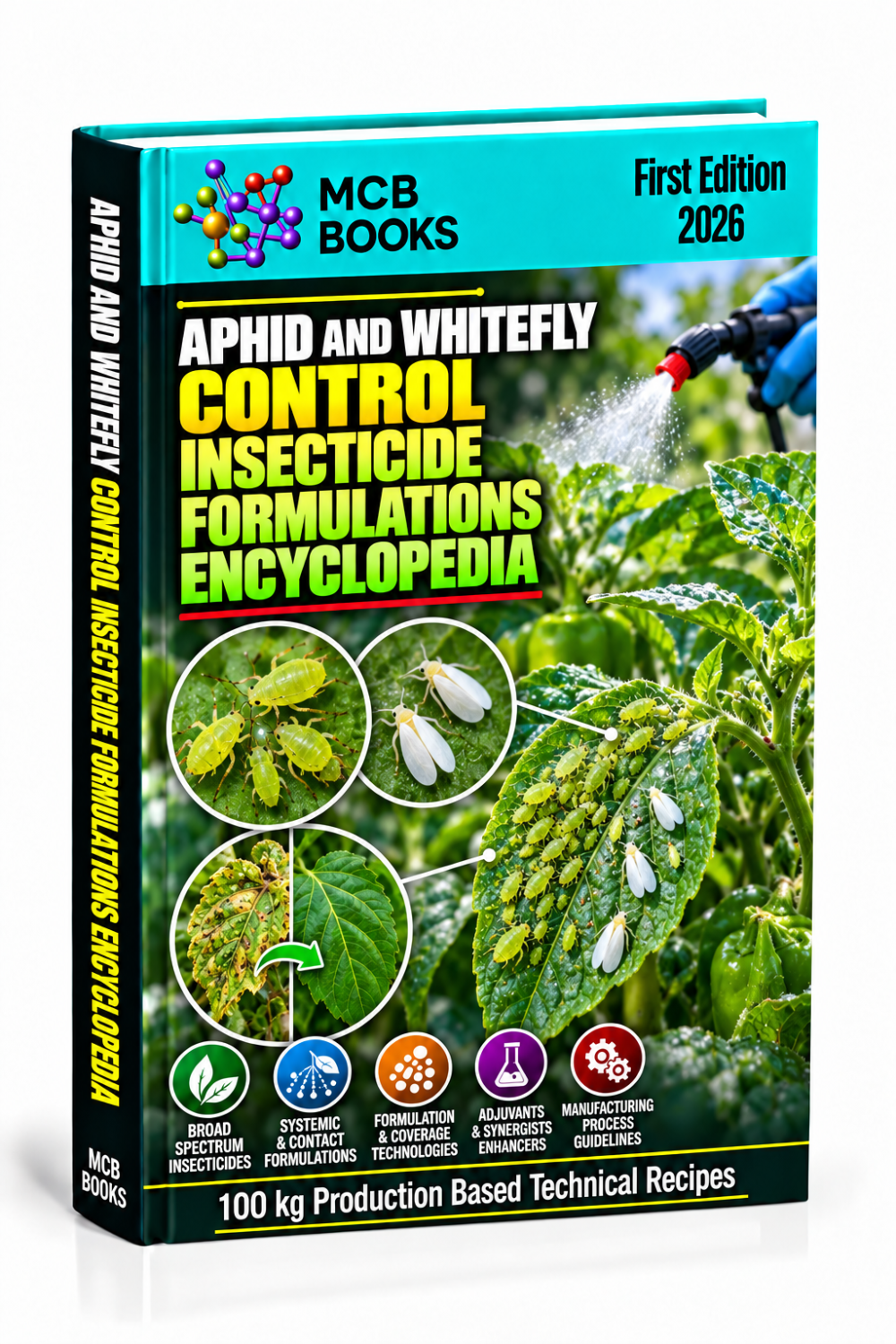
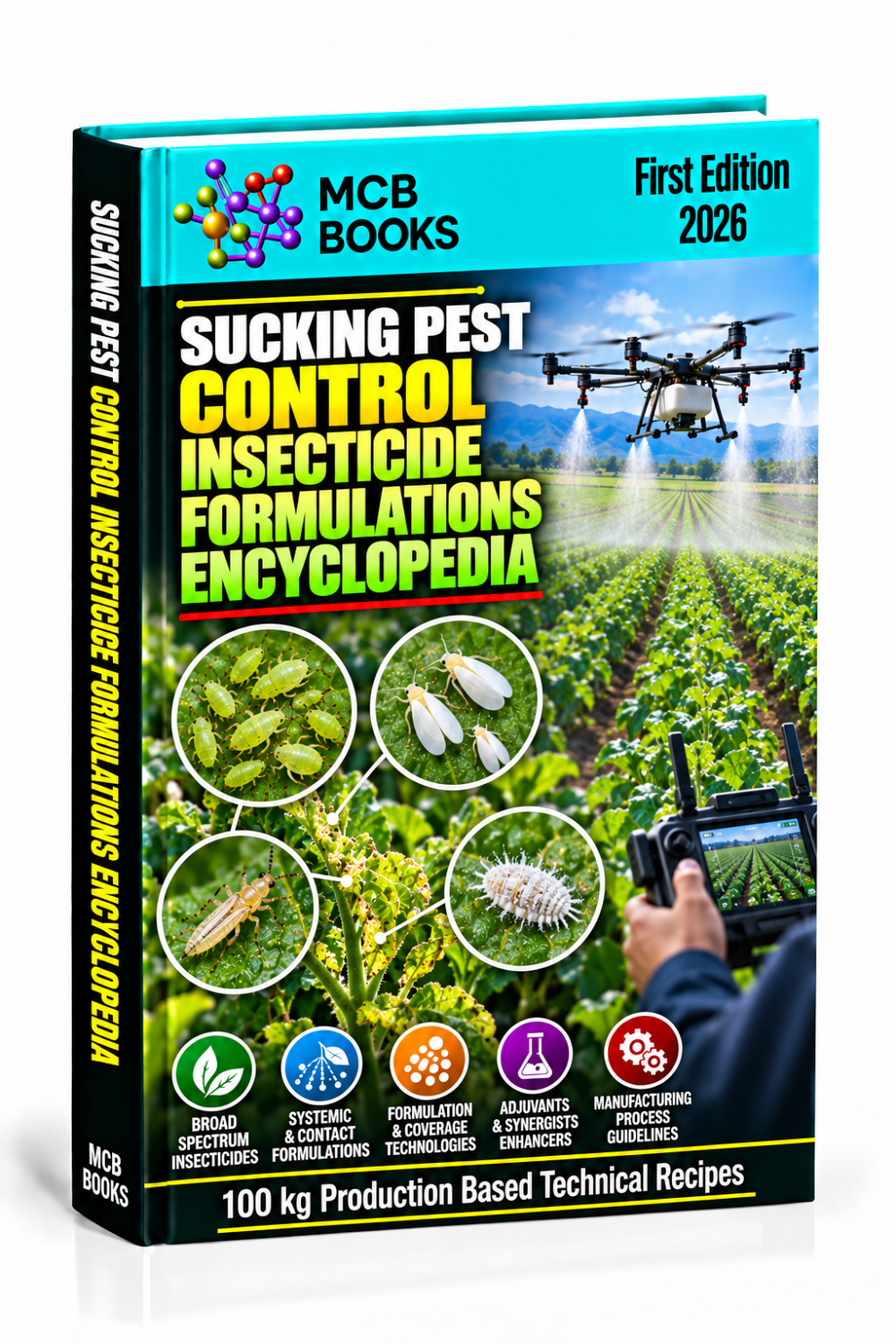
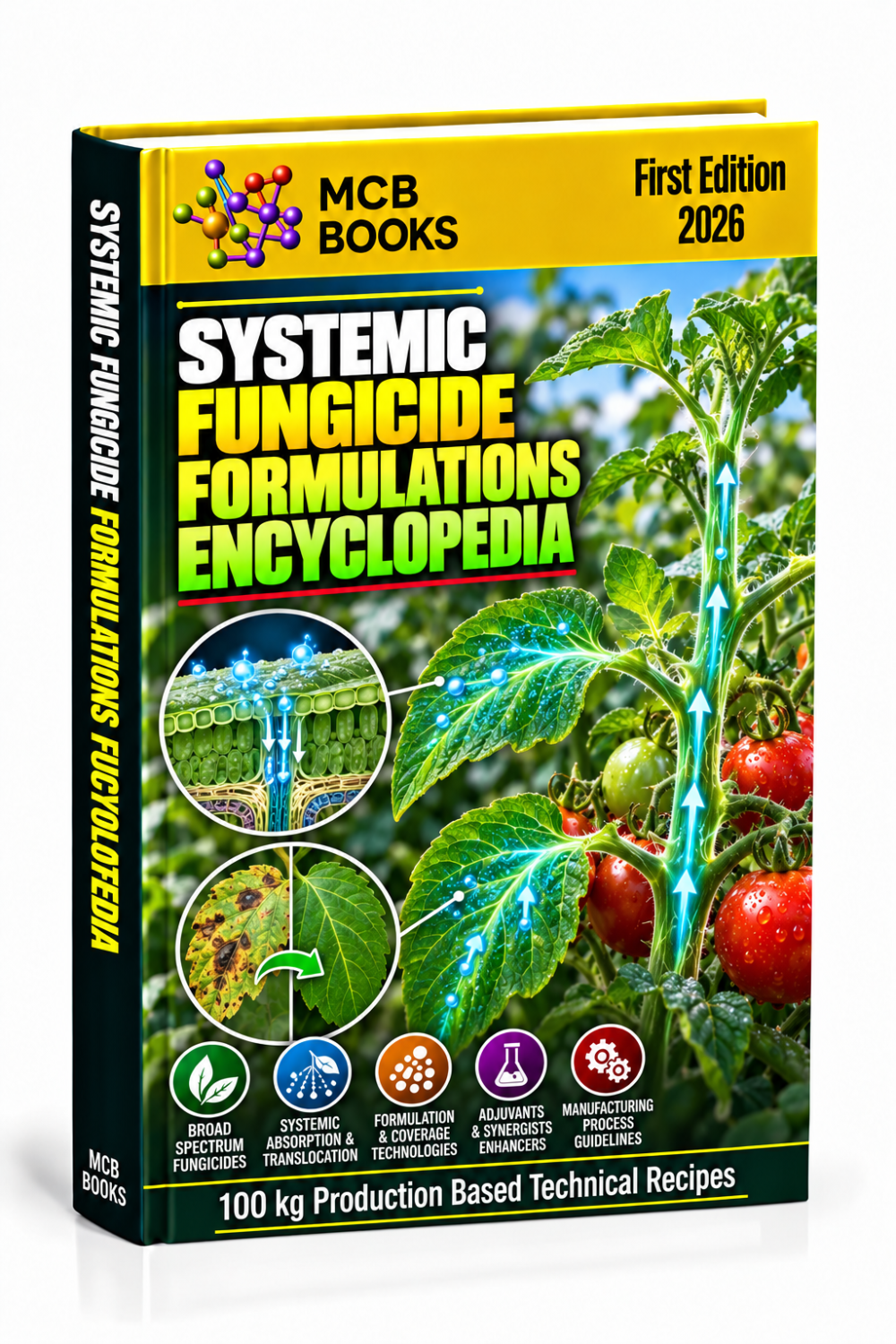
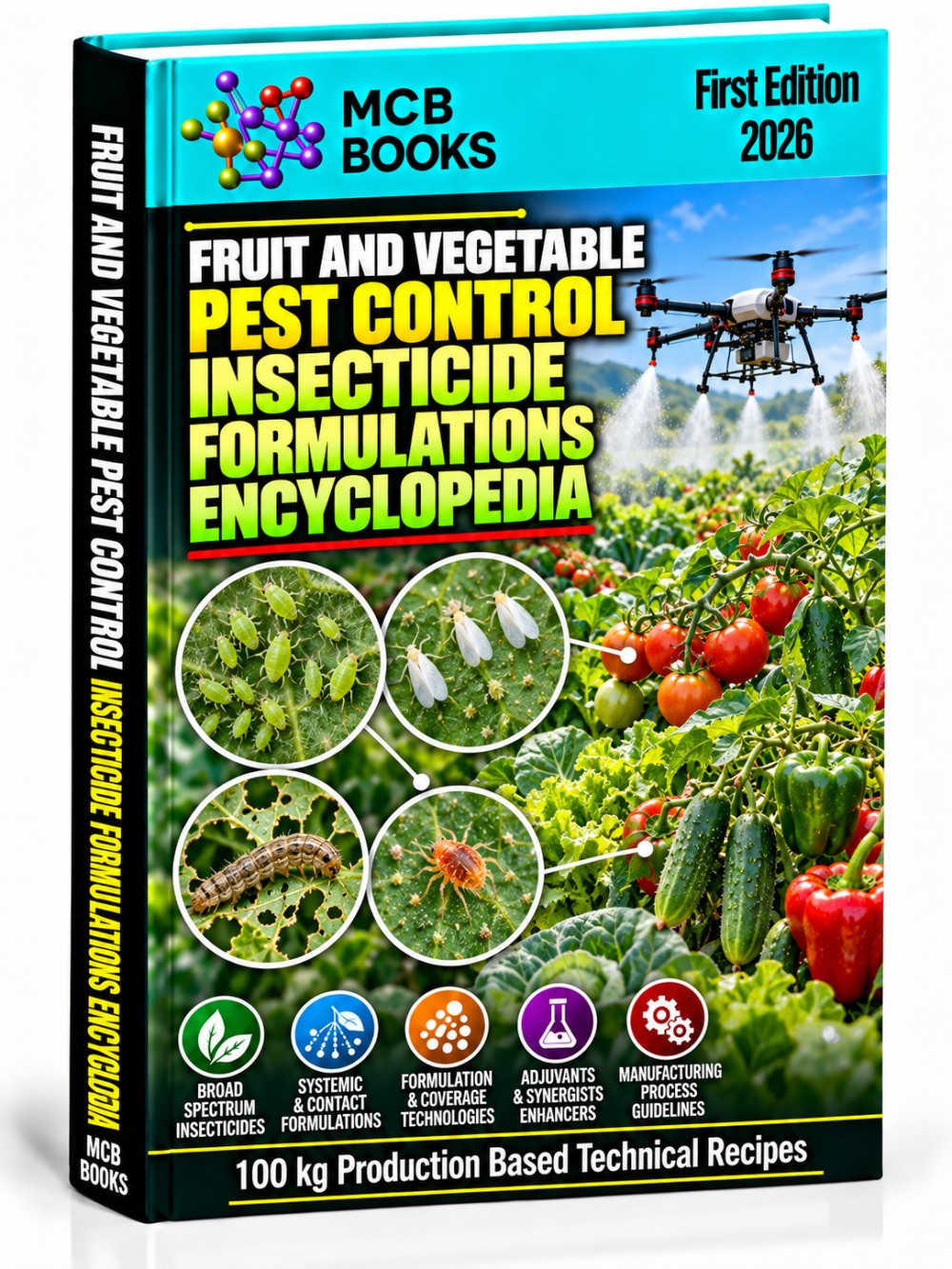
MULTI-ACTIVE FUNGICIDE FORMULATIONS ENCYCLOPEDIA
Book details
- Author
- MCB BOOKS Technical Team
- Editor
- MCB BOOKS
- ISBN
- 978-605-81137-2-5
- Number of Pages
- 385 Pages
- Publication Date
- 2026
- Copyright
- MCB BOOKS
- Format
- Hard Book & E book (PDF)
- Language
- English
About the Encyclopedia
The Multi-Active Fungicide Formulations Encyclopedia is a practical technical reference for manufacturers developing fungicides that combine two or more active ingredients in one commercial product.
It brings together combination fungicide formulations, manufacturing methods and product-development information for dual-active and multi-active systems across different formulation technologies.
The book is designed for manufacturers who want to develop a broader disease-control portfolio using complementary active ingredients rather than relying only on single-active fungicides.
Table of contents
01Page 1 Difenoconazole 150 Grams / Liter + Propiconazole 150 Grams / Liter ( 300 Ec ) Fungicide 12 formulations · 1–12
- 1DEVELOPMENT FORMULATION 1
- 2PRODUCTION PROCESS 1
- 3DEVELOPMENT FORMULATION 2
- 4PRODUCTION PROCESS 2
- 5DEVELOPMENT FORMULATION 3
- 6PRODUCTION PROCESS 3
- 7APPLICATION PROGRAM
- 8PRODUCT SPECIFICATION
- 9PRODUCT CHARACTERISTICS AND QUALITY CONTROL
- 10TROUBLESHOOTING
- 11TARGET DISEASES – IMAGES AND IDENTIFICATION
- 12TARGET DISEASES – CHARACTERISTICS AND CROP DAMAGE
02Page 13 Propiconazole 125 Grams / Liter + Azoxystrobin 100 Grams / Liter + Cyproconazole 30 Grams / Liter ( 255 Ec ) 12 formulations · 13–24
- 13DEVELOPMENT FORMULATION 1
- 14PRODUCTION PROCESS 1
- 15DEVELOPMENT FORMULATION 2
- 16PRODUCTION PROCESS 2
- 17DEVELOPMENT FORMULATION 3
- 18PRODUCTION PROCESS 3
- 19APPLICATION PROGRAM
- 20PRODUCT SPECIFICATION
- 21PRODUCT CHARACTERISTICS AND QUALITY CONTROL
- 22TROUBLESHOOTING
- 23TARGET DISEASES – IMAGES AND IDENTIFICATION
- 24TARGET DISEASES – CHARACTERISTICS AND CROP DAMAGE
03Page 25 Propiconazole 90 Grams / Liter + Prochloraz 400 Grams / Liter ( 490 Ec ) Fungicide 12 formulations · 25–36
- 25DEVELOPMENT FORMULATION 1
- 26PRODUCTION PROCESS 1
- 27DEVELOPMENT FORMULATION 2
- 28PRODUCTION PROCESS 2
- 29DEVELOPMENT FORMULATION 3
- 30PRODUCTION PROCESS 3
- 31APPLICATION PROGRAM
- 32PRODUCT SPECIFICATION
- 33PRODUCT CHARACTERISTICS AND QUALITY CONTROL
- 34TROUBLESHOOTING
- 35TARGET DISEASES – IMAGES AND IDENTIFICATION
- 36TARGET DISEASES – CHARACTERISTICS AND CROP DAMAGE
04Page 37 Azoxystrobin 37.5 Grams / Liter + Propiconazole 62.5 Grams / Liter ( Sc ) Fungicide 12 formulations · 37–48
- 37DEVELOPMENT FORMULATION 1
- 38PRODUCTION PROCESS 1
- 39DEVELOPMENT FORMULATION 2
- 40PRODUCTION PROCESS 2
- 41DEVELOPMENT FORMULATION 3
- 42PRODUCTION PROCESS 3
- 43APPLICATION PROGRAM
- 44PRODUCT SPECIFICATION
- 45PRODUCT CHARACTERISTICS AND QUALITY CONTROL
- 46TROUBLESHOOTING
- 47TARGET DISEASES – IMAGES AND IDENTIFICATION
- 48TARGET DISEASES – CHARACTERISTICS AND CROP DAMAGE
05Page 49 Chlorothalonil 450 Grams / Liter + Carbendazim 100 Grams / Liter ( 550 Sc ) Fungicide 12 formulations · 49–60
- 49DEVELOPMENT FORMULATION 1
- 50PRODUCTION PROCESS 1
- 51DEVELOPMENT FORMULATION 2
- 52PRODUCTION PROCESS 2
- 53DEVELOPMENT FORMULATION 3
- 54PRODUCTION PROCESS 3
- 55APPLICATION PROGRAM
- 56PRODUCT SPECIFICATION
- 57PRODUCT CHARACTERISTICS AND QUALITY CONTROL
- 58TROUBLESHOOTING
- 59TARGET DISEASES – IMAGES AND IDENTIFICATION
- 60TARGET DISEASES – CHARACTERISTICS AND CROP DAMAGE
06Page 61 Chlorothalonil 317 Grams / Liter + Copper Oxychloride 317 Grams / Liter ( Sc ) Fungicide 12 formulations · 61–72
- 61DEVELOPMENT FORMULATION 1
- 62PRODUCTION PROCESS 1
- 63DEVELOPMENT FORMULATION 2
- 64PRODUCTION PROCESS 2
- 65DEVELOPMENT FORMULATION 3
- 66PRODUCTION PROCESS 3
- 67APPLICATION PROGRAM
- 68PRODUCT SPECIFICATION
- 69PRODUCT CHARACTERISTICS AND QUALITY CONTROL
- 70TROUBLESHOOTING
- 71TARGET DISEASES – IMAGES AND IDENTIFICATION
- 72TARGET DISEASES – CHARACTERISTICS AND CROP DAMAGE
07Page 73 Chlorothalonil 375 Grams / Liter + Cymoxanil 50 Grams / Liter ( 425 Sc ) Fungicide 12 formulations · 73–84
- 73DEVELOPMENT FORMULATION 1
- 74PRODUCTION PROCESS 1
- 75DEVELOPMENT FORMULATION 2
- 76PRODUCTION PROCESS 2
- 77DEVELOPMENT FORMULATION 3
- 78PRODUCTION PROCESS 3
- 79APPLICATION PROGRAM
- 80PRODUCT SPECIFICATION
- 81PRODUCT CHARACTERISTICS AND QUALITY CONTROL
- 82TROUBLESHOOTING
- 83TARGET DISEASES – IMAGES AND IDENTIFICATION
- 84TARGET DISEASES – CHARACTERISTICS AND CROP DAMAGE
08Page 85 Diethofencarb 250 Grams / Liter + Carbendazim 250 Grams / Liter ( 50 Sc ) Fungicide 12 formulations · 85–96
- 85DEVELOPMENT FORMULATION 1
- 86PRODUCTION PROCESS 1
- 87DEVELOPMENT FORMULATION 2
- 88PRODUCTION PROCESS 2
- 89DEVELOPMENT FORMULATION 3
- 90PRODUCTION PROCESS 3
- 91APPLICATION PROGRAM
- 92PRODUCT SPECIFICATION
- 93PRODUCT CHARACTERISTICS AND QUALITY CONTROL
- 94TROUBLESHOOTING
- 95TARGET DISEASES – IMAGES AND IDENTIFICATION
- 96TARGET DISEASES – CHARACTERISTICS AND CROP DAMAGE
09Page 97 Epoxiconazole 125 Grams / Liter + Carbendazim 125 Grams / Liter ( 25 Sc ) Fungicide 12 formulations · 97–108
- 97DEVELOPMENT FORMULATION 1
- 98PRODUCTION PROCESS 1
- 99DEVELOPMENT FORMULATION 2
- 100PRODUCTION PROCESS 2
- 101DEVELOPMENT FORMULATION 3
- 102PRODUCTION PROCESS 3
- 103APPLICATION PROGRAM
- 104PRODUCT SPECIFICATION
- 105PRODUCT CHARACTERISTICS AND QUALITY CONTROL
- 106TROUBLESHOOTING
- 107TARGET DISEASES – IMAGES AND IDENTIFICATION
- 108TARGET DISEASES – CHARACTERISTICS AND CROP DAMAGE
10Page 109 Fludioxonil 12.5 Grams / Liter + Metalaxyl 5 Grams / Liter ( Sc ) Fungicide 12 formulations · 109–120
- 109DEVELOPMENT FORMULATION 1
- 110PRODUCTION PROCESS 1
- 111DEVELOPMENT FORMULATION 2
- 112PRODUCTION PROCESS 2
- 113DEVELOPMENT FORMULATION 3
- 114PRODUCTION PROCESS 3
- 115APPLICATION PROGRAM
- 116PRODUCT SPECIFICATION
- 117PRODUCT CHARACTERISTICS AND QUALITY CONTROL
- 118TROUBLESHOOTING
- 119TARGET DISEASES – IMAGES AND IDENTIFICATION
- 120TARGET DISEASES – CHARACTERISTICS AND CROP DAMAGE
11Page 121 Propamocarb Hcl 625 Grams / Liter + Fluopicolide 62.5 Grams / Liter ( Sc ) Fungicide 12 formulations · 121–132
- 121DEVELOPMENT FORMULATION 1
- 122PRODUCTION PROCESS 1
- 123DEVELOPMENT FORMULATION 2
- 124PRODUCTION PROCESS 2
- 125DEVELOPMENT FORMULATION 3
- 126PRODUCTION PROCESS 3
- 127APPLICATION PROGRAM
- 128PRODUCT SPECIFICATION
- 129PRODUCT CHARACTERISTICS AND QUALITY CONTROL
- 130TROUBLESHOOTING
- 131TARGET DISEASES – IMAGES AND IDENTIFICATION
- 132TARGET DISEASES – CHARACTERISTICS AND CROP DAMAGE
12Page 133 Pyrimethanil 310 Grams / Liter + Trifloxystrobin 95 Grams / Liter ( Sc ) Fungicide 12 formulations · 133–144
- 133DEVELOPMENT FORMULATION 1
- 134PRODUCTION PROCESS 1
- 135DEVELOPMENT FORMULATION 2
- 136PRODUCTION PROCESS 2
- 137DEVELOPMENT FORMULATION 3
- 138PRODUCTION PROCESS 3
- 139APPLICATION PROGRAM
- 140PRODUCT SPECIFICATION
- 141PRODUCT CHARACTERISTICS AND QUALITY CONTROL
- 142TROUBLESHOOTING
- 143TARGET DISEASES – IMAGES AND IDENTIFICATION
- 144TARGET DISEASES – CHARACTERISTICS AND CROP DAMAGE
13Page 145 Pyrimethanil 200 Grams / Liter + Tebuconazole 125 Grams / Liter ( Sc ) Fungicide 12 formulations · 145–156
- 145DEVELOPMENT FORMULATION 1
- 146PRODUCTION PROCESS 1
- 147DEVELOPMENT FORMULATION 2
- 148PRODUCTION PROCESS 2
- 149DEVELOPMENT FORMULATION 3
- 150PRODUCTION PROCESS 3
- 151APPLICATION PROGRAM
- 152PRODUCT SPECIFICATION
- 153PRODUCT CHARACTERISTICS AND QUALITY CONTROL
- 154TROUBLESHOOTING
- 155TARGET DISEASES – IMAGES AND IDENTIFICATION
- 156TARGET DISEASES – CHARACTERISTICS AND CROP DAMAGE
14Page 157 Tebuconazole 200 Grams / Liter + Azoxystrobin 120 Grams / Liter ( 320 Sc ) Fungicide 12 formulations · 157–168
- 157DEVELOPMENT FORMULATION 1
- 158PRODUCTION PROCESS 1
- 159DEVELOPMENT FORMULATION 2
- 160PRODUCTION PROCESS 2
- 161DEVELOPMENT FORMULATION 3
- 162PRODUCTION PROCESS 3
- 163APPLICATION PROGRAM
- 164PRODUCT SPECIFICATION
- 165PRODUCT CHARACTERISTICS AND QUALITY CONTROL
- 166TROUBLESHOOTING
- 167TARGET DISEASES – IMAGES AND IDENTIFICATION
- 168TARGET DISEASES – CHARACTERISTICS AND CROP DAMAGE
15Page 169 Propamocarb Hcl 530 Grams / Liter + Fosetyl – Al 310 Grams / Liter ( 840 Sl ) Fungicide 12 formulations · 169–180
- 169DEVELOPMENT FORMULATION 1
- 170PRODUCTION PROCESS 1
- 171DEVELOPMENT FORMULATION 2
- 172PRODUCTION PROCESS 2
- 173DEVELOPMENT FORMULATION 3
- 174PRODUCTION PROCESS 3
- 175APPLICATION PROGRAM
- 176PRODUCT SPECIFICATION
- 177PRODUCT CHARACTERISTICS AND QUALITY CONTROL
- 178TROUBLESHOOTING
- 179TARGET DISEASES – IMAGES AND IDENTIFICATION
- 180TARGET DISEASES – CHARACTERISTICS AND CROP DAMAGE
16Page 181 Boscalid % 25.2 + Pyraclostrobin % 12.8 Wettable Granule ( 38 Wg ) Fungicide 12 formulations · 181–192
- 181DEVELOPMENT FORMULATION 1
- 182PRODUCTION PROCESS 1
- 183DEVELOPMENT FORMULATION 2
- 184PRODUCTION PROCESS 2
- 185DEVELOPMENT FORMULATION 3
- 186PRODUCTION PROCESS 3
- 187APPLICATION PROGRAM
- 188PRODUCT SPECIFICATION
- 189PRODUCT CHARACTERISTICS AND QUALITY CONTROL
- 190TROUBLESHOOTING
- 191TARGET DISEASES – IMAGES AND IDENTIFICATION
- 192TARGET DISEASES – CHARACTERISTICS AND CROP DAMAGE
17Page 193 Chlorothalonil % 25 + Copper Oxychloride % 25 Wettable Powder ( Wp ) Fungicide 12 formulations · 193–204
- 193DEVELOPMENT FORMULATION 1
- 194PRODUCTION PROCESS 1
- 195DEVELOPMENT FORMULATION 2
- 196PRODUCTION PROCESS 2
- 197DEVELOPMENT FORMULATION 3
- 198PRODUCTION PROCESS 3
- 199APPLICATION PROGRAM
- 200PRODUCT SPECIFICATION
- 201PRODUCT CHARACTERISTICS AND QUALITY CONTROL
- 202TROUBLESHOOTING
- 203TARGET DISEASES – IMAGES AND IDENTIFICATION
- 204TARGET DISEASES – CHARACTERISTICS AND CROP DAMAGE
18Page 205 Chlorothalonil % 72 + Cymoxanil % 8 Wettable Powder ( Wp ) Fungicide 12 formulations · 205–216
- 205DEVELOPMENT FORMULATION 1
- 206PRODUCTION PROCESS 1
- 207DEVELOPMENT FORMULATION 2
- 208PRODUCTION PROCESS 2
- 209DEVELOPMENT FORMULATION 3
- 210PRODUCTION PROCESS 3
- 211APPLICATION PROGRAM
- 212PRODUCT SPECIFICATION
- 213PRODUCT CHARACTERISTICS AND QUALITY CONTROL
- 214TROUBLESHOOTING
- 215TARGET DISEASES – IMAGES AND IDENTIFICATION
- 216TARGET DISEASES – CHARACTERISTICS AND CROP DAMAGE
19Page 217 Dimethomorph % 6 + Copper Oxychloride % 40 Wettable Powder ( Wp ) Fungicide 12 formulations · 217–228
- 217DEVELOPMENT FORMULATION 1
- 218PRODUCTION PROCESS 1
- 219DEVELOPMENT FORMULATION 2
- 220PRODUCTION PROCESS 2
- 221DEVELOPMENT FORMULATION 3
- 222PRODUCTION PROCESS 3
- 223APPLICATION PROGRAM
- 224PRODUCT SPECIFICATION
- 225PRODUCT CHARACTERISTICS AND QUALITY CONTROL
- 226TROUBLESHOOTING
- 227TARGET DISEASES – IMAGES AND IDENTIFICATION
- 228TARGET DISEASES – CHARACTERISTICS AND CROP DAMAGE
20Page 229 Dimethomorph % 9 + Mancozeb % 60 Wettable Powder ( Wp ) Fungicide 12 formulations · 229–240
- 229DEVELOPMENT FORMULATION 1
- 230PRODUCTION PROCESS 1
- 231DEVELOPMENT FORMULATION 2
- 232PRODUCTION PROCESS 2
- 233DEVELOPMENT FORMULATION 3
- 234PRODUCTION PROCESS 3
- 235APPLICATION PROGRAM
- 236PRODUCT SPECIFICATION
- 237PRODUCT CHARACTERISTICS AND QUALITY CONTROL
- 238TROUBLESHOOTING
- 239TARGET DISEASES – IMAGES AND IDENTIFICATION
- 240TARGET DISEASES – CHARACTERISTICS AND CROP DAMAGE
21Page 241 Famoxadone % 22.5 + Cymoxanil % 30 Wettable Powder ( Wp ) Fungicide 12 formulations · 241–252
- 241DEVELOPMENT FORMULATION 1
- 242PRODUCTION PROCESS 1
- 243DEVELOPMENT FORMULATION 2
- 244PRODUCTION PROCESS 2
- 245DEVELOPMENT FORMULATION 3
- 246PRODUCTION PROCESS 3
- 247APPLICATION PROGRAM
- 248PRODUCT SPECIFICATION
- 249PRODUCT CHARACTERISTICS AND QUALITY CONTROL
- 250TROUBLESHOOTING
- 251TARGET DISEASES – IMAGES AND IDENTIFICATION
- 252TARGET DISEASES – CHARACTERISTICS AND CROP DAMAGE
22Page 253 Famoxadone % 22.5 + Cymoxanil % 30 Wettable Granule ( Wg ) Fungicide 12 formulations · 253–264
- 253DEVELOPMENT FORMULATION 1
- 254PRODUCTION PROCESS 1
- 255DEVELOPMENT FORMULATION 2
- 256PRODUCTION PROCESS 2
- 257DEVELOPMENT FORMULATION 3
- 258PRODUCTION PROCESS 3
- 259APPLICATION PROGRAM
- 260PRODUCT SPECIFICATION
- 261PRODUCT CHARACTERISTICS AND QUALITY CONTROL
- 262TROUBLESHOOTING
- 263TARGET DISEASES – IMAGES AND IDENTIFICATION
- 264TARGET DISEASES – CHARACTERISTICS AND CROP DAMAGE
23Page 265 Folpet % 60 + Prochloraz % 15 Wettable Powder ( Wp ) Fungicide 12 formulations · 265–276
- 265DEVELOPMENT FORMULATION 1
- 266PRODUCTION PROCESS 1
- 267DEVELOPMENT FORMULATION 2
- 268PRODUCTION PROCESS 2
- 269DEVELOPMENT FORMULATION 3
- 270PRODUCTION PROCESS 3
- 271APPLICATION PROGRAM
- 272PRODUCT SPECIFICATION
- 273PRODUCT CHARACTERISTICS AND QUALITY CONTROL
- 274TROUBLESHOOTING
- 275TARGET DISEASES – IMAGES AND IDENTIFICATION
- 276TARGET DISEASES – CHARACTERISTICS AND CROP DAMAGE
24Page 277 Mancozeb % 20 + Copper Sulfate Pentahydrate % 21 Wettable Powder ( Wp ) Fungicide 12 formulations · 277–288
- 277DEVELOPMENT FORMULATION 1
- 278PRODUCTION PROCESS 1
- 279DEVELOPMENT FORMULATION 2
- 280PRODUCTION PROCESS 2
- 281DEVELOPMENT FORMULATION 3
- 282PRODUCTION PROCESS 3
- 283APPLICATION PROGRAM
- 284PRODUCT SPECIFICATION
- 285PRODUCT CHARACTERISTICS AND QUALITY CONTROL
- 286TROUBLESHOOTING
- 287TARGET DISEASES – IMAGES AND IDENTIFICATION
- 288TARGET DISEASES – CHARACTERISTICS AND CROP DAMAGE
25Page 289 Mancozeb % 64 + Metalaxyl M % 4 Wettable Powder ( 68 Wp ) Fungicide 12 formulations · 289–300
- 289DEVELOPMENT FORMULATION 1
- 290PRODUCTION PROCESS 1
- 291DEVELOPMENT FORMULATION 2
- 292PRODUCTION PROCESS 2
- 293DEVELOPMENT FORMULATION 3
- 294PRODUCTION PROCESS 3
- 295APPLICATION PROGRAM
- 296PRODUCT SPECIFICATION
- 297PRODUCT CHARACTERISTICS AND QUALITY CONTROL
- 298TROUBLESHOOTING
- 299TARGET DISEASES – IMAGES AND IDENTIFICATION
- 300TARGET DISEASES – CHARACTERISTICS AND CROP DAMAGE
26Page 301 Mancozeb % 64 + Metalaxyl M % 8 Wettable Powder ( 72 Wp ) Fungicide 12 formulations · 301–312
- 301DEVELOPMENT FORMULATION 1
- 302PRODUCTION PROCESS 1
- 303DEVELOPMENT FORMULATION 2
- 304PRODUCTION PROCESS 2
- 305DEVELOPMENT FORMULATION 3
- 306PRODUCTION PROCESS 3
- 307APPLICATION PROGRAM
- 308PRODUCT SPECIFICATION
- 309PRODUCT CHARACTERISTICS AND QUALITY CONTROL
- 310TROUBLESHOOTING
- 311TARGET DISEASES – IMAGES AND IDENTIFICATION
- 312TARGET DISEASES – CHARACTERISTICS AND CROP DAMAGE
27Page 313 Metiram % 55 + Pyraclostrobin % 5 Wettable Granule ( 60 Wg ) Fungicide 12 formulations · 313–324
- 313DEVELOPMENT FORMULATION 1
- 314PRODUCTION PROCESS 1
- 315DEVELOPMENT FORMULATION 2
- 316PRODUCTION PROCESS 2
- 317DEVELOPMENT FORMULATION 3
- 318PRODUCTION PROCESS 3
- 319APPLICATION PROGRAM
- 320PRODUCT SPECIFICATION
- 321PRODUCT CHARACTERISTICS AND QUALITY CONTROL
- 322TROUBLESHOOTING
- 323TARGET DISEASES – IMAGES AND IDENTIFICATION
- 324TARGET DISEASES – CHARACTERISTICS AND CROP DAMAGE
28Page 325 Metiram % 57 + Cymoxanil % 4.8 Wettable Granule ( Wg ) Fungicide 12 formulations · 325–336
- 325DEVELOPMENT FORMULATION 1
- 326PRODUCTION PROCESS 1
- 327DEVELOPMENT FORMULATION 2
- 328PRODUCTION PROCESS 2
- 329DEVELOPMENT FORMULATION 3
- 330PRODUCTION PROCESS 3
- 331APPLICATION PROGRAM
- 332PRODUCT SPECIFICATION
- 333PRODUCT CHARACTERISTICS AND QUALITY CONTROL
- 334TROUBLESHOOTING
- 335TARGET DISEASES – IMAGES AND IDENTIFICATION
- 336TARGET DISEASES – CHARACTERISTICS AND CROP DAMAGE
29Page 337 Propineb % 70 + Cymoxanil % 6 Wettable Powder ( 76 Wp ) Fungicide 12 formulations · 337–348
- 337DEVELOPMENT FORMULATION 1
- 338PRODUCTION PROCESS 1
- 339DEVELOPMENT FORMULATION 2
- 340PRODUCTION PROCESS 2
- 341DEVELOPMENT FORMULATION 3
- 342PRODUCTION PROCESS 3
- 343APPLICATION PROGRAM
- 344PRODUCT SPECIFICATION
- 345PRODUCT CHARACTERISTICS AND QUALITY CONTROL
- 346TROUBLESHOOTING
- 347TARGET DISEASES – IMAGES AND IDENTIFICATION
- 348TARGET DISEASES – CHARACTERISTICS AND CROP DAMAGE
30Page 349 Tolclofos Methyl % 20 + Thiram % 30 Wettable Powder ( 50 Wp ) Fungicide 12 formulations · 349–360
- 349DEVELOPMENT FORMULATION 1
- 350PRODUCTION PROCESS 1
- 351DEVELOPMENT FORMULATION 2
- 352PRODUCTION PROCESS 2
- 353DEVELOPMENT FORMULATION 3
- 354PRODUCTION PROCESS 3
- 355APPLICATION PROGRAM
- 356PRODUCT SPECIFICATION
- 357PRODUCT CHARACTERISTICS AND QUALITY CONTROL
- 358TROUBLESHOOTING
- 359TARGET DISEASES – IMAGES AND IDENTIFICATION
- 360TARGET DISEASES – CHARACTERISTICS AND CROP DAMAGE
31Page 361 Tolclofos Methyl % 30 + Thiram % 30 Wettable Powder ( 60 Wp ) Fungicide 12 formulations · 361–372
- 361DEVELOPMENT FORMULATION 1
- 362PRODUCTION PROCESS 1
- 363DEVELOPMENT FORMULATION 2
- 364PRODUCTION PROCESS 2
- 365DEVELOPMENT FORMULATION 3
- 366PRODUCTION PROCESS 3
- 367APPLICATION PROGRAM
- 368PRODUCT SPECIFICATION
- 369PRODUCT CHARACTERISTICS AND QUALITY CONTROL
- 370TROUBLESHOOTING
- 371TARGET DISEASES – IMAGES AND IDENTIFICATION
- 372TARGET DISEASES – CHARACTERISTICS AND CROP DAMAGE
More about this book
What's Inside the Encyclopedia
The encyclopedia covers a wide range of dual-active and multi-active fungicide systems.
Readers can study combinations involving triazoles, strobilurins, protective fungicides, systemic actives, copper compounds and other important fungicide groups.
Different products are presented in liquid, suspension, powder and granule formats, giving manufacturers several routes for commercial development.
The content includes formulation development, production processes, application information, product specifications, quality control, troubleshooting and target-disease guidance.
This structure helps manufacturers understand both the formulation technology and the challenges created when multiple active ingredients need to remain stable in the same product.
Why This Encyclopedia
Combining active ingredients can create a more versatile crop-protection product, but it also makes formulation development more demanding.
Two active ingredients may have very different solubility, particle behavior or chemical stability.
A third component can make the system even more complex.
The Multi-Active Fungicide Formulations Encyclopedia helps manufacturers work with these challenges and develop commercial combination products for different disease-control markets.
Instead of offering only single-active fungicides, companies can build a more differentiated portfolio around dual-active and multi-active technologies.
About Formulations
Combination Fungicide Formulations, Dual Active Fungicides, Multi-Active Fungicides, Two Active Ingredient Fungicides, Three Active Ingredient Fungicides, Triazole Combination Fungicides, Strobilurin Combination Fungicides, Protective & Systemic Fungicide Combinations, Broad-Spectrum Fungicide Combinations, Difenoconazole Combinations, Propiconazole Combinations, Azoxystrobin Combinations, Tebuconazole Combinations, Chlorothalonil Combinations, Carbendazim Combinations, Copper Fungicide Combinations, Professional Multi-Active Fungicide Systems
Manufacturing Methods
Each formulation is presented in a clear and practical structure showing the raw materials, CAS numbers, functions of each ingredient, and exact quantities required for production.
All formulations are calculated on a 100 kg production basis, making them easy to understand, compare, scale, and adapt for laboratory or industrial R&D work.
The book uses straightforward technical language so that readers can follow the formulations without needing advanced engineering knowledge.
The Production Process section explains the manufacturing sequence step by step, including charging order, mixing, dissolution, dispersion, temperature control, viscosity adjustment, filtration, and final filling.
Special attention is given to what happens at each production stage, helping the reader understand not only what to add, but when, how, and why it is added.
The formulations are presented as practical starting formulations for laboratory, in-house, R&D, product-development, and commercial production studies, with final validation and regulatory testing required before market use.
In this way, the encyclopedia guides the reader through the complete manufacturing workflow in a form that can be followed by formulators, technicians, production staff, entrepreneurs, and manufacturers alike.
Troubleshooting
The encyclopedia helps readers understand and identify common problems that may occur during production and application.
Issues such as incorrect viscosity, poor adhesion, slow or incomplete curing, premature thickening, air bubbles, poor dispersion, and moisture-related instability can be evaluated through the formulation and production guidance.
The production processes explain critical factors such as mixing order, temperature, moisture control, dispersion, degassing, viscosity adjustment, filtration, and packaging conditions that can directly influence the final product.
Readers can also understand how substrate preparation, mixing accuracy, bond-line thickness, curing conditions, and application environment affect adhesive performance.
By comparing the expected product properties with actual production results, users can more easily determine where a problem may have originated in the manufacturing process.
This practical approach helps reduce unnecessary trial and error and provides a clearer direction for corrective formulation adjustments and process optimization.
Troubleshooting therefore becomes part of the overall formulation-development process rather than a separate, complicated engineering task.
Unlimited Technical Support
Customers purchasing the Multi-Active Fungicide Formulations Encyclopedia receive technical support from MCB BOOKS for questions related to the formulations and manufacturing information included in the book.
If you need help understanding a combination fungicide formulation, active-ingredient compatibility, solvent system, suspension technology, dispersant package or production step, you can contact our technical team.
Technical support helps manufacturers use the formulation information more confidently during laboratory development, pilot production and commercial scale-up.
Featured Articles
1 – Combination Fungicide Formulations for Commercial Manufacturing
Professional combination fungicide formulations bring two or more active ingredients together in one crop-protection product.
The main challenge is not simply choosing compatible fungicides.
All active ingredients also need to remain physically and chemically stable inside the same formulation.
For manufacturers, combination products create opportunities to develop differentiated disease-control systems and broaden an existing fungicide portfolio.
A well-designed multi-active range can also serve several crop and disease markets with clearly separated commercial products.
TAGS: combination fungicide formulations, combination fungicide, multi active fungicide, dual active fungicide, fungicide manufacturing
2 – Dual-Active Fungicide Formulations
A dual-active fungicide combines two fungicidal active ingredients in one formulation.
The actives may have different modes of action, disease spectra or physicochemical properties.
This creates both technical opportunities and formulation challenges.
Solubility, particle size, pH and compatibility need to be evaluated as one complete system.
For manufacturers, dual-active products provide a practical way to expand beyond single-active fungicides while keeping product development manageable.
TAGS: dual active fungicide, two active fungicide, combination fungicide formulation, fungicide mixture, multi active fungicide
3 – Triazole and Strobilurin Fungicide Combinations
Triazole and strobilurin active ingredients are frequently used in combination crop-protection systems.
Products containing actives from both groups can be developed for different disease-control programs and commercial markets.
The formulation may use suspension, solvent-based or other technologies depending on the physical properties of the selected ingredients.
For manufacturers, triazole-strobilurin combinations create a recognizable and commercially important multi-active product family.
TAGS: triazole strobilurin fungicide, combination fungicide, azoxystrobin combination, triazole fungicide mixture, multi active fungicide formulations
4 – Protective and Systemic Fungicide Combinations
Some combination fungicides bring together protective and systemic active ingredients in the same product.
This allows manufacturers to develop products around complementary disease-control properties without turning the product page itself into either a Contact Fungicide or Systemic Fungicide page.
The main formulation challenge is keeping different active chemistries compatible and stable in one system.
For manufacturers, these combinations create a distinct commercial category with its own development requirements.
TAGS: protective systemic fungicide combination, combination crop fungicide, fungicide mixture formulation, dual active fungicide, crop disease control
5 – Building a Multi-Active Fungicide Product Range
A multi-active fungicide portfolio can include dual-active products, three-active systems and different combinations across several formulation formats.
Manufacturers can build products around different active families, concentration levels and disease-control needs.
The commercial value comes from offering customers more than isolated single-active products.
A carefully structured combination range can help pesticide manufacturers, distributors and private-label producers build a broader and more differentiated crop-protection catalog.
TAGS: multi active fungicide, combination fungicide portfolio, dual active fungicide manufacturing, fungicide mixture products, commercial fungicide formulations
Some Raw Materials Used
Fungicide Active Ingredients, Triazole Fungicides, Strobilurin Fungicides, Protective Fungicide Actives, Systemic Fungicide Actives, Copper Compounds, Aromatic Solvents, Hydrocarbon Solvents, Glycols, Nonionic Surfactants, Anionic Surfactants, Emulsifier Blends, Wetting Agents, Dispersing Agents, Polyacrylates, Lignosulfonates, Suspension Agents, Rheology Modifiers, Mineral Carriers, Granulation Binders, Defoamers, Preservatives, pH Adjusters, Water
Why Choose This Encyclopedia
The Multi-Active Fungicide Formulations Encyclopedia is designed for manufacturers who want to move beyond single-active products and develop a broader range of combination fungicides.
It brings together dual-active and multi-active systems across several formulation technologies, allowing manufacturers to study how different active ingredients can be incorporated into stable commercial products.
The commercial advantage is product differentiation.
Manufacturers can develop two-active and three-active products, protective-systemic combinations and other multi-active systems for different crop and disease markets.
This creates opportunities with pesticide manufacturers, agricultural chemical companies, crop-protection distributors and private-label producers looking for more advanced product portfolios.
The formulations should first be evaluated through laboratory and pilot-scale development, followed by compatibility, physical stability, efficacy, crop-safety and regulatory assessment for the intended market.
Commercial fungicide manufacture, registration, labeling and sale must comply with the applicable pesticide regulations of the country where the product will be marketed.
Every MCB Books encyclopedia is available as a hard book and PDF — the PDF is delivered instantly, the printed edition ships worldwide — and all purchases include unlimited technical support. Questions before ordering? Contact the MCB Books team or write to us on WhatsApp; we reply the same day.
Related books