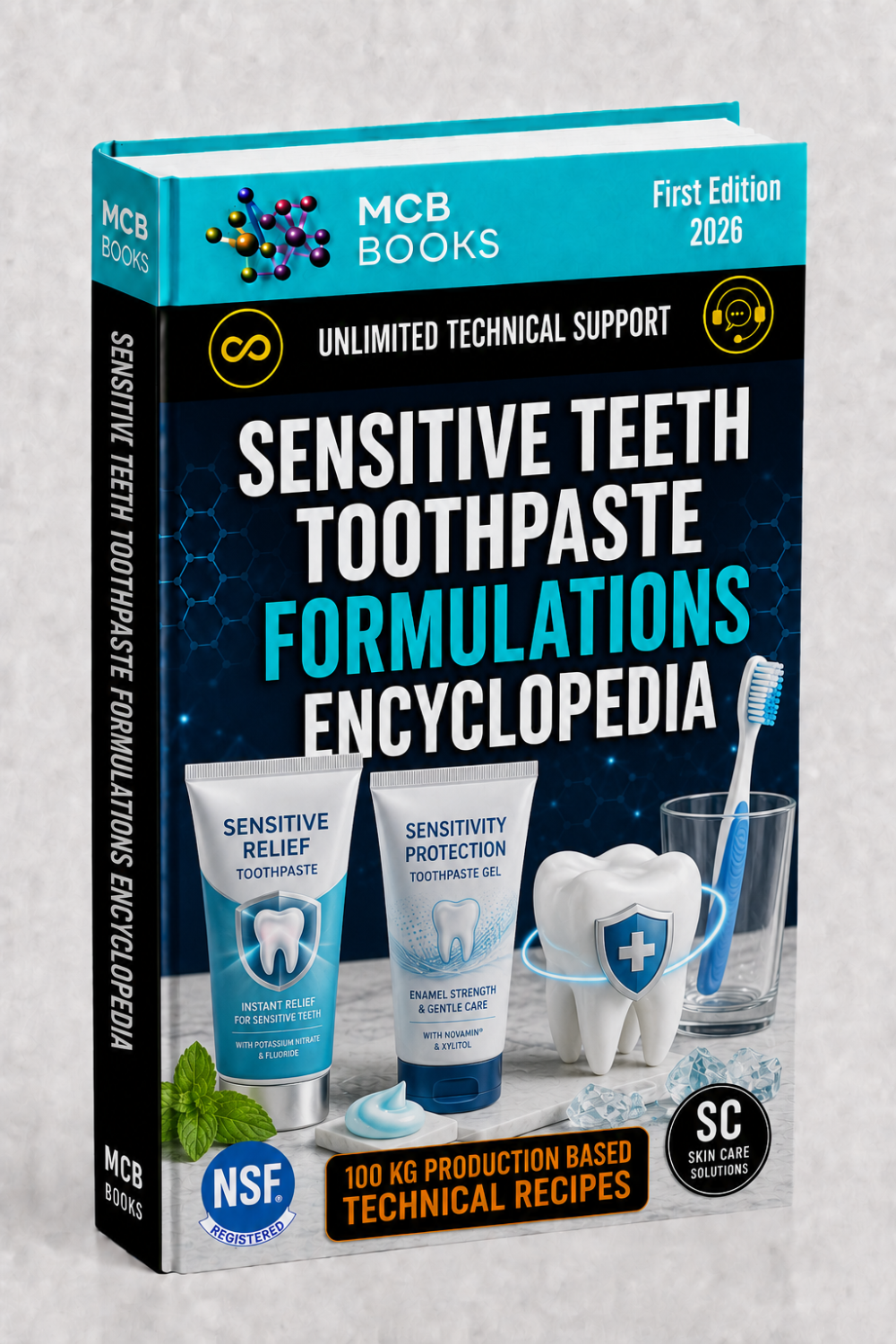
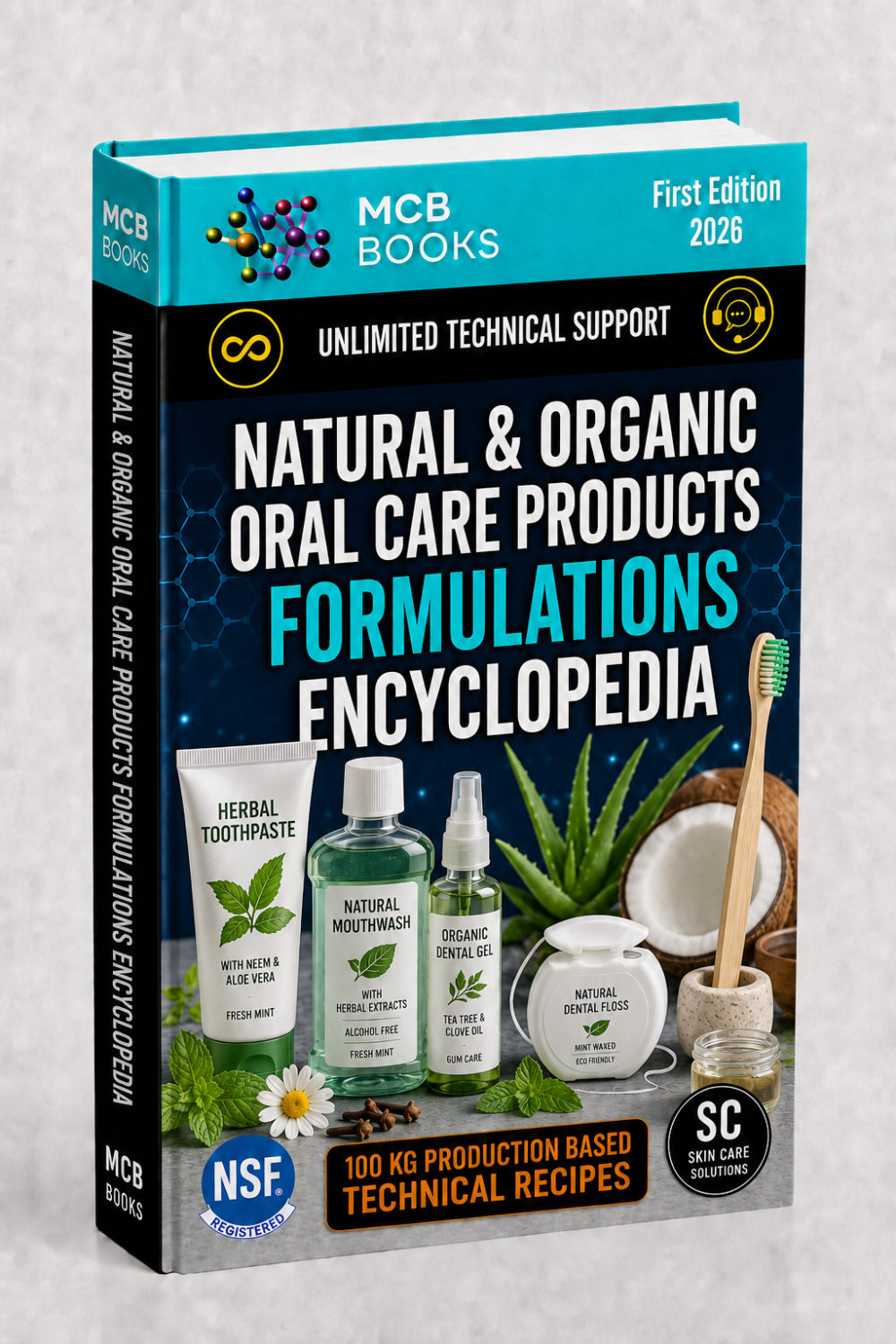
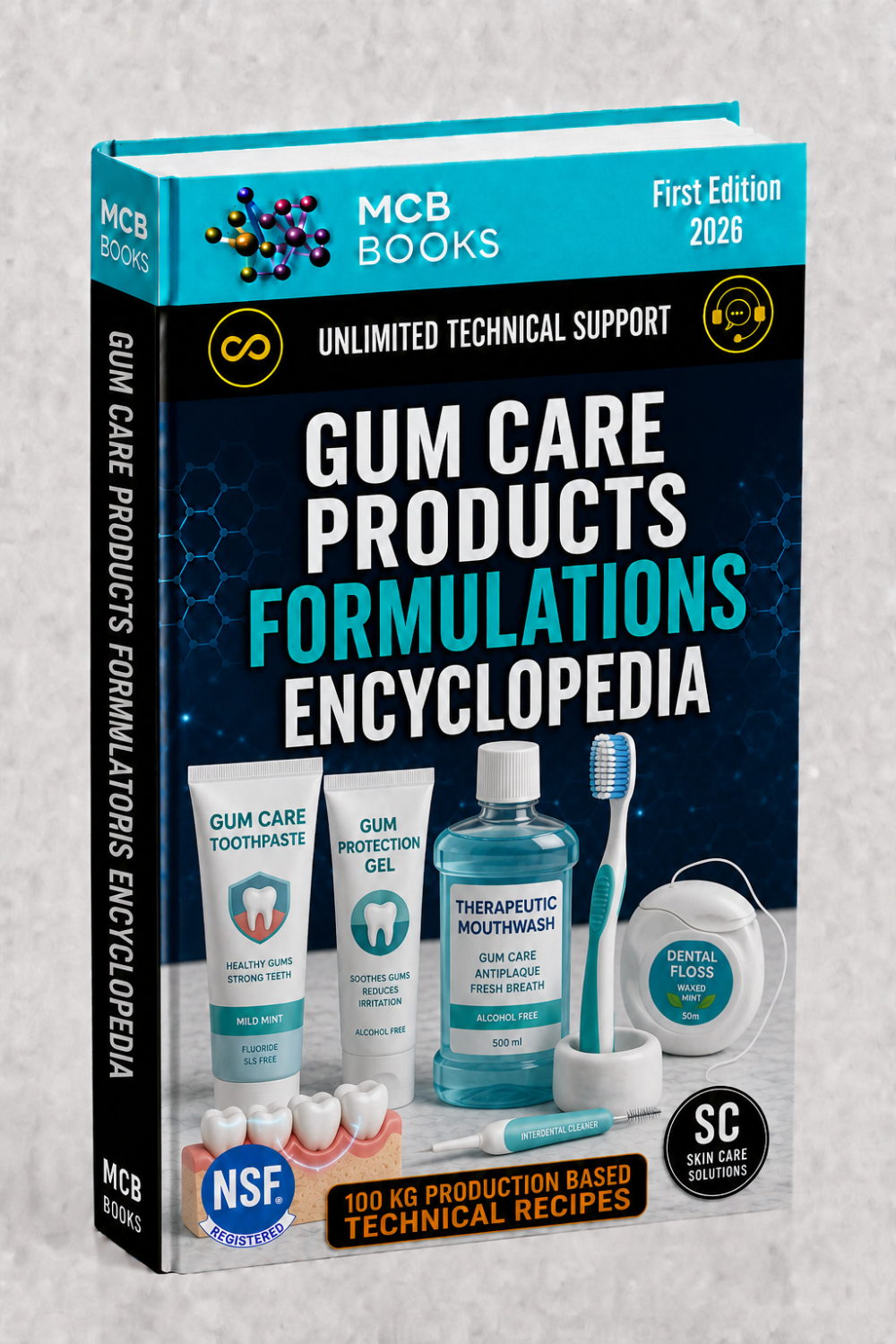
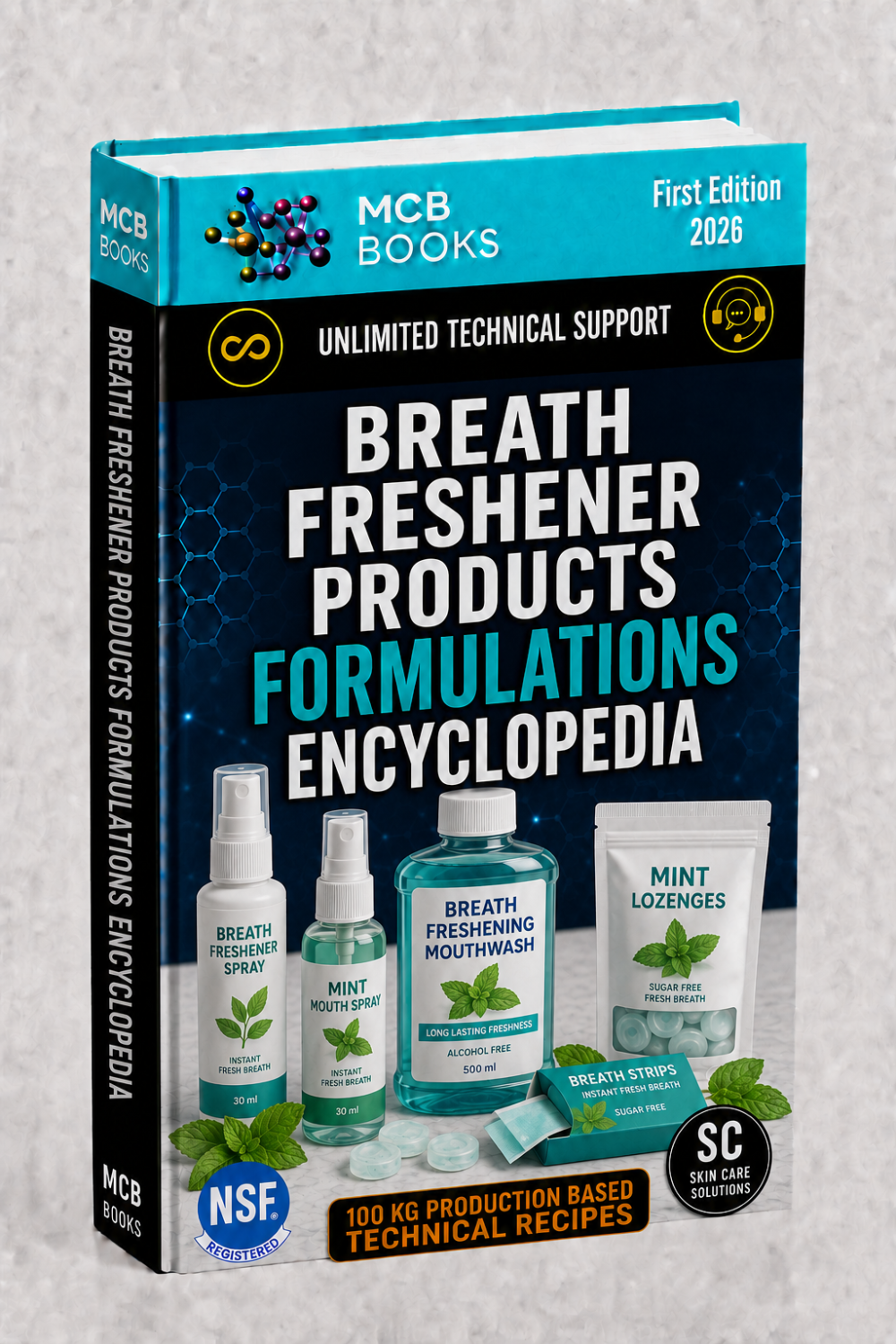
ORAL CARE PRODUCTS FORMULATIONS ENCYCLOPEDIA
Book details
- Editor
- MCB BOOKS
- ISBN
- 978-625-95879-1-2
- Number of Pages
- 350 Pages
- Publication Date
- 2026
- Copyright
- MCB BOOKS
- Format
- Hard Book & E book (PDF)
- Language
- English
About the Encyclopedia
If you're planning to manufacture oral care products, choosing the right formulas is only part of the job. You also need to understand the raw materials, production methods and technical requirements behind each product. A toothpaste, mouthwash and denture cleaning tablet may all belong to the oral care market, but making them involves very different processes.
The Oral Care Products Formulations Encyclopedia brings these products together in one technical reference. With 350 pages, 40 product groups and 120 oral care products formulations, the book covers a wide selection of products used in everyday oral hygiene, dental care and specialized oral care applications.
Inside, you'll find formulations for toothpaste, mouthwash, oral sprays, oral gels, denture cleaners, tooth cleaning powders and teeth whitening products. The collection also includes products developed around specific needs, such as sensitive teeth, enamel protection, dry mouth and children's oral care.
Each product group includes three formulations and industrial production processes, along with special specifications and technical properties. This allows manufacturers to study different approaches to the same product rather than relying on a single formula.
The encyclopedia is intended for oral care manufacturers, chemical engineers, formulation chemists, private-label producers and companies planning to introduce their own oral hygiene products.
Whether you're starting with a small toothpaste range or exploring a wider portfolio of dental care products, the book provides technical information to help you compare formulations, understand manufacturing procedures and plan your next products.
Table of contents
01Page 1 Contents 200 formulations · 1–320
- 1General Purpose Oral Care Product Formulation and Industrial Production Process 1
- 3General Purpose Oral Care Product Formulation and Industrial Production Process 2
- 5General Purpose Oral Care Product Formulation and Industrial Production Process 3
- 7General Purpose Oral Care Product Special Specification
- 8General Purpose Oral Care Product Technical Properties and Usage
- 9Toothpaste Formulation and Industrial Production Process 1
- 11Toothpaste Formulation and Industrial Production Process 2
- 13Toothpaste Formulation and Industrial Production Process 3
- 15Toothpaste Special Specification
- 16Toothpaste Technical Properties and Usage
- 17Herbal Toothpaste Formulation and Industrial Production Process 1
- 19Herbal Toothpaste Formulation and Industrial Production Process 2
- 21Herbal Toothpaste Formulation and Industrial Production Process 3
- 23Herbal Toothpaste Special Specification
- 24Herbal Toothpaste Technical Properties and Usage
- 25Whitening Toothpaste Formulation and Industrial Production Process 1
- 27Whitening Toothpaste Formulation and Industrial Production Process 2
- 29Whitening Toothpaste Formulation and Industrial Production Process 3
- 31Whitening Toothpaste Special Specification
- 32Whitening Toothpaste Technical Properties and Usage
- 33Sensitive Teeth Toothpaste Formulation and Industrial Production Process 1
- 35Sensitive Teeth Toothpaste Formulation and Industrial Production Process 2
- 37Sensitive Teeth Toothpaste Formulation and Industrial Production Process 3
- 39Sensitive Teeth Toothpaste Special Specification
- 40Sensitive Teeth Toothpaste Technical Properties and Usage
- 41Anti-Cavity Toothpaste Formulation and Industrial Production Process 1
- 43Anti-Cavity Toothpaste Formulation and Industrial Production Process 2
- 45Anti-Cavity Toothpaste Formulation and Industrial Production Process 3
- 47Anti-Cavity Toothpaste Special Specification
- 48Anti-Cavity Toothpaste Technical Properties and Usage
- 49Anti-Plaque Toothpaste Formulation and Industrial Production Process 1
- 51Anti-Plaque Toothpaste Formulation and Industrial Production Process 2
- 53Anti-Plaque Toothpaste Formulation and Industrial Production Process 3
- 55Anti-Plaque Toothpaste Special Specification
- 56Anti-Plaque Toothpaste Technical Properties and Usage
- 57Tartar Control Toothpaste Formulation and Industrial Production Process 1
- 59Tartar Control Toothpaste Formulation and Industrial Production Process 2
- 61Tartar Control Toothpaste Formulation and Industrial Production Process 3
- 63Tartar Control Toothpaste Special Specification
- 64Tartar Control Toothpaste Technical Properties and Usage
- 65Charcoal Toothpaste Formulation and Industrial Production Process 1
- 67Charcoal Toothpaste Formulation and Industrial Production Process 2
- 69Charcoal Toothpaste Formulation and Industrial Production Process 3
- 71Charcoal Toothpaste Special Specification
- 72Charcoal Toothpaste Technical Properties and Usage
- 73Fluoride Toothpaste Formulation and Industrial Production Process 1
- 75Fluoride Toothpaste Formulation and Industrial Production Process 2
- 77Fluoride Toothpaste Formulation and Industrial Production Process 3
- 79Fluoride Toothpaste Special Specification
- 80Fluoride Toothpaste Technical Properties and Usage
- 81Fluoride-Free Toothpaste Formulation and Industrial Production Process 1
- 83Fluoride-Free Toothpaste Formulation and Industrial Production Process 2
- 85Fluoride-Free Toothpaste Formulation and Industrial Production Process 3
- 87Fluoride-Free Toothpaste Special Specification
- 88Fluoride-Free Toothpaste Technical Properties and Usage
- 89Children's Toothpaste Formulation and Industrial Production Process 1
- 91Children's Toothpaste Formulation and Industrial Production Process 2
- 93Children's Toothpaste Formulation and Industrial Production Process 3
- 95Children's Toothpaste Special Specification
- 96Children's Toothpaste Technical Properties and Usage
- 97Natural Toothpaste Formulation and Industrial Production Process 1
- 99Natural Toothpaste Formulation and Industrial Production Process 2
- 101Natural Toothpaste Formulation and Industrial Production Process 3
- 103Natural Toothpaste Special Specification
- 104Natural Toothpaste Technical Properties and Usage
- 105Organic Toothpaste Formulation and Industrial Production Process 1
- 107Organic Toothpaste Formulation and Industrial Production Process 2
- 109Organic Toothpaste Formulation and Industrial Production Process 3
- 111Organic Toothpaste Special Specification
- 112Organic Toothpaste Technical Properties and Usage
- 113Mouthwash Formulation and Industrial Production Process 1
- 115Mouthwash Formulation and Industrial Production Process 2
- 117Mouthwash Formulation and Industrial Production Process 3
- 119Mouthwash Special Specification
- 120Mouthwash Technical Properties and Usage
- 121Alcohol-Free Mouthwash Formulation and Industrial Production Process 1
- 123Alcohol-Free Mouthwash Formulation and Industrial Production Process 2
- 125Alcohol-Free Mouthwash Formulation and Industrial Production Process 3
- 127Alcohol-Free Mouthwash Special Specification
- 128Alcohol-Free Mouthwash Technical Properties and Usage
- 129Herbal Mouthwash Formulation and Industrial Production Process 1
- 131Herbal Mouthwash Formulation and Industrial Production Process 2
- 133Herbal Mouthwash Formulation and Industrial Production Process 3
- 135Herbal Mouthwash Special Specification
- 136Herbal Mouthwash Technical Properties and Usage
- 137Antibacterial Mouthwash Formulation and Industrial Production Process 1
- 139Antibacterial Mouthwash Formulation and Industrial Production Process 2
- 141Antibacterial Mouthwash Formulation and Industrial Production Process 3
- 143Antibacterial Mouthwash Special Specification
- 144Antibacterial Mouthwash Technical Properties and Usage
- 145Breath Freshening Mouthwash Formulation and Industrial Production Process 1
- 147Breath Freshening Mouthwash Formulation and Industrial Production Process 2
- 149Breath Freshening Mouthwash Formulation and Industrial Production Process 3
- 151Breath Freshening Mouthwash Special Specification
- 152Breath Freshening Mouthwash Technical Properties and Usage
- 153Sensitive Mouthwash Formulation and Industrial Production Process 1
- 155Sensitive Mouthwash Formulation and Industrial Production Process 2
- 157Sensitive Mouthwash Formulation and Industrial Production Process 3
- 159Sensitive Mouthwash Special Specification
- 160Sensitive Mouthwash Technical Properties and Usage
- 161Oral Rinse Formulation and Industrial Production Process 1
- 163Oral Rinse Formulation and Industrial Production Process 2
- 165Oral Rinse Formulation and Industrial Production Process 3
- 167Oral Rinse Special Specification
- 168Oral Rinse Technical Properties and Usage
- 169Oral Spray Formulation and Industrial Production Process 1
- 171Oral Spray Formulation and Industrial Production Process 2
- 173Oral Spray Formulation and Industrial Production Process 3
- 175Oral Spray Special Specification
- 176Oral Spray Technical Properties and Usage
- 177Breath Freshening Spray Formulation and Industrial Production Process 1
- 179Breath Freshening Spray Formulation and Industrial Production Process 2
- 181Breath Freshening Spray Formulation and Industrial Production Process 3
- 183Breath Freshening Spray Special Specification
- 184Breath Freshening Spray Technical Properties and Usage
- 185Gum Care Gel Formulation and Industrial Production Process 1
- 187Gum Care Gel Formulation and Industrial Production Process 2
- 189Gum Care Gel Formulation and Industrial Production Process 3
- 191Gum Care Gel Special Specification
- 192Gum Care Gel Technical Properties and Usage
- 193Oral Care Gel Formulation and Industrial Production Process 1
- 195Oral Care Gel Formulation and Industrial Production Process 2
- 197Oral Care Gel Formulation and Industrial Production Process 3
- 199Oral Care Gel Special Specification
- 200Oral Care Gel Technical Properties and Usage
- 201Denture Cleanser Formulation and Industrial Production Process 1
- 203Denture Cleanser Formulation and Industrial Production Process 2
- 205Denture Cleanser Formulation and Industrial Production Process 3
- 207Denture Cleanser Special Specification
- 208Denture Cleanser Technical Properties and Usage
- 209Denture Cleaning Tablet Formulation and Industrial Production Process 1
- 211Denture Cleaning Tablet Formulation and Industrial Production Process 2
- 213Denture Cleaning Tablet Formulation and Industrial Production Process 3
- 215Denture Cleaning Tablet Special Specification
- 216Denture Cleaning Tablet Technical Properties and Usage
- 217Tooth Cleaning Powder Formulation and Industrial Production Process 1
- 219Tooth Cleaning Powder Formulation and Industrial Production Process 2
- 221Tooth Cleaning Powder Formulation and Industrial Production Process 3
- 223Tooth Cleaning Powder Special Specification
- 224Tooth Cleaning Powder Technical Properties and Usage
- 225Teeth Whitening Gel Formulation and Industrial Production Process 1
- 227Teeth Whitening Gel Formulation and Industrial Production Process 2
- 229Teeth Whitening Gel Formulation and Industrial Production Process 3
- 231Teeth Whitening Gel Special Specification
- 232Teeth Whitening Gel Technical Properties and Usage
- 233Teeth Whitening Pen Formulation and Industrial Production Process 1
- 235Teeth Whitening Pen Formulation and Industrial Production Process 2
- 237Teeth Whitening Pen Formulation and Industrial Production Process 3
- 239Teeth Whitening Pen Special Specification
- 240Teeth Whitening Pen Technical Properties and Usage
- 241Enamel Protection Oral Care Formulation and Industrial Production Process 1
- 243Enamel Protection Oral Care Formulation and Industrial Production Process 2
- 245Enamel Protection Oral Care Formulation and Industrial Production Process 3
- 247Enamel Protection Oral Care Special Specification
- 248Enamel Protection Oral Care Technical Properties and Usage
- 249Dry Mouth Relief Oral Care Formulation and Industrial Production Process 1
- 251Dry Mouth Relief Oral Care Formulation and Industrial Production Process 2
- 253Dry Mouth Relief Oral Care Formulation and Industrial Production Process 3
- 255Dry Mouth Relief Oral Care Special Specification
- 256Dry Mouth Relief Oral Care Technical Properties and Usage
- 257Pediatric Oral Care Formulation and Industrial Production Process 1
- 259Pediatric Oral Care Formulation and Industrial Production Process 2
- 261Pediatric Oral Care Formulation and Industrial Production Process 3
- 263Pediatric Oral Care Special Specification
- 264Pediatric Oral Care Technical Properties and Usage
- 265Professional Oral Care Formulation and Industrial Production Process 1
- 267Professional Oral Care Formulation and Industrial Production Process 2
- 269Professional Oral Care Formulation and Industrial Production Process 3
- 271Professional Oral Care Special Specification
- 272Professional Oral Care Technical Properties and Usage
- 273Premium Oral Care Formulation and Industrial Production Process 1
- 275Premium Oral Care Formulation and Industrial Production Process 2
- 277Premium Oral Care Formulation and Industrial Production Process 3
- 279Premium Oral Care Special Specification
- 280Premium Oral Care Technical Properties and Usage
- 281OEM Oral Care Product Formulation and Industrial Production Process 1
- 283OEM Oral Care Product Formulation and Industrial Production Process 2
- 285OEM Oral Care Product Formulation and Industrial Production Process 3
- 287OEM Oral Care Product Special Specification
- 288OEM Oral Care Product Technical Properties and Usage
- 289Natural Oral Care Product Formulation and Industrial Production Process 1
- 291Natural Oral Care Product Formulation and Industrial Production Process 2
- 293Natural Oral Care Product Formulation and Industrial Production Process 3
- 295Natural Oral Care Product Special Specification
- 296Natural Oral Care Product Technical Properties and Usage
- 297Eco-Friendly Oral Care Product Formulation and Industrial Production Process 1
- 299Eco-Friendly Oral Care Product Formulation and Industrial Production Process 2
- 301Eco-Friendly Oral Care Product Formulation and Industrial Production Process 3
- 303Eco-Friendly Oral Care Product Special Specification
- 304Eco-Friendly Oral Care Product Technical Properties and Usage
- 305Sustainable Oral Care Product Formulation and Industrial Production Process 1
- 307Sustainable Oral Care Product Formulation and Industrial Production Process 2
- 309Sustainable Oral Care Product Formulation and Industrial Production Process 3
- 311Sustainable Oral Care Product Special Specification
- 312Sustainable Oral Care Product Technical Properties and Usage
- 313Advanced Oral Care Technology Formulation and Industrial Production Process 1
- 315Advanced Oral Care Technology Formulation and Industrial Production Process 2
- 317Advanced Oral Care Technology Formulation and Industrial Production Process 3
- 319Advanced Oral Care Technology Special Specification
- 320Advanced Oral Care Technology Technical Properties and Usage
More about this book
What's Inside the Encyclopedia
The Oral Care Products Formulations Encyclopedia contains 40 product groups, 120 formulations and 200 technical content entries. Each product is presented with three formulation and production approaches, followed by its special specifications and technical properties.
The toothpaste section covers general toothpaste, herbal toothpaste, whitening toothpaste, sensitive teeth toothpaste, anti-cavity products, anti-plaque toothpaste, tartar control toothpaste, charcoal toothpaste, fluoride toothpaste and fluoride-free alternatives. It also includes children's toothpaste, natural toothpaste and organic toothpaste formulations.
For liquid oral care manufacturing, the encyclopedia includes mouthwash, alcohol-free mouthwash, herbal mouthwash, antibacterial mouthwash, breath freshening mouthwash, sensitive mouthwash and oral rinses. Manufacturers can also explore oral sprays and breath freshening sprays, along with gum care gels and general oral care gels.
The collection extends beyond conventional toothpaste and mouthwash. It includes denture cleansers, denture cleaning tablets, tooth cleaning powders, teeth whitening gels and teeth whitening pens. These products involve different raw materials, formulation systems and manufacturing methods.
Other sections cover enamel protection, dry mouth oral care, pediatric oral care and specialized professional products. There are also formulations developed for premium oral care, OEM manufacturing, natural oral care, eco-friendly products and sustainable oral care concepts.
The final section explores advanced oral care technology, giving manufacturers another area to investigate when expanding their product range.
This variety is what makes the encyclopedia useful. Instead of concentrating on a single oral care product, manufacturers can examine several different product types and decide which ones suit their production capabilities and customers.
Why This Encyclopedia
A manufacturer producing toothpaste may already have experience with mixing, viscosity control and packaging. Moving into mouthwash introduces different questions about ingredient solubility, liquid stability and flavor systems. Denture cleaning tablets and whitening gels require another set of considerations.
Having access to several product categories in one reference can make that development process easier to organize.
The Oral Care Products Formulations Encyclopedia provides 120 formulation approaches covering 40 product groups, allowing manufacturers to compare products with different ingredients, manufacturing procedures and technical requirements.
For a company planning to expand its oral care business, the book offers an opportunity to explore more than one product line. A manufacturer may begin with toothpaste, examine mouthwash production and later consider oral sprays, denture cleaners or other dental care products.
The book is also useful for private-label manufacturers working with customers who request different oral hygiene products. It provides technical starting points for comparing formulation systems and understanding the requirements of each product.
Rather than focusing exclusively on one specialized area, this encyclopedia offers a broader view of oral care products manufacturing.
About Formulations
Oral Care Products Formulations, Oral Care Products Manufacturing, Oral Hygiene Product Formulations, Toothpaste Production, Mouthwash Manufacturing, Oral Rinse Formulations, Oral Care Gel Manufacturing, Oral Spray Production, Denture Cleanser Formulations, Denture Cleaning Tablet Manufacturing, Tooth Cleaning Powder, Teeth Whitening Gel Production, Teeth Whitening Pen Formulations, Enamel Protection Oral Care, Dry Mouth Oral Care Products, Fluoride and Fluoride-Free Oral Care, Dental Hygiene Product Manufacturing, Professional Oral Care Products, OEM Oral Care Production, Oral Care Raw Materials
Manufacturing Methods
Each formulation is presented in a clear and practical structure showing the raw materials, CAS numbers, functions of each ingredient, and exact quantities required for production.
All formulations are calculated on a 100 kg production basis, making them easy to understand, compare, scale, and adapt for laboratory or industrial R&D work.
The book uses straightforward technical language so that readers can follow the formulations without needing advanced engineering knowledge.
The Production Process section explains the manufacturing sequence step by step, including charging order, mixing, dissolution, dispersion, temperature control, viscosity adjustment, filtration, and final filling.
Special attention is given to what happens at each production stage, helping the reader understand not only what to add, but when, how, and why it is added.
The formulations are presented as practical starting formulations for laboratory, in-house, R&D, product-development, and commercial production studies, with final validation and regulatory testing required before market use.
In this way, the encyclopedia guides the reader through the complete manufacturing workflow in a form that can be followed by formulators, technicians, production staff, entrepreneurs, and manufacturers alike.
Troubleshooting
The encyclopedia helps readers understand and identify common problems that may occur during production and application.
Issues such as incorrect viscosity, poor adhesion, slow or incomplete curing, premature thickening, air bubbles, poor dispersion, and moisture-related instability can be evaluated through the formulation and production guidance.
The production processes explain critical factors such as mixing order, temperature, moisture control, dispersion, degassing, viscosity adjustment, filtration, and packaging conditions that can directly influence the final product.
Readers can also understand how substrate preparation, mixing accuracy, bond-line thickness, curing conditions, and application environment affect adhesive performance.
By comparing the expected product properties with actual production results, users can more easily determine where a problem may have originated in the manufacturing process.
This practical approach helps reduce unnecessary trial and error and provides a clearer direction for corrective formulation adjustments and process optimization.
Troubleshooting therefore becomes part of the overall formulation-development process rather than a separate, complicated engineering task.
Unlimited Technical Support
Purchasing the Oral Care Products Formulations Encyclopedia also gives you access to our technical team for questions related to the formulations and production methods covered in the book.
If you need assistance understanding a raw material, comparing ingredient alternatives or reviewing a manufacturing procedure, you can contact our team directly.
Whether you're developing toothpaste, mouthwash, oral gels, denture cleaning tablets or another product included in the encyclopedia, we're available to discuss your technical questions.
The encyclopedia is available in PDF e-book and hard book formats.
For product information, sample pages or technical assistance, contact us through WhatsApp.
Featured Articles
1. ORAL CARE PRODUCTS FORMULATIONS: HOW TO DEVELOP AND MANUFACTURE DIFFERENT PRODUCTS
The oral care market includes far more than toothpaste and mouthwash. Denture cleaning products, oral gels, tooth cleaning powders and teeth whitening products all belong to this industry, but each requires its own formulation and manufacturing approach.
For manufacturers, working across these different categories can open the door to a wider product range. A company that already makes toothpaste may want to introduce mouthwash, while a private-label producer may need to develop several oral hygiene products for different customers.
The first step in developing oral care products formulations is deciding which type of product to manufacture. This determines the ingredients, processing methods, equipment and packaging that will be needed.
Toothpaste typically contains a combination of humectants, abrasives, binders, cleansing agents and flavoring ingredients. The proportions and ingredient choices influence texture, cleaning characteristics and stability.
Mouthwash uses a different system. Most formulations are liquid, so ingredient solubility, flavor balance and clarity become important considerations.
Oral gels require suitable thickening agents, while denture cleaning tablets need raw materials and processing conditions appropriate for a solid product.
Selecting the right raw materials is only the beginning. Manufacturers must also understand how ingredients behave during mixing, filling and storage.
Quality control is important throughout development. Depending on the product, this may include checking viscosity, pH, physical stability, microbial quality, active ingredient concentration and packaging compatibility.
A formulation developed successfully in the laboratory should also be evaluated under the intended production conditions before commercial manufacturing.
The Oral Care Products Formulations Encyclopedia brings together 120 formulations covering 40 product groups, with industrial production methods, specifications and technical properties.
For businesses entering the oral care market, this range provides several starting points for product development. Established manufacturers can also use the encyclopedia to explore additional product categories without limiting their research to the formulas they already produce.
TAGS: oral care products formulations, oral hygiene products manufacturing, dental care product development, oral care manufacturing methods
2. TOOTHPASTE AND MOUTHWASH MANUFACTURING: TWO IMPORTANT ORAL CARE PRODUCT CATEGORIES
Toothpaste and mouthwash are two familiar products in the oral care industry. They are often sold together, yet their formulation and manufacturing requirements are quite different.
Understanding those differences is important for companies planning to produce a complete oral hygiene range.
Toothpaste is generally developed as a paste or gel. Its ingredients may include humectants, abrasive materials, binders, surfactants, flavoring agents and selected functional components.
During production, the liquid ingredients are prepared and mixed with thickeners and other materials. Abrasive powders are incorporated under conditions that help maintain a smooth texture and consistent product quality.
The finished toothpaste should be easy to dispense, have a suitable consistency and remain stable during storage.
Mouthwash manufacturing involves a liquid system. Ingredients are selected according to their solubility and compatibility, while flavoring materials may require solubilizers to remain evenly distributed.
A clear mouthwash needs more than transparent ingredients. Flavor oils, preservatives and other components can interact with the formulation and affect its appearance over time.
Both product categories require careful flavor development. Peppermint, spearmint and other suitable oral-use flavors can create different sensory experiences, and their concentrations influence consumer acceptance.
Manufacturers may also develop fluoride-containing or fluoride-free products. These represent different formulation choices, and claims involving cavity prevention must reflect the finished product's demonstrated properties and applicable regulations.
When toothpaste and mouthwash are produced under the same brand, packaging and product positioning should be considered alongside technical development.
The Oral Care Products Formulations Encyclopedia includes general, herbal, whitening, fluoride and fluoride-free toothpaste, along with several types of mouthwash and oral rinse.
Rather than concentrating entirely on one product, the encyclopedia allows manufacturers to compare these two important categories and study their different production methods.
For a company developing a coordinated oral care collection, that broader perspective can help with selecting products and planning manufacturing operations.
TAGS: toothpaste and mouthwash manufacturing, oral care production methods, toothpaste and oral rinse formulations, commercial oral hygiene manufacturing
3. DENTURE CLEANSER AND DENTURE CLEANING TABLET FORMULATIONS FOR MANUFACTURERS
Denture cleaning products are an interesting part of the oral care market because they are different from products intended for direct use on natural teeth. Their job is to clean removable dental appliances, and the formulation must be suited to the materials and intended cleaning procedure.
Manufacturers can develop denture cleansers in different formats, including liquid systems and cleaning tablets. Each format has distinct production and packaging requirements.
Denture cleanser formulations may use cleaning agents, compatible surfactants and other ingredients selected for their intended function. The finished product must be evaluated for its effect on the denture materials with which it will come into contact.
Denture cleaning tablets introduce additional technical considerations. Some formulations use effervescent systems that release gas when the tablet is added to water.
These products require careful control of moisture during manufacturing. If reactive ingredients are exposed to moisture too early, the tablets may lose stability before they are used.
Powder blending, tablet characteristics and protective packaging are therefore important parts of product development.
Manufacturers must also consider how quickly the tablet dissolves, whether the cleaning solution remains suitable during its intended use and whether it can be rinsed away appropriately.
Certain cleaning ingredients may be unsuitable for particular dental appliance materials. Product compatibility should be assessed using relevant testing rather than assuming that a formulation will work with every type of denture.
Liquid denture cleansers require different manufacturing procedures, including suitable ingredient dissolution and controls for stability.
Finished products should be evaluated for cleaning performance, chemical stability, packaging compatibility and appropriate use instructions.
The Oral Care Products Formulations Encyclopedia includes denture cleanser and denture cleaning tablet formulations, along with their industrial production methods and technical properties.
These sections give oral care manufacturers an opportunity to investigate another product category beyond toothpaste and mouthwash.
For businesses supplying dental care products or private-label customers, denture cleaners may be worth considering as part of a wider oral hygiene portfolio.
TAGS: denture cleanser formulations, denture cleaning tablets manufacturing, dental appliance cleaning products, denture cleaning raw materials
4. TEETH WHITENING GELS, ORAL SPRAYS AND SPECIALIZED ORAL CARE FORMULATIONS
Oral care manufacturers often begin with familiar products such as toothpaste, but the industry also includes more specialized formats. Teeth whitening gels, whitening pens, oral sprays and products developed for dry mouth are examples of categories with different formulation requirements.
These products can be attractive to businesses looking to expand their range, although each one needs its own technical evaluation.
Teeth whitening gel formulations require careful consideration of the intended whitening mechanism, ingredient compatibility and finished-product stability.
Some whitening systems contain active ingredients subject to concentration limits, specific product classifications or professional-use restrictions in certain markets. Manufacturers need to establish the intended market requirements before selecting the formulation.
Whitening pens present another development challenge. The product must work with its applicator, maintain the required consistency and provide suitable delivery during use.
Packaging compatibility is particularly important because the applicator and container can influence how the product behaves throughout storage.
Oral sprays are a different type of product. Their manufacturing process generally involves preparing a suitable liquid base, incorporating compatible ingredients and choosing a dispensing system appropriate for oral application.
Flavor and mouthfeel often play an important role in spray development. Manufacturers should also evaluate whether the formulation remains uniform and whether the pump delivers a consistent amount.
Dry mouth oral care products require their own approach to ingredient selection and product design. Their intended function and claims should be carefully considered, particularly when the product is positioned for relief of a health-related condition.
Oral care gels may use suitable thickeners and humectants to achieve the intended texture. The formulation must remain stable and compatible with its packaging.
The Oral Care Products Formulations Encyclopedia includes whitening gels, whitening pens, oral sprays, oral care gels and dry mouth product concepts.
By covering these formats alongside standard toothpaste and mouthwash, the encyclopedia provides manufacturers with a broader selection of products to investigate.
For companies interested in developing specialized oral care products, it offers technical starting points for studying different formulation systems and the production considerations associated with each format.
TAGS: teeth whitening gel manufacturing, oral spray formulations, whitening pen production, specialized oral care products
5. STARTING AN ORAL CARE PRODUCTS MANUFACTURING BUSINESS: FORMULATIONS AND PRODUCT RANGE
Starting an oral care manufacturing business involves choosing products that match your technical capabilities, equipment and intended customers. Toothpaste and mouthwash are common starting points, but there are many other products a manufacturer can explore as the business develops.
A company may begin by producing a general toothpaste and later introduce fluoride toothpaste, oral rinse or denture cleaning products. Another business may specialize in private-label manufacturing, developing different products for brands with specific requirements.
Oral care products formulations provide the foundation for these decisions. Before selecting production equipment or packaging, manufacturers need to understand the ingredients and processes associated with each product.
Toothpaste manufacturing often requires equipment capable of dispersing powders and producing a uniform paste. Mouthwash generally involves liquid mixing and filling systems. Denture cleaning tablets may need blending, tablet production and moisture-protective packaging.
These differences influence production planning, raw material purchasing and quality control.
A wider product range does not necessarily mean every product should be manufactured on the same production line. Equipment suitability, cleaning procedures and cross-contamination controls need to be evaluated for each manufacturing operation.
Private-label manufacturers should also consider how product variations affect production. A change in flavor, active ingredient or packaging may require additional testing rather than a simple substitution.
Quality control procedures should cover incoming raw materials, in-process manufacturing and finished products. Stability studies, relevant performance evaluation and suitable regulatory review are important before commercial release.
The intended market matters as well. Products making therapeutic claims or using regulated oral care actives may face additional requirements.
The Oral Care Products Formulations Encyclopedia contains 120 formulations across 40 different product groups, including toothpaste, mouthwash, oral sprays, gels, denture cleaners and whitening products.
This variety makes the book useful for manufacturers comparing different product opportunities before investing in equipment or expanding production.
For businesses developing an oral care brand, the encyclopedia provides a broad technical reference that can support formulation research, manufacturing decisions and product range planning.
TAGS: oral care manufacturing business, private label oral care production, OEM dental care products, oral hygiene product range development
Some Raw Materials Used
Purified Water, Deionized Water, Glycerin, Sorbitol, Xylitol, Hydrated Silica, Precipitated Silica, Calcium Carbonate, Sodium Bicarbonate, Sodium Fluoride, Sodium Monofluorophosphate, Sodium Saccharin, Sucralose, Cellulose Gum, Xanthan Gum, Carrageenan, Hydroxyethyl Cellulose, Sodium Lauroyl Sarcosinate, Cocamidopropyl Betaine, Sodium Citrate, Citric Acid, Sodium Benzoate, Potassium Sorbate, Polysorbate 20, PEG-40 Hydrogenated Castor Oil, Peppermint Flavor, Spearmint Flavor, Menthol, Zinc Citrate, Zinc Gluconate, Calcium Glycerophosphate, Aloe Vera Extract, Chamomile Extract, Suitable Denture Cleaning Agents, Tablet Binders, Effervescent Ingredients, Compatible Whitening Agents, Humectants, Flavor Solubilizers, Gelling Agents, Oral Care Preservative Systems, pH Adjusting Agents.
These are representative raw materials used across oral care manufacturing technologies. They are not a verified list of every ingredient in the encyclopedia. Ingredient suitability depends on the intended product and applicable requirements.
Why Choose This Encyclopedia
If you're looking to manufacture more than one type of oral care product, the Oral Care Products Formulations Encyclopedia is a useful place to begin.
The book contains 120 oral care products formulations covering 40 product groups, together with industrial production processes, special specifications and technical properties.
Its 350 pages cover a broad range of products, including toothpaste, mouthwash, oral sprays, oral gels, denture cleaners, cleaning tablets, tooth powders, teeth whitening products and specialized oral care formulations.
This variety allows manufacturers to explore different product categories without limiting their research to a single type of toothpaste or oral rinse.
The encyclopedia is particularly suitable for oral care manufacturers, chemical engineers, formulation specialists, private-label producers and businesses planning to develop their own oral hygiene brand.
For an established manufacturer, it can help identify new product categories worth exploring. For a business entering the market, it provides technical information that can support ingredient research, laboratory development and manufacturing planning.
Unlike books devoted to a specific oral care application, this encyclopedia brings together several product categories in one collection.
Available in PDF e-book and hard book formats, it can be used as a reference during formulation development and production planning.
For purchasing information, sample pages or questions about the formulations, contact the MCB BOOKS technical team through WhatsApp.
Related books