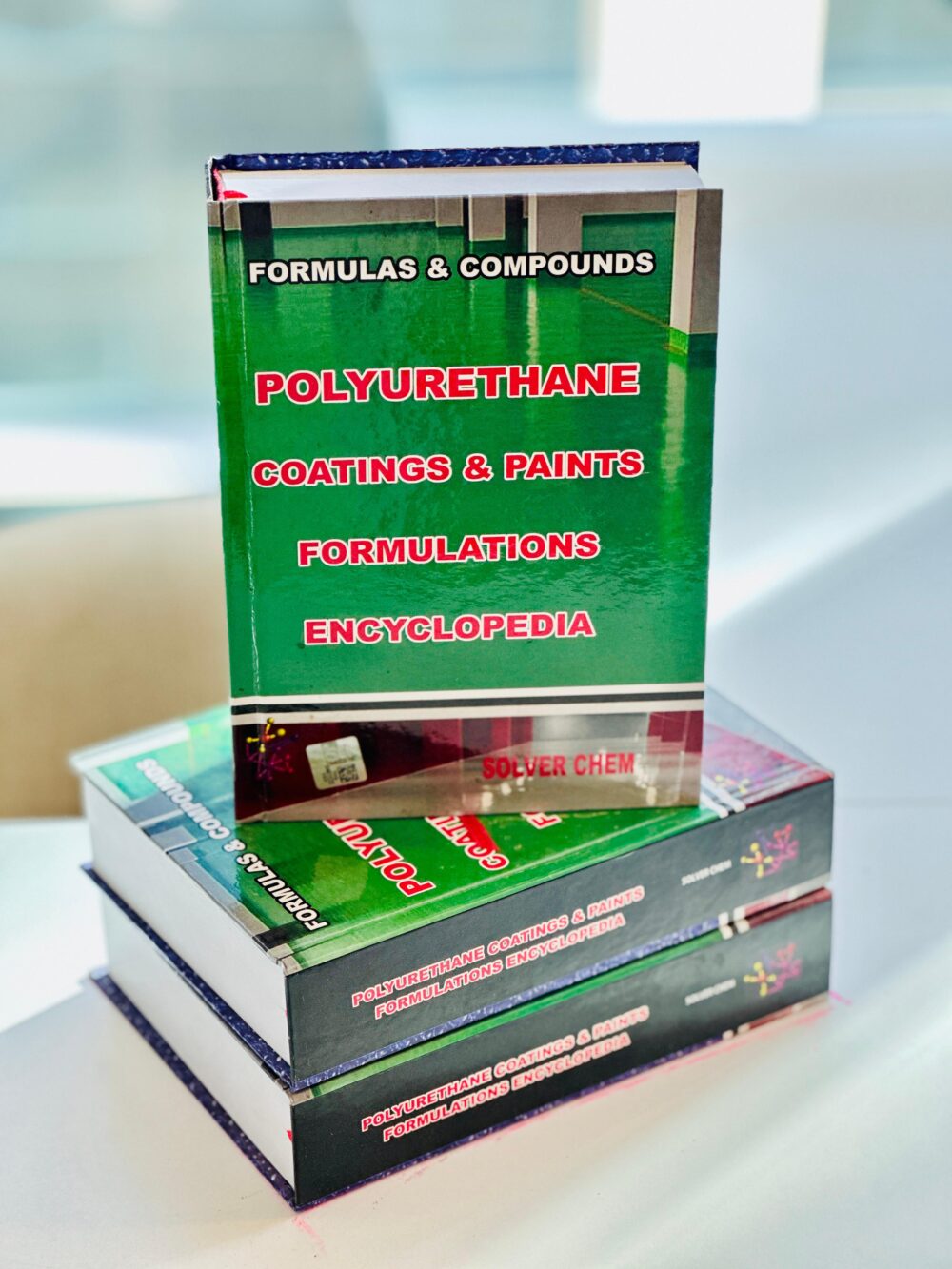
WATER-BASED POLYURETHANE FORMULATIONS ENCYCLOPEDIA
Book details
- Editor
- MCB BOOKS
- ISBN
- 978-605-88350-7-2
- Number of Pages
- 360 Pages
- Publication Date
- 2026
- Copyright
- MCB BOOKS
- Format
- Hard Book & E book (PDF)
- Language
- English
About the Encyclopedia
The WATER-BASED POLYURETHANE FORMULATIONS ENCYCLOPEDIA is a 360-page technical reference covering water-based polyurethane formulations and industrial manufacturing processes. Published by MCB BOOKS, it includes polyurethane dispersions, self-crosslinking, low-VOC, high-solids, and high-performance coating technologies. Applications cover wood, furniture, flooring, metal, concrete, textiles, leather, and industrial protective coatings. The encyclopedia provides formulation examples, production procedures, technical specifications, and product characteristics for chemical manufacturers, formulation chemists, and coating specialists.
Table of contents
01Page 1 Contents 210 formulations · 1–336
- 1General Purpose Water-Based Polyurethane Formulation and Industrial Production Process 1
- 3General Purpose Water-Based Polyurethane Formulation and Industrial Production Process 2
- 5General Purpose Water-Based Polyurethane Formulation and Industrial Production Process 3
- 7General Purpose Water-Based Polyurethane Special Specification
- 8General Purpose Water-Based Polyurethane Technical Properties and Usage
- 9High Solids Water-Based Polyurethane Formulation and Industrial Production Process 1
- 11High Solids Water-Based Polyurethane Formulation and Industrial Production Process 2
- 13High Solids Water-Based Polyurethane Formulation and Industrial Production Process 3
- 15High Solids Water-Based Polyurethane Special Specification
- 16High Solids Water-Based Polyurethane Technical Properties and Usage
- 17Low VOC Water-Based Polyurethane Formulation and Industrial Production Process 1
- 19Low VOC Water-Based Polyurethane Formulation and Industrial Production Process 2
- 21Low VOC Water-Based Polyurethane Formulation and Industrial Production Process 3
- 23Low VOC Water-Based Polyurethane Special Specification
- 24Low VOC Water-Based Polyurethane Technical Properties and Usage
- 25Ultra Low VOC Water-Based Polyurethane Formulation and Industrial Production Process 1
- 27Ultra Low VOC Water-Based Polyurethane Formulation and Industrial Production Process 2
- 29Ultra Low VOC Water-Based Polyurethane Formulation and Industrial Production Process 3
- 31Ultra Low VOC Water-Based Polyurethane Special Specification
- 32Ultra Low VOC Water-Based Polyurethane Technical Properties and Usage
- 33Self-Crosslinking Water-Based Polyurethane Formulation and Industrial Production Process 1
- 35Self-Crosslinking Water-Based Polyurethane Formulation and Industrial Production Process 2
- 37Self-Crosslinking Water-Based Polyurethane Formulation and Industrial Production Process 3
- 39Self-Crosslinking Water-Based Polyurethane Special Specification
- 40Self-Crosslinking Water-Based Polyurethane Technical Properties and Usage
- 41Fast Drying Water-Based Polyurethane Formulation and Industrial Production Process 1
- 43Fast Drying Water-Based Polyurethane Formulation and Industrial Production Process 2
- 45Fast Drying Water-Based Polyurethane Formulation and Industrial Production Process 3
- 47Fast Drying Water-Based Polyurethane Special Specification
- 48Fast Drying Water-Based Polyurethane Technical Properties and Usage
- 49High Gloss Water-Based Polyurethane Formulation and Industrial Production Process 1
- 51High Gloss Water-Based Polyurethane Formulation and Industrial Production Process 2
- 53High Gloss Water-Based Polyurethane Formulation and Industrial Production Process 3
- 55High Gloss Water-Based Polyurethane Special Specification
- 56High Gloss Water-Based Polyurethane Technical Properties and Usage
- 57Matte Water-Based Polyurethane Formulation and Industrial Production Process 1
- 59Matte Water-Based Polyurethane Formulation and Industrial Production Process 2
- 61Matte Water-Based Polyurethane Formulation and Industrial Production Process 3
- 63Matte Water-Based Polyurethane Special Specification
- 64Matte Water-Based Polyurethane Technical Properties and Usage
- 65Satin Finish Water-Based Polyurethane Formulation and Industrial Production Process 1
- 67Satin Finish Water-Based Polyurethane Formulation and Industrial Production Process 2
- 69Satin Finish Water-Based Polyurethane Formulation and Industrial Production Process 3
- 71Satin Finish Water-Based Polyurethane Special Specification
- 72Satin Finish Water-Based Polyurethane Technical Properties and Usage
- 73Clear Water-Based Polyurethane Formulation and Industrial Production Process 1
- 75Clear Water-Based Polyurethane Formulation and Industrial Production Process 2
- 77Clear Water-Based Polyurethane Formulation and Industrial Production Process 3
- 79Clear Water-Based Polyurethane Special Specification
- 80Clear Water-Based Polyurethane Technical Properties and Usage
- 81Pigmented Water-Based Polyurethane Formulation and Industrial Production Process 1
- 83Pigmented Water-Based Polyurethane Formulation and Industrial Production Process 2
- 85Pigmented Water-Based Polyurethane Formulation and Industrial Production Process 3
- 87Pigmented Water-Based Polyurethane Special Specification
- 88Pigmented Water-Based Polyurethane Technical Properties and Usage
- 89UV Resistant Water-Based Polyurethane Formulation and Industrial Production Process 1
- 91UV Resistant Water-Based Polyurethane Formulation and Industrial Production Process 2
- 93UV Resistant Water-Based Polyurethane Formulation and Industrial Production Process 3
- 95UV Resistant Water-Based Polyurethane Special Specification
- 96UV Resistant Water-Based Polyurethane Technical Properties and Usage
- 97Weather Resistant Water-Based Polyurethane Formulation and Industrial Production Process 1
- 99Weather Resistant Water-Based Polyurethane Formulation and Industrial Production Process 2
- 101Weather Resistant Water-Based Polyurethane Formulation and Industrial Production Process 3
- 103Weather Resistant Water-Based Polyurethane Special Specification
- 104Weather Resistant Water-Based Polyurethane Technical Properties and Usage
- 105Chemical Resistant Water-Based Polyurethane Formulation and Industrial Production Process 1
- 107Chemical Resistant Water-Based Polyurethane Formulation and Industrial Production Process 2
- 109Chemical Resistant Water-Based Polyurethane Formulation and Industrial Production Process 3
- 111Chemical Resistant Water-Based Polyurethane Special Specification
- 112Chemical Resistant Water-Based Polyurethane Technical Properties and Usage
- 113Abrasion Resistant Water-Based Polyurethane Formulation and Industrial Production Process 1
- 115Abrasion Resistant Water-Based Polyurethane Formulation and Industrial Production Process 2
- 117Abrasion Resistant Water-Based Polyurethane Formulation and Industrial Production Process 3
- 119Abrasion Resistant Water-Based Polyurethane Special Specification
- 120Abrasion Resistant Water-Based Polyurethane Technical Properties and Usage
- 121Scratch Resistant Water-Based Polyurethane Formulation and Industrial Production Process 1
- 123Scratch Resistant Water-Based Polyurethane Formulation and Industrial Production Process 2
- 125Scratch Resistant Water-Based Polyurethane Formulation and Industrial Production Process 3
- 127Scratch Resistant Water-Based Polyurethane Special Specification
- 128Scratch Resistant Water-Based Polyurethane Technical Properties and Usage
- 129Impact Resistant Water-Based Polyurethane Formulation and Industrial Production Process 1
- 131Impact Resistant Water-Based Polyurethane Formulation and Industrial Production Process 2
- 133Impact Resistant Water-Based Polyurethane Formulation and Industrial Production Process 3
- 135Impact Resistant Water-Based Polyurethane Special Specification
- 136Impact Resistant Water-Based Polyurethane Technical Properties and Usage
- 137Flexible Water-Based Polyurethane Formulation and Industrial Production Process 1
- 139Flexible Water-Based Polyurethane Formulation and Industrial Production Process 2
- 141Flexible Water-Based Polyurethane Formulation and Industrial Production Process 3
- 143Flexible Water-Based Polyurethane Special Specification
- 144Flexible Water-Based Polyurethane Technical Properties and Usage
- 145High Hardness Water-Based Polyurethane Formulation and Industrial Production Process 1
- 147High Hardness Water-Based Polyurethane Formulation and Industrial Production Process 2
- 149High Hardness Water-Based Polyurethane Formulation and Industrial Production Process 3
- 151High Hardness Water-Based Polyurethane Special Specification
- 152High Hardness Water-Based Polyurethane Technical Properties and Usage
- 153Wood Coating Water-Based Polyurethane Formulation and Industrial Production Process 1
- 155Wood Coating Water-Based Polyurethane Formulation and Industrial Production Process 2
- 157Wood Coating Water-Based Polyurethane Formulation and Industrial Production Process 3
- 159Wood Coating Water-Based Polyurethane Special Specification
- 160Wood Coating Water-Based Polyurethane Technical Properties and Usage
- 161Furniture Coating Water-Based Polyurethane Formulation and Industrial Production Process 1
- 163Furniture Coating Water-Based Polyurethane Formulation and Industrial Production Process 2
- 165Furniture Coating Water-Based Polyurethane Formulation and Industrial Production Process 3
- 167Furniture Coating Water-Based Polyurethane Special Specification
- 168Furniture Coating Water-Based Polyurethane Technical Properties and Usage
- 169Parquet Coating Water-Based Polyurethane Formulation and Industrial Production Process 1
- 171Parquet Coating Water-Based Polyurethane Formulation and Industrial Production Process 2
- 173Parquet Coating Water-Based Polyurethane Formulation and Industrial Production Process 3
- 175Parquet Coating Water-Based Polyurethane Special Specification
- 176Parquet Coating Water-Based Polyurethane Technical Properties and Usage
- 177Floor Coating Water-Based Polyurethane Formulation and Industrial Production Process 1
- 179Floor Coating Water-Based Polyurethane Formulation and Industrial Production Process 2
- 181Floor Coating Water-Based Polyurethane Formulation and Industrial Production Process 3
- 183Floor Coating Water-Based Polyurethane Special Specification
- 184Floor Coating Water-Based Polyurethane Technical Properties and Usage
- 185Concrete Coating Water-Based Polyurethane Formulation and Industrial Production Process 1
- 187Concrete Coating Water-Based Polyurethane Formulation and Industrial Production Process 2
- 189Concrete Coating Water-Based Polyurethane Formulation and Industrial Production Process 3
- 191Concrete Coating Water-Based Polyurethane Special Specification
- 192Concrete Coating Water-Based Polyurethane Technical Properties and Usage
- 193Metal Coating Water-Based Polyurethane Formulation and Industrial Production Process 1
- 195Metal Coating Water-Based Polyurethane Formulation and Industrial Production Process 2
- 197Metal Coating Water-Based Polyurethane Formulation and Industrial Production Process 3
- 199Metal Coating Water-Based Polyurethane Special Specification
- 200Metal Coating Water-Based Polyurethane Technical Properties and Usage
- 201Plastic Coating Water-Based Polyurethane Formulation and Industrial Production Process 1
- 203Plastic Coating Water-Based Polyurethane Formulation and Industrial Production Process 2
- 205Plastic Coating Water-Based Polyurethane Formulation and Industrial Production Process 3
- 207Plastic Coating Water-Based Polyurethane Special Specification
- 208Plastic Coating Water-Based Polyurethane Technical Properties and Usage
- 209Textile Coating Water-Based Polyurethane Formulation and Industrial Production Process 1
- 211Textile Coating Water-Based Polyurethane Formulation and Industrial Production Process 2
- 213Textile Coating Water-Based Polyurethane Formulation and Industrial Production Process 3
- 215Textile Coating Water-Based Polyurethane Special Specification
- 216Textile Coating Water-Based Polyurethane Technical Properties and Usage
- 217Leather Coating Water-Based Polyurethane Formulation and Industrial Production Process 1
- 219Leather Coating Water-Based Polyurethane Formulation and Industrial Production Process 2
- 221Leather Coating Water-Based Polyurethane Formulation and Industrial Production Process 3
- 223Leather Coating Water-Based Polyurethane Special Specification
- 224Leather Coating Water-Based Polyurethane Technical Properties and Usage
- 225Industrial Protective Water-Based Polyurethane Formulation and Industrial Production Process 1
- 227Industrial Protective Water-Based Polyurethane Formulation and Industrial Production Process 2
- 229Industrial Protective Water-Based Polyurethane Formulation and Industrial Production Process 3
- 231Industrial Protective Water-Based Polyurethane Special Specification
- 232Industrial Protective Water-Based Polyurethane Technical Properties and Usage
- 233Marine Grade Water-Based Polyurethane Formulation and Industrial Production Process 1
- 235Marine Grade Water-Based Polyurethane Formulation and Industrial Production Process 2
- 237Marine Grade Water-Based Polyurethane Formulation and Industrial Production Process 3
- 239Marine Grade Water-Based Polyurethane Special Specification
- 240Marine Grade Water-Based Polyurethane Technical Properties and Usage
- 241Anti-Corrosion Water-Based Polyurethane Formulation and Industrial Production Process 1
- 243Anti-Corrosion Water-Based Polyurethane Formulation and Industrial Production Process 2
- 245Anti-Corrosion Water-Based Polyurethane Formulation and Industrial Production Process 3
- 247Anti-Corrosion Water-Based Polyurethane Special Specification
- 248Anti-Corrosion Water-Based Polyurethane Technical Properties and Usage
- 249Waterproof Water-Based Polyurethane Formulation and Industrial Production Process 1
- 251Waterproof Water-Based Polyurethane Formulation and Industrial Production Process 2
- 253Waterproof Water-Based Polyurethane Formulation and Industrial Production Process 3
- 255Waterproof Water-Based Polyurethane Special Specification
- 256Waterproof Water-Based Polyurethane Technical Properties and Usage
- 257Food Contact Water-Based Polyurethane Formulation and Industrial Production Process 1
- 259Food Contact Water-Based Polyurethane Formulation and Industrial Production Process 2
- 261Food Contact Water-Based Polyurethane Formulation and Industrial Production Process 3
- 263Food Contact Water-Based Polyurethane Special Specification
- 264Food Contact Water-Based Polyurethane Technical Properties and Usage
- 265Eco-Friendly Water-Based Polyurethane Formulation and Industrial Production Process 1
- 267Eco-Friendly Water-Based Polyurethane Formulation and Industrial Production Process 2
- 269Eco-Friendly Water-Based Polyurethane Formulation and Industrial Production Process 3
- 271Eco-Friendly Water-Based Polyurethane Special Specification
- 272Eco-Friendly Water-Based Polyurethane Technical Properties and Usage
- 273Heavy-Duty Water-Based Polyurethane Formulation and Industrial Production Process 1
- 275Heavy-Duty Water-Based Polyurethane Formulation and Industrial Production Process 2
- 277Heavy-Duty Water-Based Polyurethane Formulation and Industrial Production Process 3
- 279Heavy-Duty Water-Based Polyurethane Special Specification
- 280Heavy-Duty Water-Based Polyurethane Technical Properties and Usage
- 281Industrial Water-Based Polyurethane Formulation and Industrial Production Process 1
- 283Industrial Water-Based Polyurethane Formulation and Industrial Production Process 2
- 285Industrial Water-Based Polyurethane Formulation and Industrial Production Process 3
- 287Industrial Water-Based Polyurethane Special Specification
- 288Industrial Water-Based Polyurethane Technical Properties and Usage
- 289Professional Water-Based Polyurethane Formulation and Industrial Production Process 1
- 291Professional Water-Based Polyurethane Formulation and Industrial Production Process 2
- 293Professional Water-Based Polyurethane Formulation and Industrial Production Process 3
- 295Professional Water-Based Polyurethane Special Specification
- 296Professional Water-Based Polyurethane Technical Properties and Usage
- 297Premium Water-Based Polyurethane Formulation and Industrial Production Process 1
- 299Premium Water-Based Polyurethane Formulation and Industrial Production Process 2
- 301Premium Water-Based Polyurethane Formulation and Industrial Production Process 3
- 303Premium Water-Based Polyurethane Special Specification
- 304Premium Water-Based Polyurethane Technical Properties and Usage
- 305Multi-Purpose Water-Based Polyurethane Formulation and Industrial Production Process 1
- 307Multi-Purpose Water-Based Polyurethane Formulation and Industrial Production Process 2
- 309Multi-Purpose Water-Based Polyurethane Formulation and Industrial Production Process 3
- 311Multi-Purpose Water-Based Polyurethane Special Specification
- 312Multi-Purpose Water-Based Polyurethane Technical Properties and Usage
- 313High Performance Water-Based Polyurethane Formulation and Industrial Production Process 1
- 315High Performance Water-Based Polyurethane Formulation and Industrial Production Process 2
- 317High Performance Water-Based Polyurethane Formulation and Industrial Production Process 3
- 319High Performance Water-Based Polyurethane Special Specification
- 320High Performance Water-Based Polyurethane Technical Properties and Usage
- 321Long Service Life Water-Based Polyurethane Formulation and Industrial Production Process 1
- 323Long Service Life Water-Based Polyurethane Formulation and Industrial Production Process 2
- 325Long Service Life Water-Based Polyurethane Formulation and Industrial Production Process 3
- 327Long Service Life Water-Based Polyurethane Special Specification
- 328Long Service Life Water-Based Polyurethane Technical Properties and Usage
- 329Advanced Water-Based Polyurethane Technology Formulation and Industrial Production Process 1
- 331Advanced Water-Based Polyurethane Technology Formulation and Industrial Production Process 2
- 333Advanced Water-Based Polyurethane Technology Formulation and Industrial Production Process 3
- 335Advanced Water-Based Polyurethane Technology Special Specification
- 336Advanced Water-Based Polyurethane Technology Technical Properties and Usage
More about this book
What's Inside the Encyclopedia
This encyclopedia contains 210 technical content entries covering water-based polyurethane formulations, production processes, specifications, and product properties. Readers can explore high-gloss, matte, satin, clear, pigmented, fast-drying, and self-crosslinking systems. Additional sections address low-VOC, ultra-low-VOC, UV-resistant, abrasion-resistant, chemical-resistant, and flexible polyurethane technologies. Application-specific content includes wood finishing, parquet coatings, concrete floors, metal protection, plastic coatings, textiles, leather, and industrial surfaces. The book also covers marine-grade, anti-corrosion, waterproof, and specialty waterborne polyurethane systems.
Why This Encyclopedia
Water-based polyurethane manufacturing requires careful control of dispersion stability, resin compatibility, film formation, viscosity, and drying conditions. Different applications demand specific combinations of adhesion, flexibility, surface hardness, and chemical resistance. This encyclopedia brings together numerous waterborne polyurethane technologies in one practical technical resource, helping manufacturers compare formulation alternatives, evaluate raw materials, understand production procedures, and develop polyurethane products for decorative and industrial coating applications.
About Formulations
General Purpose Water-Based Polyurethane Formulations, High Solids Water-Based Polyurethane, Low VOC Water-Based Polyurethane, Ultra Low VOC Water-Based Polyurethane, Self-Crosslinking Water-Based Polyurethane, Fast Drying Water-Based Polyurethane, High Gloss Water-Based Polyurethane, Matte Water-Based Polyurethane, Clear Water-Based Polyurethane, Pigmented Water-Based Polyurethane, UV Resistant Water-Based Polyurethane, Chemical Resistant Water-Based Polyurethane, Abrasion Resistant Water-Based Polyurethane, Flexible Water-Based Polyurethane, Wood Coating Water-Based Polyurethane, Furniture Coating Water-Based Polyurethane, Parquet Coating Water-Based Polyurethane, Floor Coating Water-Based Polyurethane, Metal Coating Water-Based Polyurethane, Industrial Protective Water-Based Polyurethane
Manufacturing Methods
Each formulation is presented in a clear and practical structure showing the raw materials, CAS numbers, functions of each ingredient, and exact quantities required for production.
All formulations are calculated on a 100 kg production basis, making them easy to understand, compare, scale, and adapt for laboratory or industrial R&D work.
The book uses straightforward technical language so that readers can follow the formulations without needing advanced engineering knowledge.
The Production Process section explains the manufacturing sequence step by step, including charging order, mixing, dissolution, dispersion, temperature control, viscosity adjustment, filtration, and final filling.
Special attention is given to what happens at each production stage, helping the reader understand not only what to add, but when, how, and why it is added.
The formulations are presented as practical starting formulations for laboratory, in-house, R&D, product-development, and commercial production studies, with final validation and regulatory testing required before market use.
In this way, the encyclopedia guides the reader through the complete manufacturing workflow in a form that can be followed by formulators, technicians, production staff, entrepreneurs, and manufacturers alike.
Troubleshooting
The encyclopedia helps readers understand and identify common problems that may occur during production and application.
Issues such as incorrect viscosity, poor adhesion, slow or incomplete curing, premature thickening, air bubbles, poor dispersion, and moisture-related instability can be evaluated through the formulation and production guidance.
The production processes explain critical factors such as mixing order, temperature, moisture control, dispersion, degassing, viscosity adjustment, filtration, and packaging conditions that can directly influence the final product.
Readers can also understand how substrate preparation, mixing accuracy, bond-line thickness, curing conditions, and application environment affect adhesive performance.
By comparing the expected product properties with actual production results, users can more easily determine where a problem may have originated in the manufacturing process.
This practical approach helps reduce unnecessary trial and error and provides a clearer direction for corrective formulation adjustments and process optimization.
Troubleshooting therefore becomes part of the overall formulation-development process rather than a separate, complicated engineering task.
Unlimited Technical Support
Every MCB BOOKS encyclopedia is available in hard book and PDF formats, with unlimited technical support included for customers. PDF purchases are delivered digitally, while printed-book availability and shipping arrangements can be confirmed before ordering. Our technical assistance helps readers understand polyurethane dispersions, raw material functions, manufacturing procedures, coating stability, and product performance characteristics. Whether you are developing waterborne wood coatings, studying self-crosslinking polyurethane systems, or evaluating industrial protective finishes, our team can assist with technical questions related to the encyclopedia. For product information, ordering details, and technical inquiries, contact us through our website or WhatsApp.
Featured Articles
1. WATER-BASED POLYURETHANE FORMULATIONS AND INDUSTRIAL MANUFACTURING PROCESSES
Water-based polyurethane formulations are widely used in industrial coatings, wood finishing, furniture manufacturing, flooring protection, textile treatments, and specialized surface applications. These systems use water as the principal liquid carrier, offering manufacturers an alternative to conventional solvent-based polyurethane products.
Waterborne polyurethane technology commonly involves polyurethane dispersions, also known as PUDs. These materials contain polyurethane polymer particles distributed throughout an aqueous medium, allowing the formulation to be applied using conventional or specialized coating equipment.
Polyurethane dispersions can be manufactured using different resin chemistries, including polyester-based and polyether-based systems. Their chemical composition influences mechanical strength, flexibility, adhesion, hydrolysis resistance, and other important properties.
In polyurethane dispersion manufacturing, suitable hydrophilic groups or dispersing structures help stabilize polymer particles in water. The selection of polymer chemistry and dispersion technology affects particle size, viscosity, solids content, and storage stability.
Industrial coating formulations may incorporate pigments, wetting agents, defoamers, rheology modifiers, coalescing agents, and other compatible additives.
The manufacturing process commonly involves controlled raw material addition, mixing, dispersion, viscosity adjustment, filtration, and quality control.
For pigmented water-based polyurethane coatings, suitable dispersion procedures are necessary to achieve uniform color development and prevent pigment settling.
Waterborne polyurethane film formation depends on the evaporation of water and the consolidation of polymer particles into a continuous film. Certain formulations may also involve chemical crosslinking during or after application.
Temperature, humidity, airflow, and coating thickness influence drying behavior and finished coating properties.
Manufacturers must also consider microbial stability, raw material compatibility, and the prevention of foam formation during mixing and application.
Quality control may include viscosity, pH, solids content, particle stability, drying time, adhesion, hardness, and mechanical resistance.
The WATER-BASED POLYURETHANE FORMULATIONS ENCYCLOPEDIA provides formulation examples and industrial production information covering numerous waterborne polyurethane technologies, supporting chemical manufacturers and coating professionals investigating aqueous polyurethane systems.
TAGS: Water-Based Polyurethane Formulations, Water-Based Polyurethane Manufacturing, Waterborne Polyurethane Dispersions, PUD Formulations, Industrial Water-Based Polyurethane
2. WATERBORNE POLYURETHANE DISPERSIONS: RESIN CHEMISTRY, STABILITY AND FILM FORMATION
Waterborne polyurethane dispersions are important polymer materials used in protective coatings, decorative finishes, flexible surface treatments, and industrial applications.
Their performance depends on the chemical structure of the polyurethane polymer, the characteristics of the dispersed particles, and the behavior of the formulation during drying and film formation.
Polyurethane dispersions can be developed using polyester polyols, polyether polyols, suitable diisocyanates, chain extenders, and other functional components.
Polyester-based polyurethane dispersions may provide useful mechanical strength and adhesion properties, while polyether-based systems can offer advantages in flexibility and hydrolysis resistance, depending on the formulation.
The polymer must contain an appropriate mechanism for maintaining stability in water. Some dispersion technologies incorporate ionic groups, while others rely on nonionic hydrophilic structures or combinations of stabilization methods.
Internal emulsifying components, such as dimethylolpropionic acid in selected systems, can introduce functional groups that support dispersion formation after suitable neutralization.
Particle size and particle size distribution influence dispersion appearance, viscosity, film formation, and formulation stability.
A stable polyurethane dispersion should maintain suitable properties during storage without unacceptable coagulation, sedimentation, or viscosity changes.
The pH of the aqueous system is another important consideration because changes in acidity or alkalinity can influence the stability of certain dispersions and additives.
Film formation occurs as water evaporates and dispersed polymer particles come into close contact, deform, and consolidate into a continuous coating.
The minimum film-forming characteristics of the system must be considered when selecting application and drying conditions.
Coalescing agents may be used in appropriate formulations to improve film formation, although their contribution to volatile organic compound content must be evaluated.
Dispersion properties also influence adhesion, surface hardness, flexibility, water resistance, and chemical durability.
Quality control procedures may include solids content, pH, viscosity, particle size, storage stability, and film performance testing.
The encyclopedia includes general-purpose, high-solids, flexible, high-hardness, and high-performance water-based polyurethane formulation categories, supporting technical evaluation of aqueous polyurethane technologies.
TAGS: Waterborne Polyurethane Dispersions, Polyurethane Dispersion Manufacturing, PUD Stability, Waterborne Polyurethane Chemistry, Polyurethane Film Formation
3. LOW-VOC AND SELF-CROSSLINKING WATER-BASED POLYURETHANE COATING TECHNOLOGIES
Low-VOC and self-crosslinking water-based polyurethane coatings are important technologies for manufacturers seeking specific environmental and performance characteristics.
Waterborne polyurethane systems use water as their primary carrier, but they may also contain organic co-solvents, coalescing agents, neutralizers, or other components that contribute to volatile organic compound content.
Low-VOC formulations aim to reduce these substances while maintaining suitable processing characteristics and finished coating performance.
Ultra-low-VOC technologies require even more careful selection of polyurethane dispersions and compatible formulation additives.
The actual VOC classification of a finished product depends on its complete composition and the applicable measurement requirements.
Self-crosslinking water-based polyurethane systems represent another approach to improving coating durability.
Unlike conventional physically drying polyurethane dispersions, suitable self-crosslinking materials contain functional groups that can participate in additional reactions during or after film formation.
These reactions may increase network formation within the coating and influence hardness, water resistance, chemical durability, or other mechanical characteristics.
Different self-crosslinking mechanisms are available, and their behavior depends on the specific polymer chemistry.
The selection of functional groups, reaction conditions, and processing additives is important for achieving suitable storage stability and finished coating properties.
A formulation must remain stable during manufacturing and storage while allowing the intended crosslinking process to occur under appropriate application conditions.
Drying temperature, humidity, film thickness, and substrate characteristics can influence the development of coating performance.
High-solids water-based polyurethane formulations offer another technical approach by increasing the concentration of polymer material within the aqueous system.
Higher solids content can reduce the amount of water requiring evaporation, although it may also influence viscosity and dispersion stability.
Manufacturers must carefully evaluate rheology, application behavior, film formation, and compatibility with pigments or other additives.
Testing may include viscosity, pH, solids content, drying behavior, adhesion, hardness, water resistance, and chemical resistance.
The WATER-BASED POLYURETHANE FORMULATIONS ENCYCLOPEDIA covers low-VOC, ultra-low-VOC, high-solids, and self-crosslinking formulation technologies for industrial coating development.
TAGS: Low VOC Water-Based Polyurethane, Self-Crosslinking Polyurethane, Ultra Low VOC PU Coatings, High Solids Waterborne Polyurethane, Water-Based Coating Technology
4. WATER-BASED POLYURETHANE COATINGS FOR WOOD, FURNITURE, FLOORS AND METAL SURFACES
Water-based polyurethane coatings are widely used for wood finishing, furniture protection, parquet flooring, concrete surfaces, and selected industrial metal applications.
Wood coating formulations are commonly designed to provide a protective film while maintaining the desired appearance of the underlying substrate.
Clear water-based polyurethane coatings may offer high-gloss, satin, or matte finishes depending on resin selection and the incorporation of suitable surface-modifying additives.
The formulation must balance transparency, leveling, adhesion, flexibility, and mechanical durability.
Furniture polyurethane coatings may require resistance to scratching, abrasion, and selected household cleaning substances.
Parquet flooring applications introduce additional performance considerations because coatings are exposed to repeated foot traffic and mechanical contact.
Waterborne polyurethane floor coatings can be developed to provide suitable hardness, abrasion resistance, and surface appearance.
The selection of polyurethane dispersion, crosslinking chemistry where applicable, and suitable additives influences the finished coating performance.
Concrete floor coatings require appropriate substrate preparation. Moisture, dust, surface contamination, and porosity can affect coating adhesion and long-term durability.
Industrial metal coatings represent another application category.
Water-based polyurethane systems can be formulated for selected metal surfaces, but corrosion protection depends on the complete coating structure, including primers, surface preparation, film thickness, and exposure conditions.
Pigmented polyurethane coatings may contain suitable anticorrosive pigments or other compatible functional additives according to their intended use.
Drying conditions are especially important for waterborne coatings because inadequate evaporation can interfere with film formation and coating properties.
High humidity or insufficient airflow may extend drying time and affect production efficiency.
Quality control can include gloss, adhesion, hardness, abrasion resistance, water resistance, and chemical spot testing.
For exterior applications, weathering and ultraviolet resistance may also require evaluation.
Manufacturers should select the polyurethane coating technology according to the intended substrate and service environment rather than assuming a single formulation is suitable for every surface.
The encyclopedia includes wood coating, furniture coating, parquet coating, floor coating, concrete coating, metal coating, and industrial protective water-based polyurethane formulations.
TAGS: Water-Based Polyurethane Wood Coatings, Waterborne Furniture Coatings, Water-Based Polyurethane Floor Coatings, Polyurethane Metal Coatings, Water-Based Industrial Coatings
5. WATER-BASED POLYURETHANE QUALITY CONTROL, DISPERSION STABILITY AND PRODUCTION TROUBLESHOOTING
Quality control is essential in water-based polyurethane manufacturing because coating performance depends on dispersion stability, raw material compatibility, manufacturing conditions, and film formation behavior.
One of the most important parameters is viscosity. It influences mixing efficiency, pumping, spraying, brushing, leveling, and the uniformity of the applied coating.
Waterborne polyurethane viscosity can be affected by polymer particle characteristics, solids content, pH, and the interaction of rheology modifiers with the dispersion.
Unexpected viscosity changes may indicate incompatibility, instability, or changes in the physical structure of the formulation.
The pH of the system is another important control parameter, particularly in dispersions stabilized by ionized functional groups.
Changes in pH can influence polymer particle stability and the behavior of other formulation additives.
Solids content testing provides information about polymer concentration and batch consistency.
Dispersion stability should also be evaluated during storage. Common problems include sedimentation, coagulation, phase separation, and changes in viscosity.
Foam formation is another frequent manufacturing challenge because high-speed mixing and certain surfactant-containing ingredients can introduce or stabilize air bubbles.
Suitable defoamer selection and controlled manufacturing procedures can help minimize unwanted foam.
Application defects may include pinholes, craters, poor leveling, insufficient adhesion, surface haze, and inconsistent gloss.
These problems can result from incompatible additives, contaminated substrates, unsuitable drying conditions, or incorrect formulation balance.
Drying and film formation require particular attention. Excessive humidity, low temperature, or insufficient airflow can delay water evaporation and interfere with the development of the coating film.
Abrasion resistance, scratch resistance, and chemical resistance depend on polyurethane resin chemistry and the finished polymer structure.
Quality control procedures may include viscosity, pH, solids content, storage stability, particle size, adhesion, hardness, gloss, and mechanical durability testing.
Waterborne products may also require an appropriate microbial preservation strategy when the formulation is susceptible to contamination.
Troubleshooting should involve systematic examination of raw material specifications, manufacturing records, equipment conditions, formulation compatibility, and finished coating performance.
The WATER-BASED POLYURETHANE FORMULATIONS ENCYCLOPEDIA provides formulation examples, production procedures, technical specifications, and product characteristics to support waterborne polyurethane quality assessment and industrial development.
TAGS: Water-Based Polyurethane Quality Control, Polyurethane Dispersion Stability, Waterborne Coating Troubleshooting, PUD Viscosity Control, Water-Based Polyurethane Testing
Some Raw Materials Used
Waterborne Polyurethane Dispersions, Polyester Polyols, Polyether Polyols, Polycarbonate Polyols, Polycaprolactone Polyols, Polyurethane Prepolymers, Isophorone Diisocyanate (IPDI), Hexamethylene Diisocyanate (HDI), Hydrogenated MDI, Dimethylolpropionic Acid (DMPA), Dimethylolbutanoic Acid (DMBA), Triethylamine, N-Methyldiethanolamine, Ethylenediamine, Hydrazine-Free Chain Extenders, 1,4-Butanediol, Diethylene Glycol, Water-Dispersible Polyisocyanates, Self-Crosslinking Polyurethane Resins, Deionized Water, Polyurethane-Compatible Coalescing Agents, Glycol Ethers, Wetting Agents, Dispersing Agents, Defoamers, Silicone Defoamers, Rheology Modifiers, Polyurethane Associative Thickeners, Polyacrylate Thickeners, Titanium Dioxide, Iron Oxide Pigments, Organic Pigments, Calcium Carbonate, Talc, Silica, Matting Silica, UV Absorbers, Hindered Amine Light Stabilizers, Antioxidants, Adhesion Promoters, Silane Coupling Agents, Preservatives, Corrosion Inhibitors, pH Adjusters
Why Choose This Encyclopedia
WATER-BASED POLYURETHANE FORMULATIONS ENCYCLOPEDIA is prepared for manufacturers, formulators and R&D teams who want to produce commercially, not only to read about chemistry. Every product in the book follows the same structure: raw materials with their functions and quantities; the complete production process with charging order, mixing, temperature and control points; product specifications; and troubleshooting guidance that links common production problems to their causes.
The recipes are written as tested starting points: reproduce them at laboratory scale, confirm the specification, then scale up to pilot and full production. Readers planning a new line often combine this book with SOLVENT-BASED POLYURETHANE FORMULATIONS ENCYCLOPEDIA, and our free articles offer further technical background.
Every MCB Books encyclopedia is available as a hard book and PDF — the PDF is delivered instantly, the printed edition ships worldwide — and all purchases include unlimited technical support. Questions before ordering? Contact the MCB Books team or write to us on WhatsApp; we reply the same day.
Related books