INTRODUCTION
Quaternary ammonium compounds (QACs) are among the most widely used disinfectants in modern industry due to their strong antimicrobial activity, stability, and versatility. From hospitals and food processing facilities to agricultural environments and household cleaning products, QAC-based disinfectants play a critical role in ensuring hygiene and infection control.
Understanding the formulation, raw materials, and production process of QAC disinfectants is essential for manufacturers, chemical engineers, and entrepreneurs who want to produce high-performance disinfectant products.
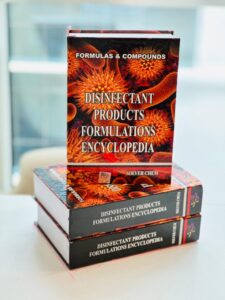
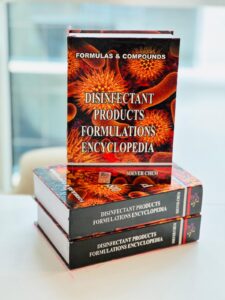
These professional formulations are included in the Disinfectant Products Formulations Encyclopedia, developed by a chemical engineer with over 40 years of experience.
WHAT ARE QAC DISINFECTANTS?
QAC disinfectants are cationic surfactants that disrupt microbial cell membranes, leading to rapid destruction of bacteria, fungi, and some viruses. Common active ingredients include:
- Benzalkonium chloride (BAC)
- Didecyldimethylammonium chloride (DDAC)
- Alkyl dimethyl benzyl ammonium chloride
These compounds are especially effective in surface disinfectants, fogging systems, and medical instrument cleaning solutions.
KEY INGREDIENTS IN QAC DISINFECTANT FORMULATION
A standard QAC disinfectant formulation consists of several functional components:
- Active ingredient (QAC compound): Main antimicrobial agent
- Solvent (Water or alcohol): Carrier medium
- Non-ionic surfactants: Improve wetting and cleaning performance
- Chelating agents (EDTA): Enhance stability and performance in hard water
- pH regulators: Maintain optimal activity
- Fragrance (optional): Improve user acceptance
These ingredients must be carefully balanced to ensure both efficiency and stability.
PRODUCTION PROCESS OF QAC DISINFECTANTS
The manufacturing process is relatively simple but requires precision:
First, purified water is added to the mixing tank. The QAC active ingredient is slowly introduced under continuous stirring to ensure complete dissolution. Non-ionic surfactants are then added to improve cleaning performance.
Next, chelating agents and stabilizers are incorporated to enhance formulation stability. The pH is adjusted to the desired level, typically between 6 and 8, depending on the application.
Finally, optional components such as fragrance and color are added before filtration and packaging.
APPLICATION AREAS OF QAC DISINFECTANTS
QAC-based disinfectants are used across multiple industries:
- Hospitals: Surface and instrument disinfection
- Food industry: Equipment sanitation
- Agriculture: Dairy farms, poultry farms, greenhouse sanitation
- Household: Multi-purpose cleaners and sprays
Their versatility makes them one of the most commercially valuable disinfectant types.
SPECIALIZED QAC FORMULATIONS
Different applications require different QAC formulations. For example:
- Fogging disinfectant solutions: Used for large area disinfection
- Surgical instrument disinfectants: Require higher purity and stability
- Surface disinfectants: Optimized for rapid action and low residue
- Dairy and poultry farm disinfectants: Designed for high organic load environments
👉 These variations are critical when developing industrial-grade products.
ADVANTAGES OF QAC DISINFECTANTS
- Broad-spectrum antimicrobial activity
- Low toxicity compared to many alternatives
- Long-lasting residual effect
- Compatibility with various surfaces
- Cost-effective production
LIMITATIONS AND CONSIDERATIONS
Despite their advantages, QAC disinfectants have some limitations:
- Reduced activity in high organic load environments
- Potential resistance development with improper use
- Not effective against certain non-enveloped viruses
Therefore, proper formulation and application are essential.
SUMMARY
QAC disinfectants are one of the most important classes of disinfectants used worldwide. Their effectiveness, ease of formulation, and wide application areas make them indispensable in both industrial and commercial cleaning products.
By understanding the formulation principles, raw materials, and production processes, manufacturers can develop high-quality disinfectant products that meet modern hygiene standards and market demands.