 The performance of a soil conditioner fertilizer depends heavily on the selection, quality and compatibility of the raw materials used in the formulation. Different ingredients perform different technical functions, such as improving soil structure, increasing organic matter, supporting nutrient availability, enhancing water retention and creating better conditions for root development. Understanding the role of each raw material is therefore essential for manufacturers developing professional and commercial soil conditioner fertilizer formulations.
Humic acid is one of the most commonly used ingredients in soil conditioner products. It is widely incorporated into formulations designed to support soil structure, improve cation exchange capacity and enhance nutrient availability in the root zone. Humic substances are particularly valuable in soils with low organic matter content and may be used in liquid, powder and granular products.
Fulvic acid is another important component used in many soil conditioner formulations. Because of its relatively low molecular weight and good solubility, fulvic acid can be incorporated into liquid products and combined with other organic and mineral ingredients. It is often used to support nutrient mobility and improve the efficiency of soil-applied formulations.
Gypsum and calcium-based materials are frequently selected for formulations intended for specific soil-management applications. Calcium can contribute to soil aggregation and structural improvement, while gypsum is commonly used in products developed for saline or sodic soil conditions. The suitability of these materials depends on soil characteristics and the intended application program.
Biochar and organic matter sources may be included to improve the physical properties of soil and increase its organic carbon content. These materials can help support water-holding capacity, aeration and the development of a more favorable root environment. Compost-derived materials and other processed organic components may also be used depending on the formulation type.
Other frequently used ingredients include magnesium compounds, amino acids, seaweed extracts and micronutrients. Magnesium may provide additional nutritional value, while amino acids and seaweed-derived materials are commonly incorporated into advanced agricultural formulations. Micronutrients such as iron, zinc, manganese and boron can also be included where the product is designed to combine soil-conditioning functions with nutritional support.
Manufacturers may additionally require functional ingredients such as pH regulators, dispersing agents, suspending agents, wetting agents, preservatives and stabilizers. These materials do not necessarily provide direct soil-conditioning effects, but they are important for maintaining product homogeneity, controlling viscosity, preventing excessive sedimentation and improving storage stability.
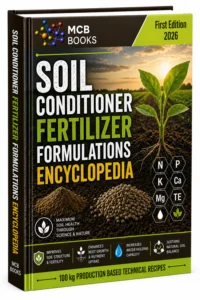
The SOIL CONDITIONER FERTILIZER FORMULATIONS ENCYCLOPEDIA provides detailed information about raw materials used in different soil conditioner products, including their functions, quantities and production roles. The formulations are structured around practical 100 kg production quantities, helping manufacturers understand how different ingredients can be combined in professional production systems.
Selecting the correct raw materials is one of the most important steps in developing successful soil conditioner products. With proper formulation knowledge, manufacturers can create liquid, suspension, powder and granular soil conditioners designed for different soil types, crop requirements and commercial agricultural applications.