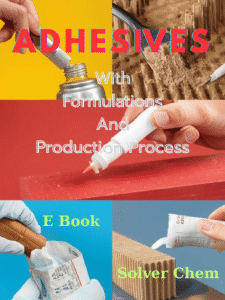
 Reactive Polyurethane Adhesives
1. What Are Reactive Polyurethane Adhesives
Reactive polyurethane adhesives are moisture-curing or chemically reactive bonding systems based on polyurethane prepolymers that crosslink during application. These adhesives form highly durable, flexible, and chemical-resistant bonds suitable for demanding industrial applications.
2. Meaning & Definition
Reactive polyurethane adhesives are defined as one-component or two-component polyurethane systems that cure through moisture, heat, or chemical reaction, leading to a strong thermoset adhesive film.
3. Overview
These adhesives offer high tensile strength, excellent flexibility, strong adhesion to porous–nonporous substrates, and high resistance to temperature, chemicals, and mechanical stress. They are widely used in automotive, construction, footwear, and wood industries.
4. Properties
-
High mechanical strength
-
Excellent impact and vibration resistance
-
Moisture-curing capability
-
Strong adhesion to metals, plastics, composites, rubber, wood
-
Chemical and solvent resistance
-
Flexible and durable bond line
-
Good gap-filling performance
5. Applications
Reactive polyurethane adhesives are used in:
-
Wood bonding & furniture manufacturing
-
Automotive assembly & structural bonding
-
Building and construction components
-
Composite panel bonding
-
Footwear and leather goods
-
Electronics encapsulation & bonding
-
Transportation industry
-
Metal–plastic hybrid assemblies
6. Advantages
-
High durability & long-term performance
-
Excellent environmental resistance
-
Strong adhesion to multi-material surfaces
-
Good elasticity for stress distribution
-
Can be formulated for fast or slow curing
-
Suitable for automated production
7. How Reactive Polyurethane Adhesives Cure
Curing occurs through:
-
Moisture in air or substrate (1K systems)
-
Reaction between polyol & isocyanate components (2K PU)
-
Heat-activated reaction
The chemical crosslinking forms a thermoset polymer structure with high bonding stability.
8. Ingredients & Raw Materials
Typical raw materials:
-
Polyurethane prepolymers
-
Polyols (polyether, polyester)
-
Isocyanate components (MDI, TDI, HDI)
-
Catalysts & accelerators
-
Plasticizers
-
Fillers & rheology modifiers
-
Stabilizers & antioxidants
-
Moisture scavengers
-
Additives for flexibility or viscosity control
9. Manufacturing Process (General)
-
Polyol components are blended with additives.
-
Isocyanate prepolymer is prepared separately.
-
Components are reacted under controlled conditions.
-
Moisture-sensitive packaging is used.
-
Final product is tested for reactivity, viscosity, and curing properties.
10. Uses
Reactive polyurethane adhesives are ideal for:
-
Structural bonding
-
Lamination
-
Wood panels and flooring
-
Composite assemblies
-
Metal–plastic joining
-
Vehicle interiors & exteriors
11. Summary
Reactive polyurethane adhesives are high-performance bonding systems that cure through moisture or chemical reaction, forming durable, flexible, and extremely strong adhesive films. Their resistance to chemicals, temperature, and mechanical stress makes them essential for industrial applications such as automotive, composites, footwear, construction, and furniture manufacturing. They bond a wide range of substrates, perform well under dynamic loads, and are ideal for demanding production environments.