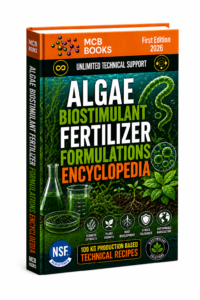
 The commercial production of seaweed extract fertilizers requires carefully controlled manufacturing methods to achieve consistent quality, good solubility, physical stability, and reliable agricultural performance. Extraction, mixing, pH control, filtration, and stability management are among the most important stages in the manufacturing process. Each step affects the final concentration, appearance, compatibility, storage life, and application characteristics of the fertilizer.
Extraction is the first major stage when seaweed is processed directly as a raw material. Different seaweed species can be used depending on the desired formulation and product characteristics. The extraction process is designed to transfer useful water-soluble and organic components from the seaweed into a concentrated liquid or soluble material. Depending on the production technology, manufacturers may use water-based, alkaline, enzymatic, or other controlled extraction methods.
Temperature, extraction time, pH, solid-to-liquid ratio, and agitation conditions can influence the characteristics of the resulting seaweed extract. Excessive processing conditions may alter sensitive organic components, while insufficient extraction can reduce extraction efficiency. For manufacturers purchasing ready-made liquid or powdered seaweed concentrates, this extraction stage is generally completed by the raw material supplier.
After obtaining or selecting the seaweed extract, the formulation process continues with controlled mixing. Water is usually transferred to a suitable mixing vessel and agitation is started. Water-soluble nutrients, micronutrients, organic components, and formulation auxiliaries are then introduced according to the selected production formula.
The order of addition is important in seaweed extract fertilizer manufacturing. Highly concentrated nutrient salts should be added gradually and allowed to dissolve completely before incompatible or sensitive ingredients are introduced. Seaweed extract can then be added under continuous agitation to obtain a homogeneous solution or dispersion. Depending on the formulation, humic acid, fulvic acid, amino acids, nitrogen, phosphorus, potassium, and micronutrients may also be incorporated.
pH control is one of the most critical stages in liquid seaweed fertilizer production. The pH of the final formulation can influence nutrient solubility, ingredient compatibility, color, microbial stability, and storage performance. Suitable acidifying or alkalizing materials may therefore be used to adjust the product to the desired pH range.
Manufacturers should avoid rapid pH adjustments because sudden changes may cause precipitation or destabilization. The pH should be measured during and after production, and the formulation should be allowed sufficient time to equilibrate before the final value is confirmed.
Filtration is particularly important for products intended for foliar spraying and fertigation systems. Undissolved particles, raw material residues, or precipitated solids can block spray nozzles and irrigation equipment. Depending on product specifications, filtration can be carried out at different stages of production using suitable filters or filtration systems.
Product stability is another essential consideration in commercial manufacturing. A stable seaweed extract fertilizer should remain sufficiently homogeneous during storage without excessive sedimentation, separation, gas formation, or undesirable changes in viscosity and appearance. Stability can be influenced by pH, temperature, ingredient compatibility, dissolved solids, microbial activity, and packaging conditions.
Preservatives, stabilizers, dispersing agents, antifoaming agents, or other formulation auxiliaries may be required depending on the product. Manufacturers should also conduct storage and stability tests under appropriate conditions before commercial distribution. Testing at different temperatures can help identify potential precipitation, separation, color change, or microbial deterioration.
Quality control should include parameters such as appearance, color, odor, pH, density, viscosity, solubility, nutrient concentration, sediment formation, and storage stability. For concentrated products, dilution behavior and compatibility with application water may also be evaluated.
The SEAWEED EXTRACT FERTILIZER FORMULATIONS ENCYCLOPEDIA provides practical information for fertilizer manufacturers, agricultural companies, entrepreneurs, and formulation specialists interested in professional seaweed fertilizer production. It covers production-based formulation concepts, raw material functions, manufacturing principles, and technical considerations related to commercial seaweed-based fertilizer products.
By carefully controlling extraction, mixing, pH adjustment, filtration, and stability, manufacturers can develop reliable seaweed extract fertilizers suitable for foliar spray, fertigation, soil application, and agricultural biostimulant programs. The SEAWEED EXTRACT FERTILIZER FORMULATIONS ENCYCLOPEDIA can serve as a practical technical reference for companies seeking to improve formulation quality and develop commercially competitive seaweed fertilizer products.