Solvent-based heavy-duty cleaning wipes are professional products developed for removing difficult industrial contaminants such as grease, lubricants, adhesive residues, printing inks, waxes, sealants, tar-like deposits, and uncured coatings. They are widely used in automotive workshops, factories, maintenance departments, printing facilities, construction sites, engineering plants, warehouses, and industrial production areas.
Unlike conventional household wipes, solvent-based industrial cleaning wipes require powerful cleaning systems, chemically resistant nonwoven materials, controlled impregnation, secure packaging, and carefully managed workplace-safety procedures. The formulation must provide strong cleaning performance without causing unacceptable damage to metals, plastics, painted surfaces, rubber components, or protective coatings.
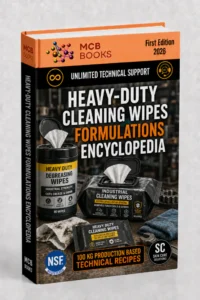
The HEAVY-DUTY CLEANING WIPES FORMULATIONS ENCYCLOPEDIA provides technical guidance for manufacturers, formulation specialists, chemical suppliers, entrepreneurs, and private-label producers developing professional industrial wipes. It covers solvent selection, supporting raw materials, manufacturing procedures, nonwoven compatibility, quality control, packaging, and commercial product development.
Solvent-based cleaning systems may contain alcohols, glycol ethers, esters, hydrocarbons, or other industrial cleaning solvents selected according to the intended contamination and surface type. Some formulations use a single solvent system, while others combine several solvents to achieve a balance between cleaning power, evaporation rate, odor, residue level, and material compatibility.
Fast-evaporating solvents may support rapid drying and low-residue cleaning. However, extremely rapid evaporation can reduce working time and increase vapor formation. Slower solvents may improve the removal of stubborn grease and adhesives but can leave surfaces wet for longer. Manufacturers should therefore develop the solvent blend according to the intended application rather than focusing only on maximum cleaning strength.
Small quantities of compatible surfactants may be added to improve soil removal and support the dispersion of oily contamination. Low-foam nonionic surfactants are frequently considered because excessive foam can leave visible residues and reduce user convenience. Solubilizers, stabilizers, corrosion inhibitors, fragrance materials, and other functional additives may also be included when technically necessary.
The HEAVY-DUTY CLEANING WIPES FORMULATIONS ENCYCLOPEDIA explains how cleaning solvents and supporting ingredients can be balanced in professionally structured formulations. Every raw material must be evaluated for compatibility because an unsuitable additive may cause separation, discoloration, odor changes, excessive residue, or reduced cleaning performance.
During manufacturing, the solvent system is prepared in a chemically resistant and properly grounded mixing vessel. Ingredients are incorporated under controlled agitation and suitable temperature conditions. Excessive mixing should be avoided when it increases evaporation or creates unnecessary vapor release.
Flammable solvents require strict precautions. Production areas may need suitable ventilation, ignition-source control, grounded transfer systems, compatible electrical installations, safe storage cabinets or tanks, spill-response procedures, and appropriate personal protective equipment. Raw materials should be handled according to their safety data sheets and applicable workplace regulations.
The finished cleaning solution should be tested for appearance, odor, density, evaporation behavior, stability, residue level, cleaning performance, and surface compatibility. Tests should be conducted on all intended materials, particularly plastics, rubber, painted metals, aluminum, coated surfaces, and electronic equipment housings.
Nonwoven fabric selection is also critical. The substrate must resist chemical degradation while providing high wet strength, abrasion resistance, low lint formation, and controlled solvent release. Textured industrial fabrics may improve the mechanical removal of heavy contamination, while softer substrates may be selected for more sensitive surfaces.
The wipes are folded, cut, and impregnated with a controlled quantity of solvent solution. Excessive loading may cause leakage and packaging deformation, while insufficient loading can reduce cleaning effectiveness. Packaging must provide strong solvent resistance and minimize evaporation throughout the intended shelf life.
The HEAVY-DUTY CLEANING WIPES FORMULATIONS ENCYCLOPEDIA offers a practical foundation for developing adhesive-removal wipes, ink-cleaning wipes, workshop degreasing wipes, machinery wipes, and low-residue industrial cleaning products. By combining suitable solvents, compatible additives, durable fabrics, controlled manufacturing, safety management, and protective packaging, producers can create effective and commercially competitive solvent-based heavy-duty cleaning wipes.