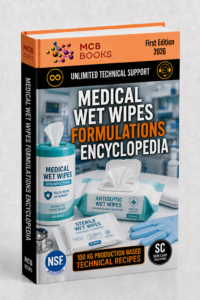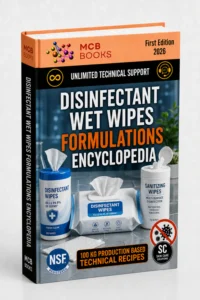
Disinfectant wet wipes are ready-to-use products developed for the rapid cleaning and disinfection of hard, nonporous surfaces. They are commonly used in hospitals, laboratories, offices, schools, hotels, factories, warehouses, food-service environments, and household cleaning applications. Commercial production requires a professionally balanced disinfectant solution, compatible nonwoven fabric, controlled liquid loading, protective packaging, and validated antimicrobial performance.
Preparing disinfectant wet wipes formulas on a 100 kg production basis provides manufacturers with a practical and organized method for calculating raw material quantities. In a correctly prepared 100 kg formula, the total quantity of all ingredients equals exactly 100 kilograms. This structure makes it easier to calculate production costs, compare alternative formulations, conduct pilot trials, and scale the formula for larger industrial batches.
The DISINFECTANT WET WIPES FORMULATIONS ENCYCLOPEDIA provides technical formulation concepts for manufacturers, entrepreneurs, private-label producers, chemical suppliers, and formulation specialists seeking practical information about commercial disinfectant wipes production. It covers alcohol-based, alcohol-free, antibacterial, antimicrobial, institutional, household, professional, and industrial wet wipes formulations.
A typical 100 kg disinfectant wet wipes solution may contain purified water, approved antimicrobial active ingredients, surfactants, solvents, chelating agents, pH regulators, stabilizers, corrosion inhibitors, and optional fragrance materials. The exact raw materials and quantities depend on the intended application, active technology, target microorganisms, required contact time, surface compatibility, and regulations of the target market.
Alcohol-based disinfectant wipes may contain ethanol or isopropyl alcohol as active ingredients and solvents. These formulations can provide rapid drying and convenient application on compatible surfaces. However, alcohol concentration, evaporation, flammability, workplace ventilation, packaging compatibility, and storage safety must be carefully controlled.
Alcohol-free disinfectant wet wipes may use legally authorized quaternary ammonium compounds, hydrogen peroxide systems, organic acids, chlorine-releasing substances, or other suitable antimicrobial technologies. These formulations may provide longer surface wetness, but they require careful evaluation of pH, active concentration, surfactant compatibility, nonwoven interaction, and material safety.
During production, purified or deionized water is transferred into a clean stainless-steel mixing tank. Chelating agents, stabilizers, and other water-soluble ingredients are normally added under controlled agitation. Surfactants, antimicrobial active ingredients, solvents, pH regulators, and optional additives are then incorporated in the correct production sequence.
Excessive mixing should be avoided when it causes foam formation. Volatile ingredients should be added under controlled temperature and ventilation conditions. The solution should be mixed until it becomes uniform and free from unacceptable sedimentation, separation, discoloration, or odor changes.
The DISINFECTANT WET WIPES FORMULATIONS ENCYCLOPEDIA explains how 100 kg formulas can be scaled according to production capacity. For example, a 100 kg formulation can theoretically be converted into a 1,000 kg batch by multiplying every raw material quantity by ten. Nevertheless, larger batches should always be confirmed through production trials because mixing time, heat transfer, foam formation, and ingredient distribution may change during scale-up.
Before the disinfectant solution is applied to the nonwoven fabric, it should be tested for appearance, odor, pH, density, active-ingredient concentration, chemical stability, and microbiological quality. The selected nonwoven substrate should provide suitable absorbency, wet strength, liquid retention, and controlled release.
Accurate impregnation is essential. Each wipe must contain enough disinfectant solution to cover the intended surface and maintain the required wet contact time. Insufficient liquid may reduce surface coverage, while excessive loading can cause leakage, packaging deformation, and unnecessary production costs.
The finished wipes may be packed in canisters, soft packs, refill bags, industrial buckets, or individually sealed sachets. Packaging must prevent moisture loss, contamination, leakage, and evaporation throughout the intended shelf life.
The DISINFECTANT WET WIPES FORMULATIONS ENCYCLOPEDIA offers a practical technical foundation for developing 100 kg disinfectant wet wipes solution production formulas. By combining professionally structured formulations, controlled manufacturing procedures, compatible nonwoven materials, validated performance, and reliable packaging, manufacturers can develop stable and commercially competitive disinfectant wipes for household, professional, institutional, and industrial markets.