Commercial disinfectant wet wipes are widely used for the convenient cleaning and disinfection of hard, nonporous surfaces in homes, hospitals, offices, schools, hotels, laboratories, factories, warehouses, and public areas. These products combine a liquid disinfectant system with a suitable nonwoven fabric, allowing users to apply a controlled amount of solution without preparing a separate dilution. Successful commercial production requires professional formulations, compatible raw materials, hygienic manufacturing, accurate impregnation, reliable packaging, and validated antimicrobial performance.
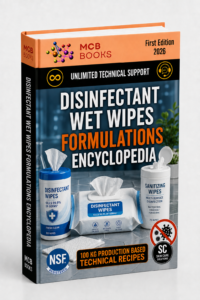
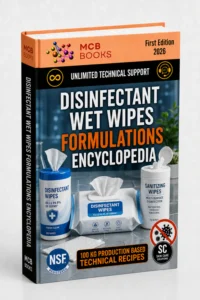
The DISINFECTANT WET WIPES FORMULATIONS ENCYCLOPEDIA has been developed for manufacturers, formulation specialists, entrepreneurs, private-label producers, chemical suppliers, and investors seeking practical technical information about disinfectant wet wipes production. It provides structured formulation concepts, production methods, raw material functions, application guidance, and technical information for different commercial and professional product categories.
The first stage of commercial manufacturing is determining the intended use of the disinfectant wipe. Products may be developed for household cleaning, healthcare environments, industrial surfaces, office equipment, food-service areas, laboratories, or institutional facilities. Each application can require a different active system, contact time, cleaning level, surface-compatibility profile, packaging format, and regulatory classification.
A commercial disinfectant wipes solution may contain purified water, approved antimicrobial active ingredients, surfactants, solvents, chelating agents, pH regulators, stabilizers, corrosion inhibitors, fragrances, and other compatible additives. Alcohol-based formulations may use ethanol or isopropyl alcohol, while alcohol-free products may contain quaternary ammonium compounds, hydrogen peroxide systems, organic acids, chlorine-releasing substances, or other authorized technologies.
Surfactants help loosen grease, dirt, fingerprints, and organic residues from treated surfaces. Their concentration must be carefully optimized because excessive surfactant may create foam, streaking, sticky deposits, or incompatibility with the antimicrobial system. Solvents and cleaning boosters may be included in commercial or industrial formulations designed to remove heavier contamination.
The DISINFECTANT WET WIPES FORMULATIONS ENCYCLOPEDIA helps manufacturers understand how active ingredients and supporting raw materials interact within the complete formulation. It also explains why the liquid solution, nonwoven substrate, and packaging should be evaluated as one finished product rather than as separate components.
During production, purified water is transferred into a clean and sanitized mixing tank. Water-soluble ingredients are added under controlled agitation, followed by surfactants, active substances, solvents, pH regulators, and other functional additives in the appropriate sequence. Volatile materials should be handled under suitable temperature, ventilation, and workplace-safety conditions.
Before impregnation, the disinfectant solution should be tested for appearance, odor, pH, density, active-ingredient concentration, chemical stability, and microbiological quality. The nonwoven material must provide sufficient absorbency, wet strength, liquid retention, and controlled release. Certain fibers may retain part of the active ingredient, making compatibility and performance testing essential.
Accurate lotion loading is one of the most important production parameters. Each wipe must release enough solution to cover the intended surface and maintain the required wet contact time. Insufficient loading may reduce coverage, while excessive loading can increase costs, cause leakage, and create packaging problems.
The impregnated wipes are folded, cut, counted, and packaged in canisters, soft packs, refill bags, industrial buckets, or individually sealed sachets. Packaging must protect the product from contamination, moisture loss, leakage, and evaporation throughout its intended shelf life. Seal quality, lid performance, label adhesion, and packaging-material compatibility should be evaluated during stability trials.
Commercial antimicrobial claims must be supported by appropriate efficacy testing and the required authorization for the target market. Manufacturers should also establish documented procedures for raw material control, batch traceability, equipment sanitation, employee hygiene, finished-product testing, and storage.
The DISINFECTANT WET WIPES FORMULATIONS ENCYCLOPEDIA offers a valuable technical foundation for companies planning to enter or expand within the disinfectant wipes market. By combining professional formulations, controlled production methods, suitable nonwoven materials, protective packaging, validated claims, and consistent quality control, producers can manufacture stable, effective, and commercially competitive disinfectant wet wipes for household, professional, institutional, and industrial applications.