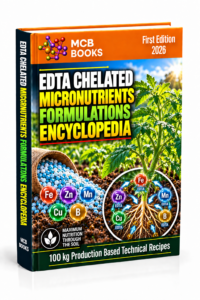
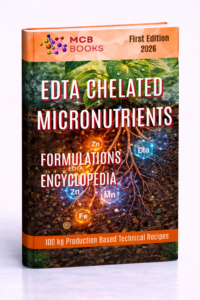
Micronutrients are essential for plant growth, yet they are required in very small amounts. Despite their low concentration, deficiencies of elements such as iron (Fe), zinc (Zn), manganese (Mn), and copper (Cu) can severely limit crop yield and quality. One of the biggest challenges in agriculture is not the absence of these nutrients in the soil, but their availability. This is why chelated micronutrients have become increasingly important in modern farming systems. They ensure that essential nutrients remain accessible to plants under a wide range of soil and environmental conditions.
What Are Chelated Micronutrients?
Chelated micronutrients are nutrients that are chemically bound to organic molecules called chelating agents (such as EDTA). This binding forms a stable complex that protects the nutrient from unfavorable chemical reactions in the soil.
👉 In simple terms:
Chelation keeps nutrients available, stable, and absorbable.
1. Increased Nutrient Availability
One of the main reasons to use chelated micronutrients in agriculture is their ability to prevent nutrient fixation.
In many soils:
- Iron, zinc, and manganese become insoluble
- Nutrients react with calcium or carbonates
- Plants cannot absorb them
Chelates solve this problem by:
- Keeping nutrients in soluble form
- Protecting them from soil reactions
- Maintaining availability over time
2. Higher Nutrient Uptake Efficiency
Chelated micronutrients are more easily absorbed by plant roots and leaves.
Benefits include:
- Faster uptake
- Better internal utilization
- Reduced fertilizer waste
👉 This leads to more efficient fertilization and improved crop performance.
3. Better Performance in Alkaline Soils
Soil pH is a major factor affecting nutrient availability.
- In alkaline soils, micronutrients become unavailable
- Traditional fertilizers fail under these conditions
Chelated micronutrients:
- Remain stable in difficult soils
- Continue to supply nutrients effectively
👉 Especially important for calcareous soils.
4. Rapid Correction of Deficiencies
Micronutrient deficiencies can quickly reduce plant health.
Chelated fertilizers:
- Act quickly when applied
- Correct chlorosis and growth issues
- Provide visible improvement in a short time
👉 Foliar application gives the fastest results.
5. Improved Plant Growth and Yield
Micronutrients play key roles in:
- Photosynthesis
- Enzyme activation
- Hormone production
Chelated forms ensure these processes function efficiently.
👉 Result:
- Stronger plants
- Higher yields
- Better crop quality
6. Versatility in Application
Chelated micronutrients can be applied through:
- Soil application
- Foliar spraying
- Fertigation systems
👉 Suitable for:
- Field crops
- Greenhouses
- Hydroponics
7. Reduced Nutrient Losses
Traditional micronutrients often suffer from:
- Leaching
- Fixation
- Chemical precipitation
Chelation reduces these losses by stabilizing nutrients.
👉 This improves fertilizer efficiency and reduces environmental impact.
8. Compatibility with Modern Farming
Chelated micronutrients are ideal for:
- Precision agriculture
- Smart fertilization systems
- Automated irrigation (fertigation)
👉 They provide predictable and consistent performance.
9. Improved Crop Quality
Chelated micronutrients enhance:
- Fruit size and uniformity
- Leaf color and health
- Nutritional value
👉 Essential for high-value crops like fruits and vegetables.
10. Economic Benefits
Although chelated fertilizers may cost more per unit:
- Lower application rates are required
- Higher efficiency reduces waste
- Yield and quality improvements increase profit
👉 Strong return on investment (ROI)
Using chelated micronutrients in agriculture is essential for ensuring efficient nutrient management, especially in soils where availability is limited. By improving nutrient stability, uptake, and plant performance, chelates provide a reliable solution for modern farming challenges. Their role in increasing yield, enhancing crop quality, and supporting sustainable agriculture makes them indispensable in today’s agricultural systems.
Chelated micronutrients are used in agriculture to improve nutrient availability, enhance uptake efficiency, and support better plant growth. They perform well in difficult soil conditions, reduce nutrient losses, and increase crop yield and quality, making them a key component of modern and efficient farming.