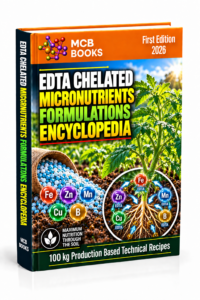
Micronutrients such as iron (Fe), zinc (Zn), manganese (Mn), and copper (Cu) are essential for plant growth, but the form in which they are applied greatly affects their efficiency. Two of the most commonly used forms are EDTA chelated micronutrients and sulfate micronutrients (such as ZnSO₄, FeSO₄). Understanding the differences between these two forms is critical for selecting the right fertilizer strategy and maximizing crop performance.
What Are EDTA Chelates and Sulfates?
EDTA chelates are micronutrients chemically bound to a chelating agent (EDTA), which keeps them stable and soluble in the soil.
Sulfate micronutrients are inorganic salts that dissolve in water but can quickly react with soil components and become unavailable to plants.
👉 In simple terms:
- EDTA = protected and stable
- Sulfate = simple and reactive
1. Nutrient Availability in Soil
One of the biggest differences is how nutrients behave after application.
EDTA Chelates:
- Remain soluble for longer periods
- Resist fixation in soil
- Provide continuous nutrient availability
Sulfates:
- Quickly dissolve but also quickly react
- Can become insoluble in alkaline soils
- Short-lived availability
👉 Result: EDTA chelates provide more reliable nutrient supply.
2. Performance in Different Soil pH Conditions
Soil pH plays a major role in micronutrient efficiency.
EDTA Chelates:
- Effective in acidic to neutral soils
- Moderate performance in slightly alkaline soils
Sulfates:
- Work well in acidic soils
- Lose effectiveness in alkaline soils
👉 Key insight:
In high pH soils, sulfate micronutrients often fail, while chelates perform better.
3. Nutrient Uptake Efficiency
EDTA Chelates:
- Higher absorption efficiency
- Better mobility in soil solution
- Improved uptake through roots and leaves
Sulfates:
- Limited uptake window
- Lower efficiency due to fixation
👉 Chelates require lower application rates for the same effect.
4. Application Flexibility
EDTA Chelates:
- Suitable for foliar application
- Compatible with fertigation systems
- Used in hydroponics and precision agriculture
Sulfates:
- Mainly used for soil application
- Limited use in foliar systems
👉 EDTA chelates offer greater versatility.
5. Speed vs Duration
Sulfates:
- Provide quick initial nutrient release
- Effect disappears quickly
EDTA Chelates:
- Provide sustained nutrient availability
- Longer-lasting effect
👉 Sulfates = fast but short-term
👉 Chelates = steady and long-term
6. Cost Comparison
Sulfates:
- Lower cost per kg
- Higher application rates required
EDTA Chelates:
- Higher cost per kg
- Lower dosage needed
- Higher efficiency
👉 Real cost per hectare is often similar or even lower with chelates.
7. Environmental Impact
EDTA Chelates:
- Reduce nutrient losses due to efficiency
- May persist in the environment (slow degradation)
Sulfates:
- Simpler compounds
- May require higher usage → increased runoff risk
👉 Both require responsible use.
8. Practical Use Recommendations
- Use sulfate micronutrients:
- In acidic soils
- When cost is the main concern
- Use EDTA chelates:
- In alkaline or calcareous soils
- For high-value crops
- In foliar and fertigation systems
👉 Best strategy: combine both depending on conditions.
Both EDTA chelates and sulfate micronutrients have their place in agriculture. While sulfates offer a low-cost solution for simple soil conditions, EDTA chelates provide higher efficiency, better stability, and improved plant uptake. The choice depends on soil pH, crop type, and production goals. For modern, high-efficiency agriculture, chelated micronutrients are often the preferred option.
EDTA chelates offer higher stability, better nutrient availability, and improved uptake efficiency compared to sulfate micronutrients. Sulfates are cheaper but less effective in challenging soil conditions. Choosing the right form depends on soil pH, crop needs, and economic considerations.