
INTRODUCTION
Chelated zinc fertilizers are widely used in modern agriculture to improve zinc availability in soils where micronutrient deficiencies limit crop productivity. Zinc is an essential plant nutrient that plays an important role in enzyme activity, plant metabolism and protein synthesis.
In many agricultural soils, especially alkaline soils, zinc becomes chemically unavailable to plants. Chelated zinc fertilizers are designed to keep zinc in a soluble and plant-available form, allowing crops to absorb micronutrients more efficiently.
Understanding the production process of chelated zinc fertilizers is important for fertilizer manufacturers producing advanced micronutrient formulations used in modern agricultural nutrient management systems.
Zinc Chelation in Fertilizer Production
Chelation is a chemical process in which zinc ions are bound to organic chelating agents such as EDTA. This process forms stable zinc complexes that remain soluble in soil and nutrient solutions.
Chelated zinc fertilizers prevent zinc precipitation in alkaline soils and improve nutrient availability for plant roots.
Common chelating agents used in zinc fertilizer production include:
• EDTA (Ethylenediaminetetraacetic acid)
• DTPA
• EDDHA
Among these chelating agents, EDTA is one of the most widely used compounds in micronutrient fertilizer formulations.
Chelated Zinc Fertilizer Production Process
Chelated zinc fertilizers are typically produced by reacting zinc salts with chelating agents under controlled pH and temperature conditions.
In industrial fertilizer production plants zinc sulfate solution is often used as the zinc source. The chelating agent such as EDTA is dissolved in water and slowly mixed with the zinc solution while maintaining proper pH conditions.
During this process zinc ions form stable chelate complexes with the chelating agent, producing soluble chelated zinc fertilizer suitable for agricultural use.
The final fertilizer product can be produced in liquid fertilizer formulations or in powder micronutrient fertilizer mixtures depending on the intended agricultural application.
Advantages of Chelated Zinc Fertilizers
Chelated zinc fertilizers provide several advantages compared to conventional zinc fertilizers.
Main advantages include:
• improved micronutrient availability in alkaline soils
• higher nutrient absorption efficiency
• reduced nutrient fixation in soil
• improved plant metabolism
• increased crop productivity
Due to these benefits chelated zinc fertilizers are widely used in high-value crops, greenhouse cultivation and fertigation systems.
SUMMARY
Chelated zinc fertilizers are advanced micronutrient fertilizers designed to improve zinc availability for plants in agricultural soils. These fertilizers are produced by chemically binding zinc ions with chelating agents such as EDTA to form stable and soluble zinc complexes.
Chelated zinc fertilizers improve nutrient uptake, enhance plant growth and help correct zinc deficiency in modern agricultural production systems.
For more information about conventional zinc fertilizer manufacturing you may also review our article on zinc sulfate fertilizer production.
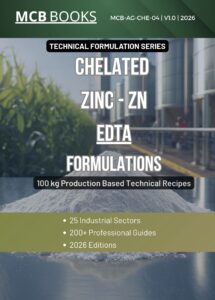
Advanced formulation techniques and industrial production methods of chelated zinc fertilizers are explained in professional formulation guides. Detailed Zn-EDTA fertilizer formulations and manufacturing methods can be found in specialized technical books used by fertilizer manufacturers.
These formulation guides help fertilizer producers develop stable, efficient and commercially viable zinc micronutrient fertilizers used in modern agriculture.