 Amino acid foliar fertilizer formulations are increasingly used in modern agriculture to support nutrient uptake, plant development, vegetative growth, flowering, fruit formation, and overall crop performance. Foliar application allows selected nutrients and functional ingredients to be applied directly to plant leaves, making amino acid-based fertilizers an important part of professional crop nutrition programs. These products can be developed for vegetables, fruits, cereals, greenhouse crops, ornamentals, and many other agricultural applications.
A typical amino acid foliar fertilizer formulation may contain free amino acids, protein hydrolysates, peptides, organic nitrogen sources, micronutrients, seaweed extracts, fulvic acid, potassium compounds, organic acids, wetting agents, stabilizers, preservatives, and water. The exact composition depends on the target crop, growth stage, nutrient requirements, and desired product performance. Manufacturers can develop specialized formulations for vegetative growth, flowering, fruit development, nutrient deficiency correction, or plant recovery after environmental stress.
Free amino acids and protein hydrolysates are key components in many foliar fertilizer formulations. These ingredients can be combined with micronutrients such as iron, zinc, manganese, boron, copper, and molybdenum to create multifunctional plant nutrition products. Depending on the formulation strategy, potassium, seaweed extracts, or fulvic acid may also be included to support different stages of crop development.
Successful foliar fertilizer formulation requires careful attention to solubility and compatibility. Since the product is applied directly to plant surfaces, excessive sediment, crystallization, or insoluble particles can reduce application quality. The pH of the finished formulation should also be carefully controlled because it can affect nutrient stability and compatibility between ingredients. Appropriate wetting and spreading agents may be included to improve coverage on leaf surfaces.
During manufacturing, water is generally added to a suitable mixing vessel before amino acid concentrates and water-soluble ingredients are incorporated under continuous agitation. Micronutrients and other functional additives are then introduced according to the production formula. Mixing order, temperature, processing time, pH, density, viscosity, and solubility should be monitored throughout production to maintain product consistency and stability.
Quality control is essential for commercial amino acid foliar fertilizer production. Important parameters may include appearance, pH, density, amino acid content, total nitrogen, micronutrient concentration, viscosity, solubility, sediment formation, and storage stability. Manufacturers should also evaluate packaging compatibility and product performance under recommended application conditions.
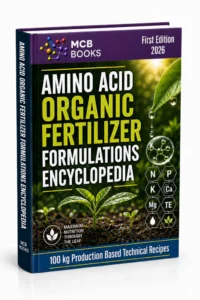
The AMINO ACID ORGANIC FERTILIZER FORMULATIONS ENCYCLOPEDIA provides practical technical information about amino acid foliar fertilizer formulations, raw materials, manufacturing procedures, production methods, and quality control. It is designed for fertilizer manufacturers, formulators, agricultural companies, and entrepreneurs seeking to develop professional foliar fertilizers for improved nutrient uptake, plant development, and modern crop nutrition programs.