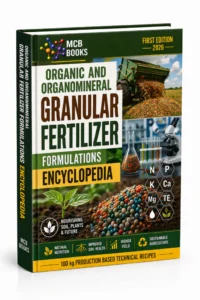
 The production of organic and organomineral granular fertilizers requires accurate formulations, carefully selected raw materials, and controlled manufacturing processes. For professional and industrial fertilizer manufacturers, 100 kg production formulas provide a practical reference for understanding ingredient ratios, nutrient balance, raw material functions, and production requirements before scaling to larger commercial batches.
Organic and organomineral granular fertilizers are designed to combine plant nutrients with organic matter in a stable and easy-to-apply granular form. Organic fertilizers may contain organic nutrient sources, humic substances, plant-derived materials, and other suitable organic components. Organomineral fertilizers combine these materials with mineral nutrients such as nitrogen, phosphorus, potassium, calcium, magnesium, sulfur, and essential micronutrients.
A properly designed 100 kg fertilizer formulation allows manufacturers to calculate the exact quantity of each raw material required for a production batch. This approach is particularly useful during product development, pilot production, manufacturing trials, and commercial formulation planning. Once a formulation has been successfully tested, production quantities can be adjusted according to factory capacity and market requirements.
Different fertilizer formulas can be developed according to their intended agricultural purpose. NPK-based organomineral granular fertilizers may be formulated for vegetative growth, root development, flowering, fruit development, or general crop nutrition. Micronutrients such as iron, zinc, manganese, boron, and copper can also be incorporated to create more specialized fertilizer products. Humic acid and other organic components may be included to increase the organic matter content and support soil fertility.
Raw material selection is one of the most important stages of fertilizer formulation. Each ingredient must be evaluated according to its nutrient contribution, compatibility, particle size, moisture content, granulation behavior, and effect on final product stability. Binders, fillers, granulation aids, and coating materials may also be required depending on the desired physical properties of the fertilizer.
After the formulation is prepared, the raw materials are accurately weighed and mixed to achieve uniform nutrient distribution. The blended material is then granulated using suitable equipment and controlled moisture conditions. The resulting granules are dried, cooled, screened, and, when necessary, coated with anti-caking or conditioning materials. Oversized and undersized particles can often be recycled back into the production process.
Industrial manufacturers must also establish appropriate quality control procedures. Nutrient content, moisture level, granule size, bulk density, mechanical strength, pH, appearance, flowability, and storage stability are among the parameters that may be monitored to maintain consistent production quality.
The ORGANIC AND ORGANOMINERAL GRANULAR FERTILIZER FORMULATIONS ENCYCLOPEDIA provides practical production-based formulations and technical information for manufacturers interested in developing commercial fertilizer products. Its 100 kg formulation approach helps professionals understand how different ingredients can be combined and processed during granular fertilizer manufacturing.
For fertilizer companies, agricultural entrepreneurs, production engineers, and formulation specialists, the ORGANIC AND ORGANOMINERAL GRANULAR FERTILIZER FORMULATIONS ENCYCLOPEDIA can serve as a useful technical reference for developing organic, NPK-based, micronutrient-enriched, humic acid-based, and specialized organomineral granular fertilizer products for professional and industrial production.