 Commercial production of organic and organomineral granular fertilizers requires a well-planned combination of formulation design, suitable raw materials, controlled granulation, drying, screening, and quality control. These fertilizers are widely used in modern agriculture because they can combine organic matter with essential mineral nutrients in a practical granular form suitable for field application.
The manufacturing process begins with determining the desired nutrient profile and selecting the appropriate raw materials. Organic components may include composted organic materials, humic substances, plant-derived organic matter, or other suitable organic nutrient sources. Mineral components can supply nitrogen, phosphorus, potassium, calcium, magnesium, sulfur, and important micronutrients such as iron, zinc, manganese, copper, and boron. The exact composition depends on the crop, soil condition, application method, and targeted fertilizer specification.
Raw materials must first be weighed accurately according to the selected formulation. Proper weighing is essential for achieving consistent nutrient content between production batches. The ingredients are then transferred to a suitable mixer where they are blended until a homogeneous mixture is obtained. Uniform mixing is particularly important in organomineral fertilizer production because both organic and mineral components must be distributed evenly throughout the final product.
After mixing, the material is prepared for granulation. Granulation converts the blended fertilizer into particles of controlled size and improves handling, storage, transportation, and field application. Depending on the production system, water, binders, or suitable granulation aids may be introduced to support granule formation. The operating conditions should be adjusted carefully to produce strong and uniform granules without excessive moisture.
The wet granules are then transferred to the drying stage. Controlled drying reduces moisture to an appropriate level and helps improve physical stability during storage. Excessive drying can negatively affect granule quality, while insufficient drying may cause caking, microbial problems, or poor shelf stability. After drying, the fertilizer is cooled before screening.
Screening separates the product according to particle size. Oversized granules can be crushed and returned to production, while undersized particles may also be recycled into the granulation process. The acceptable granule fraction proceeds to the final stages. In some formulations, a coating material or anti-caking agent may be applied to improve flowability, reduce dust formation, and enhance storage performance.
Quality control is a critical part of commercial fertilizer manufacturing. Parameters such as nutrient concentration, moisture content, particle size distribution, bulk density, granule strength, pH, appearance, and storage stability should be evaluated according to the target product specification.
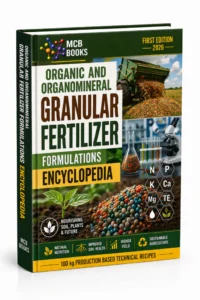
The ORGANIC AND ORGANOMINERAL GRANULAR FERTILIZER FORMULATIONS ENCYCLOPEDIA provides practical information for professionals who want to understand the formulation and manufacturing principles of these products. With production-based formulations, raw material functions, and technical manufacturing guidance, the book can support fertilizer manufacturers, entrepreneurs, agricultural companies, and formulation specialists developing commercial granular fertilizer products.
Successful commercial production depends on combining technically balanced formulations with reliable processing methods. By controlling each manufacturing stage from raw material selection to final packaging, producers can develop consistent, stable, and commercially competitive organic and organomineral granular fertilizers for modern agricultural applications.