 The quality and performance of organic and organomineral granular fertilizers depend strongly on the selection of appropriate raw materials. Each ingredient used in a fertilizer formulation has a specific purpose, such as supplying nutrients, increasing organic matter, supporting granulation, improving physical stability, or enhancing the handling characteristics of the final product. Understanding these raw materials and their functions is therefore essential for professional and commercial fertilizer manufacturing.
Organic matter sources are among the most important components of organic and organomineral granular fertilizers. Depending on the formulation, manufacturers may use processed plant materials, composted organic matter, humic substances, lignite-derived materials, or other suitable organic ingredients. These materials contribute organic carbon and may help improve soil structure, nutrient retention, and overall soil fertility.
Humic acid and fulvic substances are commonly incorporated into organomineral fertilizer formulations. Humic substances can support nutrient availability, root development, and soil conditioning. They are particularly useful in fertilizer products designed to combine mineral nutrition with the benefits of organic matter.
Nitrogen sources are used to promote vegetative growth and protein formation in plants. Common nitrogen-containing raw materials may include urea, ammonium sulfate, or other suitable nitrogen fertilizers. The selected nitrogen source must be compatible with the other ingredients and with the intended nutrient specification of the final granular fertilizer.
Phosphorus-containing materials are included primarily to support root development, energy transfer, flowering, and early plant establishment. Phosphate-based fertilizers can be incorporated into organomineral formulations according to the targeted phosphorus content.
Potassium sources are important for plant water regulation, crop quality, stress tolerance, and fruit development. Potassium sulfate, potassium chloride, or other suitable potassium materials may be selected depending on crop requirements and formulation objectives.
Secondary nutrients such as calcium, magnesium, and sulfur may also be incorporated. Calcium contributes to plant structural development, magnesium is essential for chlorophyll formation, and sulfur supports protein and enzyme synthesis. These nutrients allow manufacturers to create more complete fertilizer formulations for specific crops and soil conditions.
Micronutrients such as iron, zinc, manganese, copper, boron, and molybdenum are required in smaller quantities but remain essential for many plant physiological processes. Micronutrient-enriched organomineral fertilizers can be developed for crops or soils where specific deficiencies are common.
In addition to nutrient sources, granular fertilizer production may require functional raw materials such as binders, fillers, granulation aids, anti-caking agents, and coating materials. Binders help particles form strong granules, while fillers can adjust product composition and physical characteristics. Granulation aids support particle formation, and coatings may improve flowability, reduce dust, and minimize caking during storage.
Particle size, moisture content, compatibility, nutrient concentration, and chemical stability should all be considered when selecting raw materials. Poorly matched ingredients may lead to segregation, weak granules, excessive moisture absorption, caking, or inconsistent nutrient distribution.
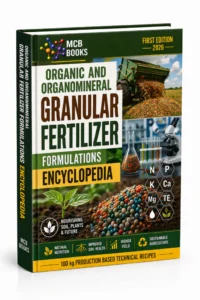
The ORGANIC AND ORGANOMINERAL GRANULAR FERTILIZER FORMULATIONS ENCYCLOPEDIA provides practical information about raw material selection, fertilizer formulations, ingredient functions, and commercial production principles. It can serve as a valuable technical reference for fertilizer manufacturers, agricultural companies, production specialists, and entrepreneurs developing professional organic and organomineral granular fertilizer products.
By understanding the function of every ingredient, manufacturers can design more balanced formulations, improve production efficiency, and develop stable granular fertilizers with consistent nutrient content and reliable agricultural performance.