 The production of organic and organomineral granular fertilizers requires a carefully controlled manufacturing process to obtain uniform, stable, and commercially acceptable fertilizer granules. Mixing, granulation, drying, screening, and coating are among the most important stages of production. Each step directly influences nutrient distribution, granule strength, moisture stability, flowability, storage performance, and the overall quality of the finished fertilizer.
The first major stage is mixing. Organic materials, mineral nutrient sources, micronutrients, fillers, binders, and other formulation components are accurately weighed according to the selected recipe. These raw materials are then blended until a homogeneous mixture is obtained. Uniform mixing is essential because poor distribution can result in inconsistent nutrient concentrations within the final product. Particle size, moisture content, and compatibility of the raw materials should also be considered during this stage.
Granulation follows the mixing process. During granulation, the blended fertilizer materials are converted into granules of a controlled size. Depending on the production technology, moisture, binders, or granulation aids may be introduced to promote particle adhesion and granule formation. Drum granulators, disc granulators, or other suitable granulation systems can be used in industrial fertilizer production. Proper control of feed rate, moisture level, residence time, and equipment operating conditions is important for producing strong and uniform granules.
After granulation, the wet fertilizer granules must be dried. Drying removes excess moisture and helps improve the mechanical stability and storage properties of the product. Drying temperature and residence time should be carefully controlled because excessive heat can negatively affect some organic materials, while insufficient drying may cause caking, microbial activity, or poor shelf stability. After drying, the fertilizer is generally cooled before further processing.
Screening is used to separate granules according to particle size. The desired commercial fraction is collected, while oversized particles can be crushed and recycled. Fine particles may also be returned to the granulation stage. This recycling system can improve raw material utilization and help manufacturers maintain a consistent granule size distribution.
Coating is often used as the final conditioning stage. Anti-caking agents, dust-control materials, or suitable coating substances may be applied to the granules to improve flowability, reduce dust formation, and prevent the particles from sticking together during storage and transportation. The coating must be applied evenly to obtain consistent product performance.
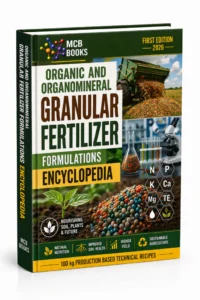
The ORGANIC AND ORGANOMINERAL GRANULAR FERTILIZER FORMULATIONS ENCYCLOPEDIA provides practical information about fertilizer formulations, raw materials, production methods, and commercial manufacturing principles. It is designed to support fertilizer manufacturers, agricultural companies, production engineers, and entrepreneurs interested in professional organic and organomineral granular fertilizer production.
Successful fertilizer manufacturing depends on controlling every production stage. Proper mixing ensures nutrient uniformity, granulation determines particle formation, drying provides moisture stability, screening controls granule size, and coating improves final handling characteristics. By combining technically balanced formulations with carefully managed production methods, manufacturers can develop stable, consistent, and commercially competitive organic and organomineral granular fertilizers for modern agricultural applications.