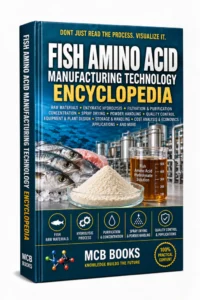
 Starting a fish amino acid manufacturing plant requires careful planning of raw materials, processing technology, equipment, quality control, and waste management. The production system must be designed to convert fish or fish-processing by-products into a stable amino acid-rich liquid or powder suitable for agricultural applications.
The first consideration is raw material supply. Fish heads, frames, skin, viscera, trimmings, off-cuts, and other protein-rich fish residues can be used as feedstock. Raw materials should be fresh or properly preserved because uncontrolled decomposition can negatively affect product quality, odor, microbiological stability, and processing efficiency.
A typical production line begins with receiving, washing, sorting, and size reduction. Crushers, grinders, or industrial mincers are commonly used to prepare the fish material before hydrolysis. The processed raw material is then transferred to a hydrolysis reactor equipped with agitation, temperature control, and pH monitoring.
The hydrolysis stage is the core of the plant. Manufacturers may select enzymatic hydrolysis, acid hydrolysis, or another controlled protein-decomposition process. Enzymatic systems require accurate control of enzyme dosage, temperature, pH, and reaction time, while acid hydrolysis requires suitable chemical handling systems and corrosion-resistant equipment.
After hydrolysis, the mixture must be separated into useful soluble fractions and unwanted solids. Screens, filters, decanter centrifuges, separators, or clarification systems may be used to remove bones, undigested tissues, suspended matter, and excess fats.
The clarified fish amino acid solution is then concentrated using evaporation equipment when a higher-solids product is required. Liquid products may proceed to stabilization, fine filtration, storage, and packaging. For powder production, additional equipment such as spray dryers, powder collection systems, mills, sieves, and packaging machines is required.
A complete fish amino acid manufacturing plant may therefore include raw material receiving tanks, grinders, hydrolysis reactors, dosing systems, pumps, filtration units, centrifuges, evaporators, storage tanks, dryers, laboratory equipment, and packaging lines.
Quality control is another critical production requirement. Manufacturers should monitor parameters such as pH, total nitrogen, free amino acid content, moisture, solids, solubility, density, microbiological quality, and heavy metals.
Plant design should also include odor control, wastewater treatment, cleaning systems, hygienic processing areas, and proper handling of solid residues. With a well-designed process flow and reliable raw material supply, fish-processing by-products can be converted into commercially valuable fish amino acid products for fertilizer and biostimulant manufacturing.