
 Starting a plant-derived amino acid powder manufacturing plant requires careful planning of raw materials, hydrolysis technology, separation systems, concentration and drying equipment, quality control, utilities, and production capacity. The efficiency and profitability of the plant depend largely on choosing the correct protein source and designing a process that delivers consistent amino acid content and powder quality.
The first stage is raw material selection. Common vegetable protein sources include soybean meal, soy protein, corn protein, wheat protein, pea protein, rice protein, and other protein-rich plant materials. Each raw material has a different protein composition, ash level, carbohydrate content, moisture level, and hydrolysis behavior. Raw material consistency is therefore one of the most important factors in industrial production.
Before hydrolysis, the plant material may require grinding, screening, hydration, or slurry preparation. Typical equipment can include crushers, mills, vibrating screens, feeding systems, storage silos, mixing tanks, and transfer pumps. Proper preparation helps improve contact between the protein material and the hydrolysis medium.
The main production stage is protein hydrolysis. Depending on the desired product, manufacturers may use enzymatic, acid, alkaline, or combined hydrolysis. Industrial hydrolysis reactors usually require agitation, heating or cooling, pH monitoring, dosing systems, temperature control, and corrosion-resistant construction.
Hydrolysis conditions strongly influence the final amino acid and peptide profile. Parameters such as reaction time, temperature, pH, enzyme dosage, reagent concentration, solid-to-liquid ratio, and mixing intensity must therefore be carefully controlled.
After hydrolysis, the mixture is transferred to solid-liquid separation and clarification equipment. Filter presses, centrifuges, decanters, settling tanks, bag filters, or membrane filtration systems may be used to remove insoluble plant residues and obtain a cleaner amino acid-rich solution.
The clarified liquid can then enter a purification and refinement section. Depending on the required product grade, the plant may include activated carbon treatment, membrane separation, fine filtration, ion exchange, decolorization, or other purification systems. This stage is important for controlling ash, color, odor, insoluble matter, and overall product consistency.
The purified amino acid solution is normally sent to a concentration system before drying. Vacuum evaporators are commonly considered because they can increase solids content while reducing unnecessary thermal exposure. Efficient concentration can also reduce dryer energy consumption.
For powder production, the concentrated solution is transferred to a drying system. Spray dryers are widely used in industrial plants because they provide continuous operation, rapid moisture removal, and relatively uniform powder formation. Dryer design should consider feed solids, viscosity, inlet and outlet temperature, atomization system, airflow, powder recovery, and production capacity.
After drying, the product may pass through milling, sieving, blending, and packaging equipment. These operations help manufacturers achieve uniform particle size and standardized commercial specifications. Moisture-resistant packaging is particularly important for powders that can absorb humidity during storage.
A complete plant also requires a quality control laboratory. Typical tests may include total amino acid content, free amino acid content, moisture, pH, ash, solubility, particle size, bulk density, color, and appearance. Depending on the intended market, additional microbiological, heavy metal, or contaminant testing may also be necessary.
The main cost factors in a plant-derived amino acid powder manufacturing plant include vegetable protein raw materials, enzymes or hydrolysis chemicals, water, energy, filtration materials, evaporation, drying, labor, wastewater treatment, equipment maintenance, laboratory analysis, packaging, and plant capacity.
Hydrolysis efficiency and drying energy consumption can have a major impact on production economics. A plant with poor protein conversion, excessive product losses, or inefficient evaporation and drying can have significantly higher manufacturing costs.
For this reason, plant design should focus on raw material utilization, hydrolysis yield, energy efficiency, water management, filtration performance, automation, powder recovery, and consistent quality control rather than production capacity alone.
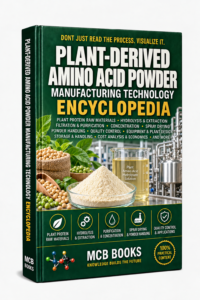
The PLANT-DERIVED AMINO ACID POWDER MANUFACTURING TECHNOLOGY ENCYCLOPEDIA provides comprehensive technical information on vegetable protein raw materials, hydrolysis technologies, plant equipment, purification systems, concentration, drying, process control, quality testing, troubleshooting, and industrial plant-derived amino acid powder manufacturing.