
In modern agriculture, achieving larger fruit size and higher yields is a primary goal for growers and commercial producers. Among the most effective tools to accomplish this is Gibberellic Acid (GA3), a powerful plant growth regulator known for its ability to stimulate cell elongation, improve fruit set, and enhance overall crop performance.
However, not all GA3 products deliver the same results. The effectiveness of gibberellin depends heavily on the formulation type, application method, and combination with other nutrients or hormones. Selecting the right formulation can significantly impact fruit size, uniformity, and yield.
In this guide, we will explore the best gibberellin formulations for fruit size increase and yield improvement, including their composition, advantages, and application strategies.
HOW GIBBERELLIN IMPROVES FRUIT SIZE AND YIELD
Gibberellins work at the cellular level to promote growth and development.
Key Mechanisms
- Stimulate cell elongation and division
- Enhance nutrient mobilization
- Improve fruit set and retention
- Increase photosynthetic efficiency indirectly
These effects result in larger fruits, better shape, and higher overall productivity.
TOP GA3 FORMULATION TYPES FOR FRUIT SIZE INCREASE
1. Liquid GA3 Formulations (SL – Soluble Liquid)
Overview
Liquid formulations are the most widely used for fruit crops due to their fast absorption and ease of application.
Advantages
- Rapid uptake through leaves
- Uniform coverage on fruit surfaces
- Immediate physiological response
Best Use Cases
- Grapes
- Apples
- Citrus
Why It Works
Liquid GA3 penetrates plant tissues quickly, making it ideal for critical growth stages such as fruit set and early development.
2. GA3 + Micronutrient Blends
Overview
Combining GA3 with micronutrients such as zinc, boron, or iron enhances overall plant metabolism.
Benefits
- Improved nutrient uptake
- Stronger plant growth
- Enhanced fruit development
Typical Components
- GA3
- Zinc (Zn)
- Boron (B)
- Iron (Fe)
Why It Works
Micronutrients support enzymatic activity and hormonal balance, amplifying the effects of GA3.
3. Soluble Powder GA3 (SP)
Overview
Soluble powders are widely used due to their stability and long shelf life.
Advantages
- Easy storage and transport
- Consistent concentration
- High stability
Best Use Cases
- Large-scale farming
- Export-oriented production
Why It Works
SP formulations provide reliable and uniform performance when properly dissolved and applied.
4. GA3 + Auxin Combination Formulations
Overview
Combining GA3 with auxins (such as NAA or IBA) creates a synergistic effect.
Benefits
- Improved fruit set
- Reduced fruit drop
- Enhanced fruit size
Why It Works
Auxins help in fruit retention while GA3 promotes growth, resulting in higher yield and better quality.
5. Controlled Release GA3 Granules (GR)
Overview
Granular formulations are designed for slow and sustained release.
Advantages
- Long-lasting effect
- Reduced application frequency
- Suitable for soil application
Best Use Cases
- Orchards
- Perennial crops
Why It Works
Controlled release ensures continuous availability of GA3 during critical growth periods.
6. Nano-Based GA3 Formulations
Overview
Advanced nano formulations are gaining popularity in precision agriculture.
Benefits
- Enhanced absorption efficiency
- Reduced dosage requirements
- Improved effectiveness
Why It Works
Nano-sized particles increase the surface area, allowing better penetration into plant tissues.
COMPARISON OF BEST GA3 FORMULATIONS
| Formulation Type | Absorption Speed | Effect Duration | Best Application |
|---|---|---|---|
| Liquid (SL) | Fast | Short | Foliar spray |
| Powder (SP) | Medium | Medium | Foliar spray |
| Granular (GR) | Slow | Long | Soil application |
| GA3 + Nutrients | Fast | Medium | Foliar spray |
| Nano Formulations | Very Fast | Medium | Precision agriculture |
APPLICATION STRATEGIES FOR MAXIMUM RESULTS
1. Timing
- Apply during early fruit development stage
- Avoid late applications that may affect quality
2. Dosage
- Follow recommended ppm levels
- Overuse can cause excessive elongation
3. Method
- Foliar spray is most effective
- Ensure uniform coverage
4. Environmental Conditions
- Avoid high temperatures and strong sunlight
- Apply during early morning or evening
COMMON MISTAKES TO AVOID
- Incorrect dosage leading to poor results
- Using unstable formulations
- Applying at the wrong growth stage
- Poor mixing or dilution
ADVANCED FORMULATION TRENDS
Modern agriculture is moving toward:
- Multi-hormone formulations
- Nano delivery systems
- Controlled release technologies
These innovations improve efficiency and reduce environmental impact.COMMERCIAL IMPORTANCE
The use of optimized GA3 formulations is critical for:
- Increasing export-quality fruit production
- Improving consistency and uniformity
- Maximizing profitability
High-performance formulations are particularly important in competitive markets.
PROFESSIONAL FORMULATION KNOWLEDGE
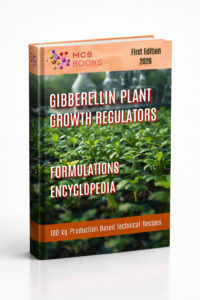
For those interested in advanced formulations and industrial production, the Gibberellin Plant Growth Regulators Formulations Encyclopedia provides:
- Detailed formulation strategies
- Industrial production methods
- Commercial product insights
- High-performance formulation systems
This resource is essential for professionals aiming to develop premium agricultural products.
SUMMARY
Gibberellin (GA3) is a powerful tool for increasing fruit size and improving yield, but its success depends on selecting the right formulation. Liquid, powder, granular, and advanced nano formulations each offer unique advantages depending on the crop and application method.
By understanding formulation types and applying them correctly, growers can significantly enhance crop performance, improve fruit quality, and achieve higher profitability.
As agricultural technologies continue to evolve, optimized GA3 formulations will remain a key factor in high-efficiency farming systems.