
Gibberellin-based plant growth regulators (PGRs) are essential components of modern agriculture, widely used to enhance plant growth, increase yield, and improve crop quality. Among the various gibberellins, Gibberellic Acid (GA3) is the most commercially important due to its strong biological activity and consistent performance across different crops.
The industrial production of gibberellins involves a combination of biotechnological fermentation, chemical processing, and advanced formulation techniques. Unlike many agrochemicals that are synthesized purely through chemical reactions, gibberellins are primarily produced through microbial fermentation, making their production process both scientifically complex and highly specialized.
In this article, we will explain the complete industrial production process of gibberellin-based plant growth regulators, from raw material preparation to final formulation and packaging.
OVERVIEW OF GIBBERELLIN PRODUCTION
Gibberellins are naturally produced by certain fungi, especially Gibberella fujikuroi. Industrial production mimics this natural process under controlled conditions to obtain high yields of GA3.
Key Production Stages
- Fermentation
- Extraction
- Purification
- Formulation
- Packaging
Each stage plays a critical role in determining product quality, purity, and performance.
RAW MATERIALS AND INPUTS
Industrial production requires carefully selected raw materials to ensure efficiency and consistency.
1. Microbial Strain
- Gibberella fujikuroi (primary production organism)
- High-yield strains are selected through biotechnology
2. Fermentation Substrates
- Glucose or sucrose (carbon source)
- Nitrogen sources (ammonium salts, urea)
- Minerals and trace elements
3. Solvents
- Ethyl acetate, methanol
- Used for extraction and purification
4. Additives
- Antifoaming agents
- pH regulators
FERMENTATION PROCESS
1. Inoculum Preparation
The selected fungal strain is cultured in a sterile environment to prepare the inoculum.
2. Fermentation Stage
- Conducted in large bioreactors
- Temperature: 25–30°C
- pH: Controlled (typically 5–6)
- Aeration and agitation are maintained
During fermentation, the microorganism produces gibberellic acid as a secondary metabolite.
3. Monitoring
- Biomass growth
- GA3 concentration
- pH and dissolved oxygen
The fermentation process typically lasts several days.
EXTRACTION OF GA3
After fermentation, GA3 must be separated from the fermentation broth.
Steps
- Filtration
Remove microbial biomass - Solvent Extraction
Use organic solvents (e.g., ethyl acetate) - Phase Separation
Separate organic and aqueous layers - Concentration
Evaporate solvent to obtain crude GA3
PURIFICATION PROCESS
Crude GA3 contains impurities and must be purified to achieve commercial-grade quality.
Common Techniques
- Recrystallization
- Chromatography
- Activated carbon treatment
Final Output
- Technical GA3 (90%–95% purity)
- Further refined grades for specialized applications
FORMULATION OF GIBBERELLIN PRODUCTS
Once purified, GA3 is converted into usable agricultural products.
Common Formulation Types
1. Soluble Powder (SP)
- Mixed with carriers and dispersants
- Easily dissolved in water
2. Liquid Concentrate (SL)
- Dissolved in solvents
- Includes stabilizers and surfactants
3. Granular Formulations (GR)
- Combined with carriers for soil application
- Controlled release
FORMULATION PROCESS (INDUSTRIAL SCALE)
Step 1: Pre-Mixing
Active ingredient is combined with formulation additives.
Step 2: Homogenization
Ensure uniform distribution of GA3.
Step 3: Stabilization
Add stabilizers to prevent degradation.
Step 4: Quality Adjustment
Adjust pH, viscosity, and concentration.
Step 5: Final Processing
- Filtration (liquids)
- Milling (powders)
- Granulation (solids)
QUALITY CONTROL AND TESTING
Industrial production requires strict quality control to ensure product consistency.
Key Parameters
- Active ingredient content
- Purity level
- pH value
- Stability under storage conditions
- Solubility and dispersibility
Products must meet regulatory standards before commercialization.
PACKAGING AND STORAGE
Proper packaging is essential to maintain product stability.
Packaging Requirements
- UV-resistant containers
- Airtight sealing
- Moisture-proof materials
Storage Conditions
- Cool and dry environment
- Protection from direct sunlight
CHALLENGES IN INDUSTRIAL PRODUCTION
1. Fermentation Efficiency
- Requires optimized conditions for high yield
2. Purification Cost
- Advanced techniques increase production cost
3. Stability Issues
- GA3 degrades under unfavorable conditions
4. Scale-Up Complexity
- Maintaining consistency at large scale is challenging
ADVANCED PRODUCTION TECHNOLOGIES
Modern industries are adopting innovative techniques to improve efficiency:
Strain Improvement
- Genetic engineering for higher yield
Bioprocess Optimization
- Automated fermentation control systems
Nano Formulations
- Enhanced delivery and effectiveness
Microencapsulation
- Improved stability and controlled release
COMMERCIAL IMPORTANCE
Gibberellin-based plant growth regulators are widely used in:
- Fruit production (grapes, apples, citrus)
- Vegetable cultivation
- Seed treatment
- Ornamental plants
The global demand is increasing due to the need for higher agricultural productivity and quality.
PROFESSIONAL FORMULATION INSIGHT
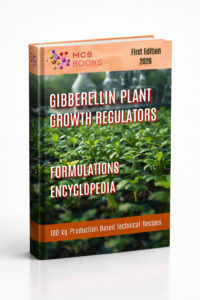
For those interested in industrial-scale production and advanced formulations, the Gibberellin Plant Growth Regulators Formulations Encyclopedia provides:
- Detailed industrial formulations
- Production techniques
- Raw material selection
- Commercial product strategies
This resource is valuable for manufacturers and entrepreneurs in the agrochemical industry.
SUMMARY
The industrial production of gibberellin-based plant growth regulators is a complex process that combines biotechnology, chemical engineering, and formulation science. From microbial fermentation to final product formulation, each stage requires precision and expertise.
Gibberellic Acid (GA3) remains a key component in modern agriculture due to its effectiveness and versatility. As technology advances, production processes are becoming more efficient, enabling the development of high-quality, stable, and innovative PGR products.
Understanding this production process is essential for anyone involved in agrochemical manufacturing or agricultural innovation.