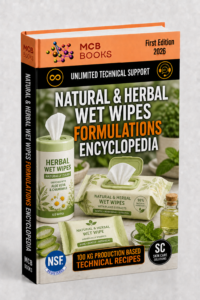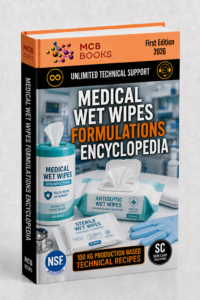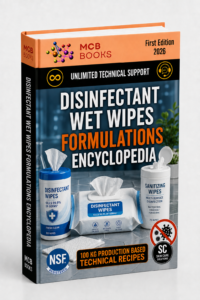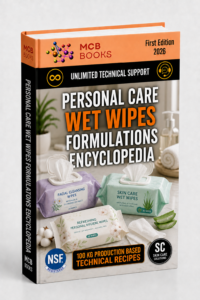
Commercial cleaning wipes are practical, ready-to-use products developed for removing grease, oil, dust, fingerprints, workshop residues, inks, adhesives, lubricants, and other contaminants from professional and industrial surfaces. They are widely used in factories, automotive service centers, warehouses, construction sites, maintenance departments, offices, hotels, printing facilities, engineering plants, and institutional cleaning operations.
Successful commercial cleaning wipes production requires more than combining a cleaning liquid with nonwoven fabric. Manufacturers must develop a balanced formulation, select a durable substrate, control liquid impregnation, use compatible packaging, and establish reliable quality-control procedures. Cleaning strength, surface compatibility, drying speed, odor, residue formation, production cost, and storage stability must all be considered during product development.
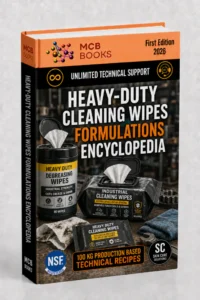
The HEAVY-DUTY CLEANING WIPES FORMULATIONS ENCYCLOPEDIA has been prepared for manufacturers, formulation specialists, private-label producers, chemical suppliers, entrepreneurs, and investors seeking practical technical information about professional cleaning wipes. It covers water-based, solvent-based, hybrid, degreasing, machinery-cleaning, adhesive-removal, ink-removal, and multi-surface industrial wipe formulations.
Commercial cleaning wipes solutions may contain purified water, surfactants, cleaning solvents, alkaline builders, chelating agents, corrosion inhibitors, pH regulators, preservatives, hydrotropes, solubilizers, stabilizers, and optional fragrance materials. The exact composition depends on the intended contamination, surface type, required cleaning strength, drying rate, safety profile, and product positioning.
Water-based heavy-duty cleaning wipes are commonly selected for products requiring lower odor, reduced solvent content, and broader surface compatibility. Purified or deionized water serves as the main carrier, while low-foam surfactants help loosen grease, oils, dust, and particulate contamination. Water-compatible solvents may be added to improve the removal of inks, lubricants, adhesives, and stubborn industrial residues.
Solvent-based cleaning wipes are generally developed for heavier oils, waxes, sealants, printing inks, adhesive residues, and difficult workshop contamination. Suitable solvents may include alcohols, glycol ethers, esters, hydrocarbons, or other industrial cleaning materials. Solvent selection must consider cleaning performance, evaporation rate, odor, flammability, worker exposure, packaging compatibility, and potential effects on plastics, rubber, painted surfaces, or protective coatings.
The HEAVY-DUTY CLEANING WIPES FORMULATIONS ENCYCLOPEDIA explains how these raw materials can be combined in professionally structured commercial formulas. It also helps manufacturers understand the importance of balancing powerful soil removal with controlled pH, low residue, corrosion protection, formulation stability, and material compatibility.
During production, purified water is transferred into a clean and chemically resistant mixing tank. Water-soluble ingredients such as chelating agents, preservatives, builders, and pH regulators are added under controlled agitation. Surfactants, cleaning solvents, corrosion inhibitors, solubilizers, and other additives are then incorporated according to the required production sequence.
Volatile or flammable ingredients should be handled with appropriate ventilation, grounding, safe storage, ignition-source control, and personal protective equipment. Excessive agitation should be avoided when it causes foam formation or increases solvent evaporation.
The finished cleaning solution should be tested for appearance, odor, pH, density, viscosity, stability, cleaning efficiency, drying behavior, residue formation, microbiological quality, and surface compatibility. Tests should be conducted on all materials listed for product use, including stainless steel, aluminum, painted metal, plastic, rubber, glass, ceramic, and sealed surfaces.
The selected nonwoven fabric should provide high wet strength, absorbency, abrasion resistance, low lint formation, and controlled liquid release. Textured materials can improve mechanical scrubbing, while softer fabrics may be preferred for polished or more sensitive surfaces.
The prepared solution is applied to the nonwoven material through a controlled impregnation system. Finished wipes may be packaged in canisters, industrial buckets, soft packs, refill bags, or individually sealed sachets. Packaging must prevent leakage, drying, contamination, and solvent loss throughout the intended shelf life.
The HEAVY-DUTY CLEANING WIPES FORMULATIONS ENCYCLOPEDIA provides a valuable technical foundation for companies entering or expanding within the commercial cleaning wipes market. By combining professional formulations, controlled manufacturing, durable nonwoven fabrics, compatible packaging, and consistent quality testing, producers can manufacture effective and commercially competitive cleaning wipes for professional, commercial, and industrial applications.