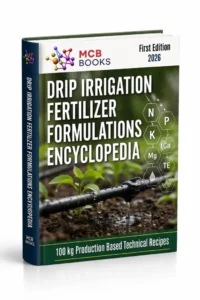
Modern agriculture increasingly depends on efficient irrigation and precise plant nutrition. Drip irrigation systems allow growers to deliver water and nutrients directly to the root zone, helping reduce waste, improve nutrient uptake, and support consistent crop development. However, the success of fertigation depends heavily on the quality, solubility, stability, and compatibility of the fertilizer products used. The Drip Irrigation Fertilizer Formulations Encyclopedia is designed to provide practical and professional guidance for companies, agricultural chemical manufacturers, entrepreneurs, and technical specialists interested in producing fertilizers for drip irrigation systems.
Drip irrigation fertilizers are specially developed to dissolve completely in water and move easily through irrigation lines without causing sediment, crystallization, or emitter blockage. These products may contain nitrogen, phosphorus, potassium, secondary nutrients, trace elements, organic acids, chelating agents, pH regulators, and stabilizing materials. Each ingredient must be selected carefully according to its solubility, chemical compatibility, nutrient concentration, and intended agricultural application.
Professional fertilizer production requires more than simply combining nutrient salts. The formulation must be balanced to prevent precipitation and undesirable chemical reactions during manufacturing, storage, dilution, and field application. Calcium-containing materials, for example, may react with phosphates or sulfates and produce insoluble compounds. For this reason, raw material selection, addition order, water quality, production temperature, pH control, and mixing conditions are critical elements of the manufacturing process.
The Drip Irrigation Fertilizer Formulations Encyclopedia includes professional fertilizer production formulas developed on a practical manufacturing basis. The book focuses on different product groups that can be used in fertigation programs for vegetables, fruit trees, greenhouse crops, field crops, ornamental plants, and soilless cultivation systems. Depending on the formulation, products may be prepared as liquid fertilizers, concentrated nutrient solutions, water-soluble powders, micronutrient mixtures, NPK fertilizers, root-development fertilizers, flowering fertilizers, fruit-development fertilizers, and crop-specific nutrient blends.
One of the main advantages of professional fertigation products is their ability to deliver nutrients in controlled and readily available forms. Nitrogen can support vegetative growth, phosphorus can contribute to root development and energy transfer, while potassium can help improve flowering, fruit formation, water regulation, and crop quality. Micronutrients such as iron, zinc, manganese, copper, boron, and molybdenum are also essential for enzyme activity, chlorophyll formation, reproductive development, and overall plant metabolism.
The book also provides information about raw material functions, production procedures, product characteristics, application principles, and technical properties. Formulations are presented to help readers better understand how commercial fertilizer products can be developed and manufactured. This makes the encyclopedia useful not only for experienced fertilizer producers but also for investors and entrepreneurs planning to establish a small- or medium-scale agricultural fertilizer production business.
Water quality is another major consideration in drip irrigation fertilizer production. Hardness, bicarbonate content, electrical conductivity, and pH can affect fertilizer solubility and system performance. Professional formulations should therefore be tested under realistic dilution conditions before commercial use. Storage stability, packaging compatibility, nutrient analysis, filtration, and quality-control procedures must also be evaluated.
With its practical approach and professionally structured content, the Drip Irrigation Fertilizer Formulations Encyclopedia can serve as a valuable technical reference for developing efficient, stable, and commercially applicable fertigation products. Businesses seeking to expand their agricultural chemical product range can use the book as a guide for understanding fertilizer formulation, production planning, raw material selection, and modern drip irrigation nutrition technologies.