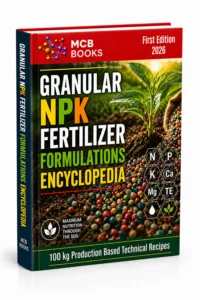
 Commercial fertilizer production requires accurate formulations, carefully selected raw materials, suitable manufacturing equipment, and controlled quality standards. Granular NPK fertilizers are among the most widely used agricultural inputs because they supply nitrogen, phosphorus, and potassium in balanced or crop-specific ratios. These nutrients support vegetative growth, root development, flowering, fruit formation, stress resistance, and overall crop productivity. For fertilizer manufacturers and entrepreneurs, access to reliable technical information can make product development more efficient and reduce costly formulation mistakes.
The GRANULAR NPK FERTILIZER FORMULATIONS ENCYCLOPEDIA is designed for businesses, technical specialists, agricultural engineers, researchers, production managers, and investors interested in professional granular fertilizer manufacturing. It provides practical guidance on production formulas, raw material functions, manufacturing methods, technical specifications, application areas, and quality-control procedures. This information can help producers develop commercial fertilizer products suitable for different crops, soils, climates, and agricultural production systems.
Granular NPK fertilizers may be manufactured in standard grades such as NPK 15-15-15, NPK 20-10-10, NPK 12-12-17, NPK 10-20-20, and NPK 8-24-24. Customized blends can also be designed for cereals, vegetables, fruit trees, vineyards, greenhouse crops, industrial plants, and chloride-sensitive species. Common raw materials include urea, ammonium sulfate, monoammonium phosphate, diammonium phosphate, potassium chloride, potassium sulfate, fillers, binders, micronutrients, coating agents, and anticaking materials.
Commercial manufacturing generally includes raw material inspection, crushing, screening, weighing, blending, granulation, drying, cooling, final screening, coating, and packaging. Each production stage affects the chemical and physical quality of the finished fertilizer. Accurate dosing helps achieve the declared nutrient analysis, while effective mixing supports uniform nutrient distribution. Controlled granulation produces stable particles, and proper drying and cooling improve hardness, moisture balance, and storage performance.
The GRANULAR NPK FERTILIZER FORMULATIONS ENCYCLOPEDIA can also support manufacturers in understanding particle-size control, dust reduction, caking prevention, flowability, coating performance, and batch consistency. Finished fertilizers should be tested for nitrogen, phosphorus, potassium, moisture, bulk density, granule strength, particle-size distribution, nutrient uniformity, and storage stability. Packaging weight, labeling, traceability, and production records should also be monitored carefully.
A broad product portfolio can help fertilizer companies serve multiple agricultural markets and respond to changing customer requirements. Producers may develop balanced fertilizers, starter products, high-nitrogen formulas, high-potassium grades, micronutrient-enriched products, and crop-specific blends. Reliable formulations can simplify laboratory trials, pilot production, cost calculations, and industrial batch scaling.
The GRANULAR NPK FERTILIZER FORMULATIONS ENCYCLOPEDIA is a valuable technical and commercial resource for anyone planning to establish, improve, or expand a fertilizer production business. With production-focused formulas and practical manufacturing guidance, the encyclopedia can help companies create stable, effective, and marketable granular NPK fertilizers for professional agricultural use.