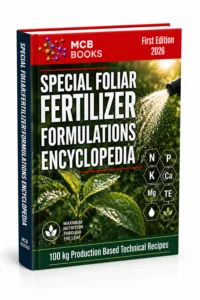
 Foliar fertilizers are specialized plant nutrition products applied directly to leaf surfaces to deliver nutrients quickly and efficiently. They are widely used in field crops, vegetables, fruit trees, vineyards, greenhouse plants, ornamental species, and intensive agricultural production systems. Successful foliar fertilizer manufacturing requires accurate formulations, highly soluble raw materials, suitable chelating agents, controlled pH, good solution stability, and reliable quality-control procedures.
The SPECIAL FOLIAR FERTILIZER FORMULATIONS ENCYCLOPEDIA is designed for fertilizer manufacturers, agricultural engineers, formulation specialists, researchers, production managers, investors, and entrepreneurs interested in commercial foliar fertilizer production. It provides practical technical information about production formulas, raw material functions, manufacturing processes, application areas, product specifications, and quality requirements.
Commercial foliar fertilizer formulations may contain nitrogen, phosphorus, potassium, magnesium, calcium, sulfur, iron, zinc, manganese, copper, boron, and molybdenum. These nutrients can be supplied through water-soluble salts, chelated micronutrients, organic complexes, amino acids, seaweed extracts, humic substances, and selected plant-supporting additives. The choice of each ingredient depends on the target crop, nutritional deficiency, growth stage, application rate, water quality, and desired product performance.
Foliar fertilizers can be developed for vegetative growth, root support, flowering, fruit setting, fruit enlargement, color formation, stress resistance, and crop quality improvement. Special products may also be designed for cereals, vegetables, citrus fruits, grapes, olives, tomatoes, potatoes, cotton, maize, and greenhouse crops. Crop-specific formulations allow manufacturers to serve different agricultural markets and create a wider commercial product portfolio.
The manufacturing process generally begins with water preparation, raw material inspection, accurate weighing, and controlled mixing. Highly soluble ingredients should be added in the correct order to prevent precipitation, incompatibility, and sediment formation. pH adjustment is especially important because it influences nutrient solubility, chelate stability, product compatibility, and storage performance. After mixing, the solution may be filtered to remove insoluble particles before final quality testing and packaging.
The SPECIAL FOLIAR FERTILIZER FORMULATIONS ENCYCLOPEDIA provides production-focused guidance that can support laboratory trials, pilot batches, commercial manufacturing, and product development. It can help producers understand how nutrients, chelating agents, surfactants, stabilizers, preservatives, and other formulation components affect the final product.
Quality control should include testing for nutrient content, pH, density, appearance, solubility, filtration behavior, sediment formation, storage stability, and packaging compatibility. Manufacturers should also evaluate dilution stability and compatibility with commonly used agricultural inputs before recommending tank-mix applications.
The SPECIAL FOLIAR FERTILIZER FORMULATIONS ENCYCLOPEDIA : COMMERCIAL PRODUCTION FORMULAS AND MANUFACTURING GUIDE is a valuable technical resource for businesses planning to enter or expand within the foliar fertilizer market. With practical production formulas, manufacturing guidance, and raw material information, the book can support the development of stable, effective, and marketable foliar fertilizer products for professional agriculture.