Commercial fertilizer production requires much more than simply combining nutrient sources. Successful manufacturing depends on correctly designed formulations, suitable raw materials, controlled production processes, consistent quality standards, and an understanding of how each ingredient influences the final product. For companies planning to manufacture organic and organomineral granular fertilizers, access to practical formulation and production information can significantly simplify product development.
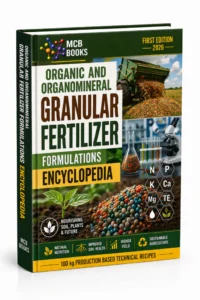
The ORGANIC AND ORGANOMINERAL GRANULAR FERTILIZER FORMULATIONS ENCYCLOPEDIA is designed as a practical technical reference for fertilizer manufacturers, agricultural companies, entrepreneurs, production specialists, and professionals interested in commercial granular fertilizer production. The book brings together formulation concepts, raw material functions, manufacturing methods, and production-based technical information for developing different types of organic and organomineral fertilizers.
One of the first stages of commercial fertilizer manufacturing is formulation design. Manufacturers must determine the target nutrient composition according to the intended product and agricultural application. Organic and organomineral fertilizers may contain organic matter, humic substances, nitrogen, phosphorus, potassium, calcium, magnesium, sulfur, and micronutrients such as iron, zinc, manganese, copper, boron, and molybdenum.
Different nutrient ratios can be developed for different agricultural purposes. Some products may focus on root development and early plant establishment, while others are designed for vegetative growth, flowering, fruit formation, fruit enlargement, or general crop nutrition. Manufacturers can also develop crop-specific fertilizers for vegetables, fruit trees, cereals, vineyards, greenhouse crops, and other agricultural applications.
Raw material selection is another important factor in commercial fertilizer production. Every ingredient should be evaluated according to nutrient concentration, compatibility, moisture content, particle size, physical characteristics, and its behavior during granulation. Organic materials, mineral nutrient sources, fillers, binders, granulation aids, and coating materials must work together to produce a stable and homogeneous granular fertilizer.
The manufacturing process generally includes raw material preparation, accurate weighing, mixing, granulation, drying, cooling, screening, coating, and packaging. Homogeneous mixing helps ensure uniform nutrient distribution, while controlled granulation creates particles with the required size and strength. Drying reduces excess moisture, and screening separates the desired commercial granules from oversized and undersized material.
Coating or anti-caking treatments may also be applied to improve flowability, reduce dust formation, and minimize caking during storage and transportation. These physical properties are particularly important for fertilizers that will be packaged, stored, transported, and mechanically applied in agricultural fields.
Quality control should be integrated into every commercial fertilizer production system. Important parameters may include nutrient content, organic matter level, moisture, pH, bulk density, particle size distribution, granule strength, appearance, flowability, and storage stability. Maintaining consistent specifications between production batches is essential for creating reliable commercial products.
The ORGANIC AND ORGANOMINERAL GRANULAR FERTILIZER FORMULATIONS ENCYCLOPEDIA also provides production-based formulation concepts that can help manufacturers understand ingredient quantities and their functions more clearly. 100 kg production formulas can be particularly useful during product development and manufacturing planning because they provide a practical basis for evaluating formulation structure before adapting production to larger industrial capacities.
For companies entering the fertilizer industry or expanding an existing product portfolio, the ORGANIC AND ORGANOMINERAL GRANULAR FERTILIZER FORMULATIONS ENCYCLOPEDIA can serve as a comprehensive guide to commercial fertilizer formulation and manufacturing. By combining practical formulas with information about raw materials, granulation technology, processing stages, and quality control, the book supports the development of professional organic and organomineral granular fertilizer products for modern agricultural markets.