
 Potassium fulvate powder is a highly soluble agricultural raw material produced by converting fulvic acid-rich materials into a stable potassium-based powder. It is widely used in fertilizers, foliar nutrients, fertigation products, soil conditioners, and specialty agricultural formulations because of its excellent water solubility and ability to support nutrient availability.
Potassium Fulvate Powder Manufacturing Process
Industrial potassium fulvate powder production generally starts with a fulvic acid-rich raw material obtained from sources such as leonardite, lignite, or other humic substances. The quality and composition of the starting material have a significant influence on the final product.
The raw material is first prepared and, when necessary, reduced to a suitable particle size to improve extraction efficiency. Fulvic substances are then extracted under controlled conditions using water and suitable alkaline reagents. Temperature, pH, mixing intensity, and extraction time must be carefully controlled to maximize the recovery of soluble fulvic fractions.
After extraction, the liquid is separated from insoluble residues through filtration, clarification, or centrifugation. This purification step is important because excessive suspended solids can affect the appearance, solubility, and consistency of the finished potassium fulvate powder.
Potassium Conversion and Concentration
The purified fulvic acid solution is reacted with a suitable potassium source under controlled pH conditions. This converts the soluble fulvic components into potassium fulvate. Correct reagent dosage and proper mixing are important for obtaining a stable product with consistent potassium and organic matter content.
The resulting potassium fulvate solution is then concentrated by removing part of the water. Evaporation systems may be used to increase solids concentration before drying.
Drying and Powder Production
The concentrated solution is converted into powder using industrial drying equipment, commonly spray drying or other suitable drying technologies. Drying conditions must be optimized to obtain a free-flowing powder while minimizing thermal degradation.
After drying, the product may be milled, sieved, blended, and packed according to the required particle size and commercial specification.
Quality Control of Potassium Fulvate Powder
Typical quality control parameters include moisture content, water solubility, potassium content, fulvic substance content, pH, particle size, and appearance. Batch consistency is particularly important for manufacturers supplying fertilizer and agricultural formulation companies.
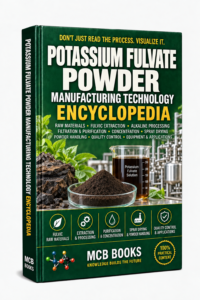
The POTASSIUM FULVATE POWDER MANUFACTURING TECHNOLOGY ENCYCLOPEDIA provides detailed technical information about raw materials, production stages, equipment, process control, drying technology, troubleshooting, and quality control required for industrial potassium fulvate powder manufacturing.