
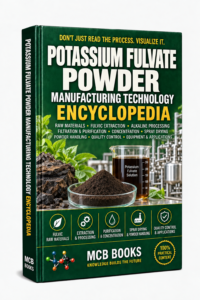
 Potassium fulvate powder is an important agricultural raw material widely used in water-soluble fertilizers, foliar feeds, fertigation products, soil conditioners, and specialty plant nutrition formulations. Industrial production typically involves converting fulvic acid or fulvic acid-rich material into a potassium-based, highly soluble powder through controlled neutralization, concentration, drying, and finishing stages.
Raw Materials Used in Potassium Fulvate Powder Manufacturing
The principal raw material is fulvic acid or a purified fulvic acid-rich extract. Depending on the production route, the fulvic fraction may originate from leonardite, lignite, humic substances, or other suitable organic mineral sources.
A potassium-containing alkaline material is then used to convert the fulvic acid into potassium fulvate. Potassium hydroxide is commonly associated with this type of conversion, although the exact reagent system depends on the desired product specification, potassium concentration, process economics, and manufacturer technology.
Water quality is also important. Process water should have controlled hardness and low levels of undesirable ions that could reduce solubility or cause precipitation during production.
Fulvic Acid Preparation and Dissolution
The fulvic acid feed is first introduced into a mixing system containing a controlled quantity of water. Agitation helps disperse and dissolve the soluble organic fractions.
During this stage, temperature and pH are monitored carefully. Proper dissolution is essential because incomplete dispersion can lead to sediment formation, filtration problems, and inconsistent finished-product quality.
When a raw fulvic extract is used instead of purified fulvic acid, additional clarification or filtration may be required before the potassium conversion step.
Conversion to Potassium Fulvate
The prepared fulvic acid solution is gradually reacted with a potassium source under controlled mixing conditions. The alkaline potassium reagent neutralizes acidic functional groups in the fulvic material and forms soluble potassium fulvate compounds.
Reagent addition should be controlled to prevent excessive localized alkalinity. Continuous monitoring of pH, temperature, viscosity, and solution appearance helps the operator maintain stable reaction conditions.
Once the target reaction conditions are reached, the solution may be held under agitation to promote complete conversion and homogenization.
Filtration and Purification
Following reaction, the potassium fulvate solution may undergo filtration, centrifugation, or clarification to remove insoluble mineral particles and other suspended impurities.
This stage plays an important role in producing a powder with good water solubility and low sediment formation. High-quality agricultural potassium fulvate products generally require careful control of insoluble matter.
Concentration of Potassium Fulvate Solution
Before drying, the purified solution is normally concentrated to increase its solids content. Evaporation reduces the amount of water that must be removed during the final drying operation.
The concentration stage must be controlled carefully because excessive temperatures can negatively affect the organic components. Vacuum evaporation or other low-temperature concentration technologies may therefore be useful for heat-sensitive materials.
Drying and Powder Formation
The concentrated potassium fulvate liquid is converted into powder using suitable industrial drying equipment. Spray drying is one of the commonly used approaches because it can produce a relatively uniform, rapidly soluble powder.
Dryer inlet temperature, outlet temperature, feed rate, atomization conditions, and solids concentration should be balanced to obtain the required moisture content, particle structure, and flow characteristics.
After drying, the powder may pass through milling and sieving equipment to achieve a consistent particle-size distribution.
Final Blending and Packaging
The dried product may be homogenized in a blending system before packaging. This helps improve batch uniformity, particularly when several drying batches are combined.
Packaging materials should provide adequate protection against moisture because potassium fulvate powders can be hygroscopic. Proper storage conditions help maintain powder flowability and product stability.
Quality Control Parameters
Typical quality control tests may include fulvic substance content, potassium content, moisture, water solubility, pH, particle size, appearance, bulk density, and insoluble matter.
Manufacturers should also monitor batch-to-batch consistency because potassium fulvate powder is frequently used as a functional ingredient in precision fertilizer formulations.
The POTASSIUM FULVATE POWDER MANUFACTURING TECHNOLOGY ENCYCLOPEDIA provides detailed information about raw material selection, fulvic acid preparation, potassium conversion, filtration, concentration, drying, equipment selection, process control, troubleshooting, and finished-product quality management for industrial potassium fulvate powder production.