 Manufacturing bio insecticides for commercial and professional agricultural production requires careful formulation design, suitable biological active ingredients, controlled processing conditions, and effective quality management. Bio insecticides are increasingly used in modern agriculture because they can provide targeted pest control while supporting integrated pest management programs and reducing dependence on conventional synthetic insecticides.
The first stage of bio insecticide production is the selection of the active biological component. Depending on the intended product, active materials may include beneficial microorganisms, microbial metabolites, botanical extracts, naturally derived insecticidal compounds, or other biological substances capable of suppressing agricultural pests. The selected active ingredient must be compatible with the formulation system and remain stable during manufacturing, storage, transportation, and field application.
Commercial formulations also require carefully selected auxiliary raw materials. These may include carriers, wetting agents, dispersing agents, emulsifiers, suspending agents, stabilizers, preservatives, anti-foaming agents, adhesion enhancers, and protective additives. Each ingredient has a specific function in maintaining product stability, improving dispersion in water, supporting adhesion to plant surfaces, and protecting biological activity.
The manufacturing process generally begins with preparing the liquid or carrier phase under controlled mixing conditions. Water quality, temperature, and pH should be monitored carefully because biological materials can be sensitive to unsuitable processing environments. Functional additives are incorporated gradually according to the required mixing order. High-shear homogenization may be used for certain formulations, while microbial products may require gentler processing to prevent damage to living organisms.
Temperature control is especially important during biological insecticide production. Excessive heat can reduce the activity or viability of microorganisms and may also degrade sensitive botanical compounds. For this reason, many production processes are carried out under mild temperature conditions. The final pH must also be adjusted to a suitable range to maximize physical stability and biological performance.
Quality control is essential before commercial packaging. Parameters such as appearance, pH, viscosity, density, suspension stability, dispersibility, microbial concentration where applicable, contamination levels, and active ingredient performance should be evaluated. Stability studies are also required to determine whether the formulation maintains its properties throughout the intended shelf life.
Packaging materials should protect the product from moisture, excessive temperature, oxygen, and ultraviolet exposure when these factors may affect product stability. Clear storage instructions should accompany the finished product.
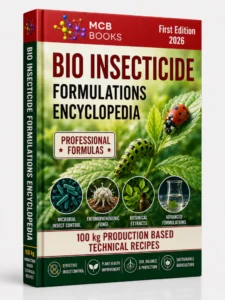
The Bio Insecticide Formulations Encyclopedia provides practical guidance for manufacturers seeking to develop professional biological pest control products. By combining formulation principles, raw material selection, manufacturing procedures, quality control, and production knowledge, it can support the development of reliable bio insecticides for commercial agricultural applications.