 Special foliar fertilizers are liquid or fully water-soluble plant nutrition products designed for direct application to leaf surfaces. They are used to deliver nutrients rapidly during critical growth stages, correct visible or hidden deficiencies, and support plant development under challenging soil or environmental conditions. Manufacturing effective foliar fertilizers requires accurate formulations, high-quality raw materials, proper mixing procedures, controlled pH, good filtration, and reliable storage stability.
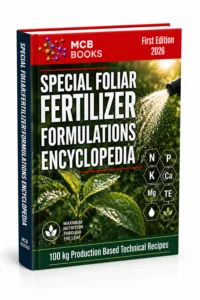
The first stage of foliar fertilizer production is determining the purpose of the product. Manufacturers may develop formulations for vegetative growth, flowering, fruit setting, fruit enlargement, ripening, stress resistance, color formation, or micronutrient deficiency correction. Products can also be designed for particular crops such as cereals, vegetables, tomatoes, potatoes, citrus fruits, grapes, olives, cotton, maize, fruit trees, and greenhouse plants. The SPECIAL FOLIAR FERTILIZER FORMULATIONS ENCYCLOPEDIA provides practical technical guidance for developing different commercial fertilizer products and selecting suitable nutrient combinations.
Common raw materials used in foliar fertilizer formulations include urea, potassium nitrate, monopotassium phosphate, magnesium sulfate, calcium salts, boric acid, sodium molybdate, and water-soluble micronutrient compounds. Iron, zinc, manganese, and copper may be supplied in chelated forms such as EDTA or DTPA to improve solubility and stability. Amino acids, seaweed extracts, organic acids, humic substances, wetting agents, surfactants, stabilizers, preservatives, antifoaming agents, and pH regulators may also be included depending on the formulation.
Production normally begins with preparing clean process water. Water quality is important because hardness, salts, and unsuitable pH can cause precipitation or reduce product stability. The main mixing tank is filled with part of the required water, and agitation is started. Raw materials are then added gradually in the correct order. Highly soluble macronutrients are generally dissolved first, followed by chelated micronutrients and lower-dose additives.
Each ingredient must be completely dissolved before the next material is introduced. Mixing temperature should be controlled because excessive heat may damage sensitive organic ingredients or destabilize certain chelates. The pH is adjusted carefully to maintain nutrient solubility and reduce sediment formation. Surfactants, stabilizers, preservatives, and antifoaming agents are usually added near the end of production.
After all ingredients are incorporated, the remaining water is added to reach the final batch weight. The solution is mixed until it becomes uniform and is then filtered to remove undissolved particles. The finished foliar fertilizer should be tested for nutrient content, pH, density, appearance, solubility, sediment, dilution stability, and storage performance.
The SPECIAL FOLIAR FERTILIZER FORMULATIONS ENCYCLOPEDIA can support manufacturers, agricultural engineers, entrepreneurs, researchers, and production managers during laboratory trials, pilot batches, and commercial production. Accurate formulas and controlled processing help reduce incompatibility, precipitation, crystallization, and customer complaints.
Successful manufacturing depends on combining formulation knowledge with disciplined production control. The SPECIAL FOLIAR FERTILIZER FORMULATIONS ENCYCLOPEDIA is a valuable technical resource for businesses seeking to produce stable, effective, and marketable foliar fertilizers for professional agricultural applications.