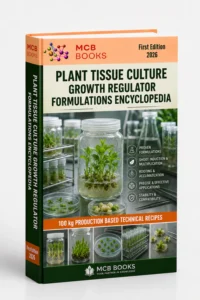
 Plant tissue culture is one of the most important techniques used in modern plant biotechnology, commercial micropropagation, nursery production, crop improvement and research. Plant growth regulators play a central role in tissue culture because they influence cell division, callus formation, shoot induction, root development, organogenesis and plant regeneration. The correct selection and balance of auxins, cytokinins and other growth regulators are therefore essential for obtaining reliable and repeatable tissue culture results.
The PLANT TISSUE CULTURE GROWTH REGULATOR FORMULATIONS ENCYCLOPEDIA is designed as a comprehensive technical reference for manufacturers, formulators, laboratory professionals, researchers and companies involved in plant tissue culture and micropropagation. It provides practical information covering formulation principles, raw materials, production methods, application concepts and commercial manufacturing considerations for tissue culture growth regulator products.
Plant tissue culture formulations may contain different growth regulators depending on the desired biological response. Common auxins include Indole-3-Acetic Acid (IAA), Indole-3-Butyric Acid (IBA), 1-Naphthaleneacetic Acid (NAA) and 2,4-Dichlorophenoxyacetic Acid (2,4-D). Cytokinins such as 6-Benzylaminopurine (BAP/6-BA), kinetin and other specialized compounds may be used for shoot proliferation and cell division. Gibberellins and other plant growth regulators may also be incorporated for specific tissue culture applications.
Commercial formulations may be produced as concentrated stock solutions, liquid concentrates, soluble preparations or other laboratory-oriented products. Because many plant growth regulators have different solubility characteristics, appropriate solvents, co-solvents, pH-adjusting agents, stabilizers and purified water systems must be selected carefully. The formulation must provide uniform active ingredient distribution and adequate chemical stability during storage.
Manufacturing usually begins with preparing the required liquid carrier or solvent system under controlled conditions. Individual growth regulators are dissolved or dispersed according to their physicochemical properties, followed by the addition of stabilizing or supporting ingredients where required. Accurate weighing, controlled mixing, pH adjustment and proper filtration are especially important in tissue culture products because even small variations in concentration can influence plant response.
Different auxin-to-cytokinin ratios can produce very different developmental effects. Higher auxin levels may favor rooting or callus formation, while higher cytokinin concentrations may promote shoot initiation and multiplication. Balanced combinations can be used for organogenesis and regeneration protocols. For this reason, formulation design must always consider plant species, tissue type, culture stage and intended laboratory application.
Quality control is a critical part of commercial production. Finished products may be evaluated for active ingredient concentration, pH, appearance, clarity, homogeneity, stability and compatibility with tissue culture media. Sterility and contamination control are also important considerations where products are intended for laboratory use.
The PLANT TISSUE CULTURE GROWTH REGULATOR FORMULATIONS ENCYCLOPEDIA brings together practical formulation knowledge and commercial production principles for professionals working with micropropagation and plant biotechnology. It provides a valuable technical foundation for developing reliable growth regulator products for shoot induction, rooting, callus formation, multiplication and complete plant regeneration.