 Calcium-based fertilizers are widely used in modern agriculture to support cell-wall development, root growth, fruit firmness, crop quality, and resistance to physiological disorders caused by calcium deficiency. The performance of a calcium fertilizer depends greatly on the calcium source, supporting ingredients, water quality, compatibility, manufacturing method, and intended application system. Understanding the raw materials used in calcium-based fertilizers and their functions is therefore essential for developing stable and commercially effective products.
Calcium nitrate is one of the most important raw materials used in calcium fertilizer manufacturing. It provides both water-soluble calcium and nitrate nitrogen, making it suitable for fertigation, drip irrigation, hydroponics, greenhouse production, and foliar applications. Calcium nitrate dissolves easily in water and supports rapid nutrient availability. However, it should not be combined in concentrated solutions with phosphate or sulfate fertilizers because insoluble deposits may form.
Calcium chloride is another highly soluble calcium source. It can be used in concentrated liquid calcium fertilizers and certain foliar formulations. Its high solubility allows manufacturers to produce products with significant calcium content. Nevertheless, the chloride concentration must be carefully controlled because chloride-sensitive crops may be damaged by excessive application.
Calcium acetate and calcium formate are organic salt-based calcium sources used in specialty liquid and foliar fertilizers. These materials may provide good solubility and compatibility in formulations containing organic acids, amino acids, or plant-supporting additives. They are often selected for premium products intended to improve calcium availability, fruit quality, and foliar performance.
Calcium gluconate is commonly used in organically complexed calcium fertilizer formulations. It helps maintain calcium in a soluble form and may improve formulation stability under certain conditions. Calcium lignosulfonate is another complexed calcium source that can provide calcium while also contributing organic matter and complexing properties.
Calcium carbonate is widely used in soil conditioners, liming materials, suspension fertilizers, and products developed to reduce soil acidity. It contains a high percentage of calcium but has limited water solubility. For this reason, fine particle size, efficient dispersion, suspension stability, and controlled application are important when calcium carbonate is used in liquid suspension fertilizers.
Calcium oxide and calcium hydroxide are mainly used in soil improvement products and pH correction systems. These materials are strongly alkaline and react with water, so they require careful handling during manufacturing. They are generally not preferred for concentrated foliar fertilizers because their high alkalinity may cause instability or plant damage.
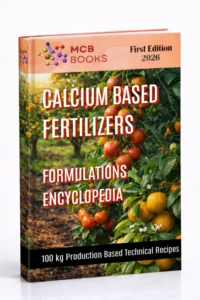
The CALCIUM BASED FERTILIZERS FORMULATIONS ENCYCLOPEDIA explains the technical functions of different calcium sources and supporting ingredients used in commercial fertilizer production. Selecting the correct raw materials allows manufacturers to produce calcium fertilizers for foliar spraying, fertigation, hydroponic systems, soil application, greenhouse crops, orchards, and vegetable production.
Amino acids are frequently incorporated into advanced calcium fertilizer formulations. They may act as complexing agents, support foliar absorption, improve compatibility, and contribute to plant recovery under environmental stress. Glycine and other low-molecular-weight amino acids are commonly considered in specialty calcium products.
Organic acids such as citric acid, gluconic acid, acetic acid, formic acid, lactic acid, and selected carboxylic acids may be used to adjust pH, improve solubility, support complex formation, or reduce precipitation. The amount of acid must be controlled carefully because excessive acidity may cause corrosion, instability, or damage to plant tissues.
Chelating and complexing agents help maintain calcium in a more stable and available form. Lignosulfonates, gluconates, amino acids, and selected organic complexes may be used according to the desired formulation. Conventional chelating agents must be evaluated carefully because not every chelating system forms a strong or commercially useful complex with calcium.
Boron compounds are frequently added to calcium fertilizers because calcium and boron both contribute to cell-wall formation, flowering, pollen development, fruit set, and tissue strength. Common boron sources include boric acid, boron ethanolamine, sodium borate, and water-soluble boron complexes. Boron concentration must be controlled because the difference between adequate and excessive boron can be narrow.
Magnesium compounds may be included in calcium-magnesium fertilizers designed to support chlorophyll formation, photosynthesis, enzyme activity, and balanced plant nutrition. Manufacturers must avoid incompatible sulfate sources in concentrated calcium products unless stability testing confirms acceptable performance.
Surfactants are mainly used in foliar calcium fertilizers to improve spreading, wetting, and coverage on leaf and fruit surfaces. Nonionic surfactants are generally preferred because they often provide better compatibility with fertilizer salts. Humectants such as glycerin, sorbitol, or glycols may reduce rapid drying and extend contact time on plant surfaces.
Stabilizers, dispersing agents, thickeners, antifoaming agents, preservatives, and filtration aids may also be required depending on the final product form. Suspension fertilizers containing calcium carbonate need effective dispersants and suspension agents, while clear liquid fertilizers require complete dissolution and fine filtration.
Water is one of the most critical raw materials in liquid calcium fertilizer production. Water containing sulfate, phosphate, carbonate, bicarbonate, or excessive hardness may react with calcium and produce sediment or crystals. Purified, demineralized, softened, or low-mineral water is normally recommended for professional production.
The CALCIUM BASED FERTILIZERS FORMULATIONS ENCYCLOPEDIA can help manufacturers understand the relationship between raw materials, production methods, product stability, nutrient content, and agricultural performance. Every ingredient should be selected according to purity, solubility, compatibility, regulatory suitability, and intended application.
By combining an appropriate calcium source with compatible complexing agents, nutrients, surfactants, stabilizers, and high-quality water, manufacturers can develop stable and effective calcium-based fertilizers. Correct raw-material selection supports consistent production, improved plant calcium availability, better crop quality, and reliable commercial performance.