The performance, stability, and commercial quality of humic and fulvic organic fertilizers depend strongly on the raw materials used in their formulations. Humic acid, fulvic acid, potassium humate, leonardite-derived materials, amino acids, seaweed extracts, micronutrients, potassium sources, organic acids, stabilizers, preservatives, and water can all be used to develop professional fertilizer products. Understanding the function and compatibility of each ingredient is essential for producing effective humic and fulvic fertilizer formulations for modern agriculture.
Humic acid is one of the primary raw materials used in humic organic fertilizers. It is commonly obtained from humic-rich materials such as leonardite and is frequently incorporated into products intended for soil conditioning, root development, nutrient availability, and plant growth. The quality of humic acid can vary according to its source, extraction process, concentration, solubility, mineral content, and pH. These characteristics should be carefully evaluated before formulation.
Fulvic acid is another important component in organic fertilizer production. Compared with many humic materials, fulvic acid generally offers high water solubility and can be incorporated into liquid fertilizers, fertigation products, and certain foliar formulations. It is often combined with micronutrients, amino acids, and other plant nutrition ingredients to create multifunctional fertilizer products designed to support nutrient uptake and crop development.
Potassium humate is widely used as a soluble source of humic substances and potassium. It can be produced in powder, flake, granular, or liquid forms and is commonly selected for liquid humic fertilizer manufacturing. Its solubility, potassium content, humic acid concentration, and insoluble fraction are important technical parameters that can influence final product quality.
Leonardite is an important raw material source for many commercial humic products. It contains naturally occurring humic substances and is commonly processed or extracted to obtain humic acid and humate-based fertilizer ingredients. Manufacturers should evaluate leonardite quality carefully because raw material composition can affect extraction efficiency and finished fertilizer characteristics.
Additional ingredients may include amino acids, seaweed extracts, nitrogen sources, potassium compounds, and micronutrients such as iron, zinc, manganese, boron, copper, and molybdenum. These materials can be used to develop specialized formulations for root development, vegetative growth, flowering, fruit production, and nutrient management.
Organic acids may be used for pH adjustment or formulation support, while stabilizers and preservatives can help maintain product consistency during storage. Water quality is also important because hardness, mineral content, and pH may affect solubility and stability.
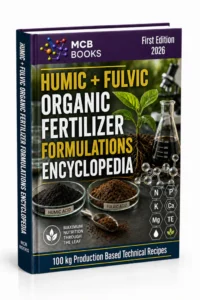
The HUMIC + FULVIC ORGANIC FERTILIZER FORMULATIONS ENCYCLOPEDIA provides practical technical information about humic and fulvic fertilizer raw materials, their functions, formulation principles, production methods, and quality control. It is designed for fertilizer manufacturers, formulators, agricultural companies, and entrepreneurs seeking to develop professional humic and fulvic organic fertilizers for commercial agricultural production.