 Humic and fulvic acid fertilizers are widely used in modern agriculture to support soil fertility, root development, nutrient availability, and healthy plant growth. These products can be applied through soil treatment, fertigation, root-zone applications, and selected foliar programs. Because humic and fulvic substances can be combined with many plant nutrition ingredients, they are increasingly incorporated into professional organic fertilizer and agricultural biostimulant formulations.
Humic acid is commonly used in fertilizer products developed to improve soil-related growing conditions and support root-zone performance. Commercial humic fertilizers may be manufactured from leonardite-derived humic substances, potassium humate, or concentrated humic acid materials. When incorporated into soil fertilizer programs, humic substances can contribute to improved soil structure, nutrient retention, and nutrient availability. These characteristics make humic acid fertilizers particularly relevant for intensive agriculture, greenhouse production, horticulture, and field crops.
Fulvic acid is another important component in modern plant nutrition. Its high water solubility makes it suitable for liquid fertilizers, fertigation products, and certain foliar applications. Fulvic acid formulations can also be combined with micronutrients, amino acids, seaweed extracts, and potassium compounds to develop multifunctional fertilizers intended to support nutrient uptake and plant development.
Root development is closely connected with efficient crop nutrition. A larger and more active root system allows plants to explore a greater volume of soil for water and essential nutrients. Humic and fulvic acid fertilizer formulations can therefore be developed for seedlings, transplant establishment, vegetative growth, and other stages when root development is especially important. Products may contain humic acid, fulvic acid, potassium humate, amino acids, seaweed extracts, phosphorus, potassium, and selected micronutrients depending on the intended agricultural application.
Humic and fulvic fertilizers can also support broader plant growth programs. Commercial formulations may be designed for vegetables, fruits, cereals, ornamental plants, greenhouse crops, and high-value agricultural production. They can be integrated with conventional fertilizers to create balanced programs targeting nutrient management, vegetative development, flowering, fruit production, and crop quality.
Manufacturing high-quality humic and fulvic acid fertilizers requires careful attention to raw material compatibility, pH, solubility, density, viscosity, and storage stability. Quality-control procedures should evaluate humic acid content, fulvic acid content, appearance, sediment formation, nutrient concentration, and product stability before commercial distribution.
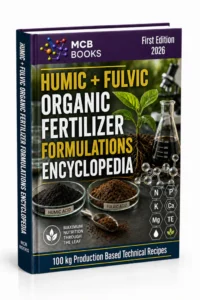
The HUMIC + FULVIC ORGANIC FERTILIZER FORMULATIONS ENCYCLOPEDIA provides practical information about humic and fulvic fertilizer formulations, raw materials, manufacturing methods, production procedures, and quality control. It is a comprehensive technical reference for fertilizer manufacturers, formulators, agricultural companies, and entrepreneurs developing professional products for soil fertility, root development, nutrient uptake, and plant growth.