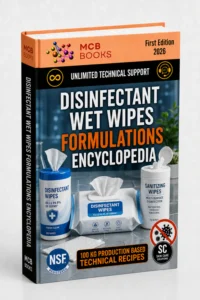
Establishing a disinfectant wet wipes production facility requires detailed planning, suitable manufacturing equipment, controlled hygiene practices, validated formulations, and compliance with the regulations of the target market. Commercial production involves more than applying a disinfectant solution to nonwoven fabric. Manufacturers must coordinate water treatment, solution preparation, fabric processing, liquid dosing, packaging, laboratory testing, workplace safety, and finished-product storage.
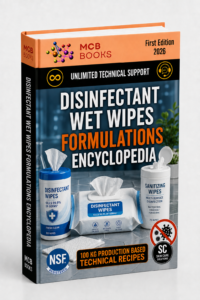
The DISINFECTANT WET WIPES FORMULATIONS ENCYCLOPEDIA provides structured technical guidance for entrepreneurs, manufacturers, formulation specialists, private-label producers, and investors planning to establish a professional wet wipes factory. It covers formulation principles, raw material functions, production processes, equipment requirements, nonwoven material selection, quality control, and commercial product development.
A well-organized facility should include separate areas for raw material storage, purified-water preparation, disinfectant solution mixing, nonwoven processing, packaging, quality control, quarantine, and finished-product storage. Production flow should be designed to reduce cross-contamination and prevent unnecessary movement between clean and uncontrolled areas. Product-contact tanks, pipelines, pumps, filters, and filling components should be made from materials compatible with the selected disinfectant system.
The main production equipment may include a purified-water system, stainless-steel mixing tanks, transfer pumps, filtration units, intermediate storage tanks, lotion-dosing equipment, nonwoven unwinding systems, folding and cutting machines, wipe-counting systems, packaging machines, coding equipment, and checkweighers. The capacity of each machine should be selected according to the planned batch size, package format, daily production target, and future expansion requirements.
The disinfectant solution may contain purified water, approved antimicrobial active ingredients, surfactants, solvents, chelating agents, pH regulators, stabilizers, corrosion inhibitors, and other compatible additives. The active system must be selected according to the intended microorganisms, surface type, required contact time, use environment, and legally permitted claims. CDC guidance emphasizes that surface-cleaning and disinfection procedures depend on the intended use of the surface or equipment.
The DISINFECTANT WET WIPES FORMULATIONS ENCYCLOPEDIA explains how the solution, nonwoven substrate, and packaging must be evaluated as one complete product. The selected fabric should provide suitable absorbency, wet strength, liquid retention, and controlled release. Accurate impregnation is critical because every wipe must deliver enough solution to cover the intended area and keep the treated surface visibly wet for the contact time stated on the authorized label.
Quality-control equipment may include calibrated pH meters, density-measurement instruments, weighing systems, active-ingredient analysis equipment, microbiological testing resources, stability chambers, package-seal testers, and liquid-loading controls. Routine evaluations should cover appearance, odor, pH, density, active concentration, wipe weight, lotion distribution, package integrity, stability, and microbiological quality.
Facilities producing alcohol-based wipes require additional precautions because ethanol and isopropyl alcohol generate flammable vapors. Appropriate ventilation, approved storage systems, ignition-source control, grounding, bonding, spill procedures, and correctly classified electrical installations may be necessary. OSHA requires hazardous areas to be classified according to the likelihood that flammable vapors or liquids may be present.
Packaging must minimize leakage, contamination, moisture loss, and evaporation. Depending on the target market, manufacturers may use canisters, soft packs, refill bags, industrial buckets, or individually sealed sachets. Packaging compatibility and shelf-life stability should be confirmed using the complete impregnated product.
Regulatory authorization must be planned before commercial production begins. In the European system, disinfectants not intended for direct application to humans or animals are generally classified as Product Type 2 biocidal products.
The DISINFECTANT WET WIPES FORMULATIONS ENCYCLOPEDIA offers a practical foundation for establishing a controlled, efficient, and scalable production facility. Combining professional formulations, appropriate machinery, hygienic manufacturing, validated performance, protective packaging, trained personnel, and documented quality systems can support the production of reliable and commercially competitive disinfectant wet wipes.