 Water-soluble NPK fertilizers are widely used in modern drip irrigation systems because they provide nitrogen, phosphorus, and potassium in forms that can be rapidly dissolved and delivered directly to the plant root zone. These fertilizers are an essential part of professional fertigation programs for greenhouse crops, vegetables, fruit trees, field crops, ornamental plants, nurseries, and soilless cultivation systems. Developing effective water-soluble NPK fertilizer formulations requires careful nutrient balancing, appropriate raw material selection, high solubility, and reliable chemical compatibility.
Nitrogen, phosphorus, and potassium are the three primary nutrients required for healthy plant development. Nitrogen supports vegetative growth, leaf formation, chlorophyll production, and protein synthesis. Phosphorus contributes to root development, energy transfer, flowering, and early crop establishment. Potassium helps regulate water movement, improve fruit quality, strengthen plant tissues, support sugar formation, and increase resistance to environmental stress.
Different NPK ratios are used according to the crop type and growth stage. High-nitrogen formulations may be preferred during early vegetative development, while balanced NPK fertilizers can support general plant growth. High-phosphorus products are commonly used during rooting, transplanting, and flowering stages. High-potassium fertilizer formulations are generally selected during fruit formation, ripening, and quality-development periods.
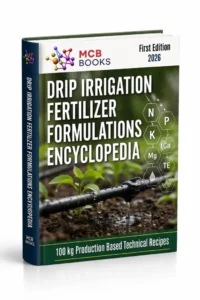
The Drip Irrigation Fertilizer Formulations Encyclopedia provides practical information about professional fertilizer production formulas, raw material functions, manufacturing processes, product specifications, and application principles. The book is designed for fertilizer producers, agricultural chemical companies, technical specialists, investors, and entrepreneurs who want to develop commercial products for modern fertigation systems.
Common raw materials used in water-soluble NPK fertilizer production include urea, ammonium nitrate, ammonium sulfate, monoammonium phosphate, monopotassium phosphate, potassium nitrate, potassium sulfate, phosphoric acid, and potassium hydroxide. The appropriate ingredients should be selected according to the desired nutrient analysis, product form, chloride content, pH target, and compatibility requirements.
Solubility is one of the most important quality parameters in drip irrigation fertilizers. Raw materials must dissolve completely in irrigation water without producing sediment, crystals, or suspended particles. Insoluble residues may clog filters, irrigation pipes, and emitters, reducing system performance and causing uneven fertilizer distribution. High-purity fertilizer-grade raw materials are therefore preferred for commercial water-soluble NPK formulations.
Chemical compatibility must also be evaluated carefully. Calcium-containing materials may react with phosphate or sulfate sources and form insoluble compounds. For this reason, calcium fertilizers are often separated from concentrated NPK products and applied through a different stock tank. In professional fertigation programs, A and B tank systems are commonly used to prevent unwanted reactions between incompatible nutrients.
The manufacturing process depends on whether the product is prepared as a soluble powder or a concentrated liquid fertilizer. Powder production may involve weighing, sieving, blending, moisture control, and anti-caking treatment. Liquid fertilizer production generally begins with suitable water, followed by gradual addition and dissolution of nutrient salts under controlled mixing conditions. The final solution may be filtered before packaging.
Quality-control tests should include nutrient analysis, moisture content, pH, electrical conductivity, solubility, appearance, particle size, caking tendency, dilution stability, and storage performance. The product should dissolve quickly and remain stable under the recommended storage and application conditions.
The Drip Irrigation Fertilizer Formulations Encyclopedia helps readers understand how water-soluble NPK fertilizers can be formulated for different crops and production purposes. It also provides guidance on raw material compatibility, preparation order, technical properties, production planning, and commercial fertilizer development.
By selecting highly soluble ingredients and applying professional formulation principles, manufacturers can produce effective NPK fertilizers that improve nutrient delivery, reduce fertilizer losses, and support consistent crop development. Water-soluble NPK fertilizer formulations represent an important commercial opportunity for companies serving the expanding drip irrigation and precision agriculture markets.