 Drip irrigation fertilizers are specially formulated products designed to deliver essential plant nutrients directly to the root zone through irrigation water. The performance of these fertilizers depends largely on the quality, solubility, purity, compatibility, and nutritional value of the raw materials used. Understanding the functions of fertilizer ingredients is therefore essential for producing stable, effective, and commercially successful fertigation products.
Nitrogen sources are among the most important raw materials used in drip irrigation fertilizers. Nitrogen supports vegetative growth, leaf development, chlorophyll formation, and protein synthesis. Urea is widely used because of its high nitrogen content and good water solubility. Ammonium nitrate, ammonium sulfate, calcium nitrate, and potassium nitrate may also be selected according to the required nutrient balance and product type.
Phosphorus sources are commonly included to support root growth, energy transfer, flowering, and early plant development. Monoammonium phosphate, monopotassium phosphate, phosphoric acid, and selected phosphate salts are frequently used in water-soluble fertilizer formulations. These materials must be handled carefully because phosphates may react with calcium and magnesium compounds, forming insoluble precipitates.
Potassium is essential for fruit quality, flowering, water regulation, sugar formation, and resistance to environmental stress. Potassium nitrate, monopotassium phosphate, potassium sulfate, potassium carbonate, and potassium hydroxide may be used as potassium sources. The appropriate material is selected according to the required pH, nutrient analysis, chloride sensitivity, and compatibility of the final formulation.
Secondary nutrients such as calcium, magnesium, and sulfur also play important roles in plant development. Calcium nitrate can provide both calcium and nitrogen, helping strengthen plant cell walls and support fruit quality. Magnesium sulfate and magnesium nitrate are commonly used to supply magnesium, which is a central component of chlorophyll. Sulfur-containing materials contribute to enzyme activity, protein formation, and overall plant metabolism.
Micronutrients are required in smaller quantities but are essential for healthy crop growth. Iron, zinc, manganese, copper, boron, and molybdenum may be added to drip irrigation fertilizers. These nutrients can be supplied as mineral salts or chelated compounds. Chelating agents such as EDTA, DTPA, and EDDHA help maintain micronutrient availability and reduce precipitation under different soil and water conditions.
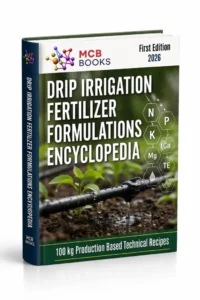
The Drip Irrigation Fertilizer Formulations Encyclopedia provides detailed information about raw materials, their functions, professional production formulas, manufacturing methods, and technical product characteristics. It is designed for fertilizer manufacturers, agricultural chemical companies, entrepreneurs, technical personnel, and businesses planning to develop commercial fertigation products.
Acids and pH regulators are also commonly used in liquid fertilizer production. Phosphoric acid, nitric acid, citric acid, potassium hydroxide, and selected buffering agents may help adjust product pH, improve nutrient solubility, and reduce mineral deposits inside irrigation systems. However, acids must be added under controlled conditions with appropriate safety equipment.
Purified or demineralized water is normally used as the main carrier in liquid fertilizer formulations. Water quality directly affects product clarity, stability, and shelf life. High levels of bicarbonates, calcium, magnesium, iron, or suspended solids may cause precipitation or unwanted chemical reactions.
Other functional ingredients may include dispersing agents, stabilizers, anti-caking agents, preservatives, humectants, organic acids, amino acids, seaweed extracts, and filtration aids. Their use depends on whether the fertilizer is produced as a liquid concentrate, soluble powder, suspension, organic-mineral fertilizer, or specialized plant nutrition product.
The Drip Irrigation Fertilizer Formulations Encyclopedia helps readers understand how these raw materials can be combined to create balanced and commercially applicable fertilizer products. The book also includes guidance concerning production order, compatibility, quality control, application principles, and product specifications.
Selecting suitable raw materials is one of the most critical stages of drip irrigation fertilizer manufacturing. By using highly soluble, compatible, and technically appropriate ingredients, producers can develop stable fertilizers that support effective crop nutrition while minimizing sediment formation, crystallization, and emitter blockage.