 Calcium fertilizers are important plant nutrition products used to improve cell-wall strength, root development, fruit firmness, crop quality, and resistance to several physiological disorders. For professional fertilizer manufacturers, producing calcium fertilizers in standardized 100 kg batches provides a practical foundation for commercial-scale manufacturing, cost calculation, quality control, and production planning.
A professional calcium fertilizer formula must contain carefully selected calcium sources, compatible supporting ingredients, and a suitable carrier system. Common calcium raw materials include calcium nitrate, calcium chloride, calcium acetate, calcium formate, calcium lignosulfonate, calcium gluconate, calcium carbonate, and chelated calcium compounds. The correct raw material depends on the intended application method, target calcium content, crop sensitivity, solubility requirements, and final product form.
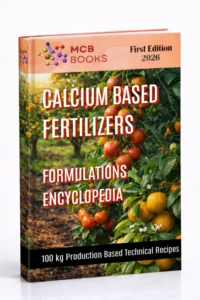
The CALCIUM BASED FERTILIZERS FORMULATIONS ENCYCLOPEDIA provides technical formulation concepts for manufacturing different calcium fertilizer products in commercially applicable batch sizes. These may include liquid calcium nitrate fertilizers, calcium-boron foliar products, calcium-magnesium solutions, amino acid-complexed calcium fertilizers, organic acid-based calcium concentrates, suspension fertilizers, and water-soluble calcium products.
In a 100 kg liquid fertilizer formula, water is usually the main carrier. The quantity of water must be adjusted according to the amounts of calcium salts, stabilizers, complexing agents, additives, and additional nutrients used in the formulation. The total weight of all ingredients must always equal exactly 100 kg. This allows the manufacturer to calculate raw-material costs accurately and scale the formula to larger production volumes.
For example, a 1,000 kg commercial batch can generally be prepared by multiplying each ingredient in a 100 kg formula by ten. However, larger batches may require changes in mixing time, agitation speed, heating capacity, cooling time, filtration efficiency, and order of addition. Therefore, pilot-scale testing should be completed before full industrial production.
Water quality is one of the most important factors in calcium fertilizer manufacturing. Water containing high levels of sulfate, phosphate, carbonate, or bicarbonate may react with calcium and produce insoluble particles. These reactions can cause sedimentation, crystallization, reduced nutrient availability, blocked filters, and unstable final products. Purified, softened, or low-mineral water is generally preferred for high-quality liquid formulations.
The production process normally begins by adding the required amount of water to a clean mixing vessel. Agitation is started, and the selected calcium source is added slowly. Rapid addition should be avoided because it may create local concentration differences, incomplete dissolution, excessive heat, or crystal formation. Additional ingredients are then introduced individually according to their solubility and compatibility.
Calcium-boron fertilizers are frequently manufactured for flowering, fruit development, and tissue strength. Calcium-magnesium products may be designed to support photosynthesis, plant structure, and balanced nutrition. Amino acid-based calcium fertilizers are often developed for foliar application, while calcium nitrate solutions are widely used in fertigation, hydroponic systems, and greenhouse production.
Manufacturers must avoid combining calcium directly with incompatible phosphate or sulfate sources unless the formulation has been professionally stabilized. Laboratory compatibility tests should be performed before including additional nutrients, micronutrients, organic acids, chelating agents, surfactants, preservatives, or plant-supporting additives.
The pH of the product should be measured throughout production. Incorrect pH may cause precipitation, color changes, reduced storage stability, packaging corrosion, or nutrient degradation. After complete dissolution or uniform dispersion, the fertilizer should be mixed for a controlled period and passed through an appropriate filtration system.
Quality-control tests for a 100 kg calcium fertilizer batch should include appearance, color, odor, pH, density, viscosity, calcium content, nitrogen content, solubility, sediment formation, crystallization resistance, storage stability, and temperature resistance. Retained batch samples should also be stored for future comparison and traceability.
The CALCIUM BASED FERTILIZERS FORMULATIONS ENCYCLOPEDIA can help fertilizer producers develop professional formulations with clearly defined raw materials, ingredient quantities, manufacturing steps, quality parameters, and application areas. Standardized 100 kg formulas support consistent production and make industrial scale-up easier.
By combining technically correct formulations, compatible ingredients, controlled processing, and reliable quality testing, manufacturers can produce stable calcium fertilizers for foliar feeding, fertigation, soil application, hydroponics, greenhouse crops, orchards, vegetables, and commercial agricultural programs.