Liquid calcium fertilizers are widely used in modern agriculture to support strong plant development, improve fruit firmness, strengthen cell walls, and reduce physiological disorders associated with calcium deficiency. These products can be applied through foliar spraying or fertigation systems, allowing growers to deliver calcium efficiently during critical crop-development stages. Developing stable liquid calcium fertilizer formulations requires the correct selection of calcium sources, compatible raw materials, suitable production methods, and reliable quality-control procedures.
Common calcium sources used in liquid fertilizer manufacturing include calcium nitrate, calcium chloride, calcium acetate, calcium formate, calcium gluconate, calcium lignosulfonate, and various chelated or organically complexed calcium compounds. Each raw material provides different calcium concentrations, solubility levels, compatibility characteristics, and agricultural benefits.
Calcium nitrate is frequently used in fertigation products because it provides both soluble calcium and nitrate nitrogen. It is suitable for drip irrigation, greenhouse production, hydroponic systems, and soil-based crop nutrition. Calcium chloride is highly soluble and can provide a concentrated calcium source, but its chloride content must be carefully considered when the product is intended for chloride-sensitive crops.
Organic acid-based and amino acid-complexed calcium fertilizers are commonly preferred for foliar applications. These formulations may include calcium acetate, calcium formate, calcium gluconate, amino acids, lignosulfonates, or selected chelating agents. Their purpose is to maintain calcium in a stable and plant-available form while improving spreading, wetting, and leaf-surface contact.
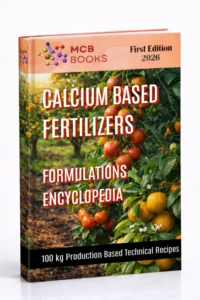
The CALCIUM BASED FERTILIZERS FORMULATIONS ENCYCLOPEDIA presents practical formulation concepts for producing liquid calcium fertilizers suitable for foliar spray and fertigation applications. The book can support manufacturers in developing calcium nitrate solutions, calcium-boron fertilizers, calcium-magnesium products, amino acid-based calcium concentrates, and crop-specific nutritional formulations.
Water quality is one of the most important considerations in liquid calcium fertilizer production. Water containing excessive sulfate, phosphate, carbonate, or bicarbonate may react with calcium and form insoluble precipitates. These deposits may reduce nutrient availability, create sediment, block irrigation filters, and decrease the storage stability of the product. Purified, softened, or low-mineral water is therefore recommended for professional manufacturing.
The production process normally begins by adding a portion of the required water to a clean mixing tank. Agitation is started, and the calcium source is introduced gradually. Rapid addition should be avoided because it may cause local crystallization, incomplete dissolution, or excessive temperature increases.
After the calcium compound has dissolved, compatible ingredients such as organic acids, amino acids, boron sources, humectants, surfactants, stabilizers, or preservatives may be added. Each ingredient should be incorporated separately, and complete dissolution should be confirmed before the next material is introduced.
Calcium is generally incompatible with concentrated phosphate and sulfate sources. Directly combining calcium with phosphoric acid, potassium phosphate, ammonium phosphate, magnesium sulfate, or sulfate-based micronutrients may cause precipitation. Compatibility testing must therefore be completed before including these materials in the same formulation or tank mixture.
Foliar calcium fertilizers require effective wetting and spreading properties. A suitable nonionic surfactant may help the spray solution distribute evenly across leaf and fruit surfaces. Humectants can also reduce rapid drying and increase contact time. However, excessive surfactant concentrations may damage sensitive plant tissues, so application trials are essential.
Fertigation-grade calcium fertilizers must be fully soluble and free from suspended particles. Fine filtration is recommended before packaging to prevent drip-line blockage. Manufacturers should also test product compatibility with irrigation water, stock solutions, and commonly used agricultural inputs.
Quality-control parameters include appearance, color, odor, pH, density, calcium content, nitrogen content, viscosity, solubility, sediment formation, crystallization resistance, and storage stability. Low-temperature testing is especially important because concentrated calcium solutions may crystallize during cold storage.
The CALCIUM BASED FERTILIZERS FORMULATIONS ENCYCLOPEDIA can help fertilizer manufacturers design stable and commercially valuable products for vegetables, fruits, greenhouse crops, orchards, hydroponics, and field agriculture. Professional formulations may be developed for tomatoes, peppers, cucumbers, apples, grapes, strawberries, citrus fruits, melons, and leafy vegetables.
By combining suitable calcium sources, clean water, compatible additives, controlled pH, efficient mixing, and comprehensive quality testing, manufacturers can produce effective liquid calcium fertilizers for both foliar spray and fertigation systems. These products can support crop quality, fruit strength, shelf life, and overall commercial agricultural performance.